Margaret, 71, kept asking her grandchildren to repeat themselves at dinner. Everyone assumed she just wasn’t paying attention. Her family finally convinced her to get tested, and the audiologist’s findings were clear: moderate high-frequency hearing loss in both ears — classic presbycusis. She’d been living with it for years and had no idea treatment was this accessible or affordable.
Her story isn’t unusual. According to the NIDCD, 28.8 million U.S. adults could benefit from hearing aids — and presbycusis, the slow breakdown of inner ear hair cells that comes with aging, accounts for the vast majority of those cases. By age 65, one in three Americans has significant hearing loss. By 75, it’s one in two. The kicker? The average American waits 7 years from first noticing symptoms to actually getting help.
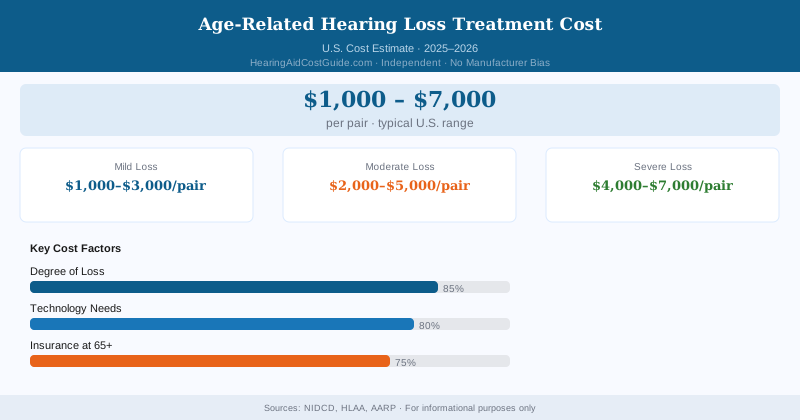
Typical Cost of Treating Presbycusis
| Treatment Path | Cost | Best For |
|---|---|---|
| Audiological evaluation | $150–$350 (often covered) | Everyone — first step |
| OTC hearing aids (mild-moderate loss) | $799–$1,499/pair | Mild, symmetrical high-frequency loss |
| Costco hearing aids | $1,499–$2,199/pair | Moderate loss, professional fitting wanted |
| Private prescription hearing aids | $3,500–$7,000/pair | Moderate-to-severe, complex fitting needs |
| Medicare Advantage (with benefit) | $0–$1,999/pair copay | Medicare enrollees with hearing benefit |
| Cochlear implant (severe cases) | $50,000–$100,000 (insured: $1,600–$9,000 OOP) | Severe-profound loss, poor aided speech understanding |
The Audiogram Pattern That Gives Presbycusis Away
Age-related hearing loss has a signature. High-frequency hearing drops first — the 4,000–8,000 Hz range goes before the lower frequencies do. That’s why the most common complaint sounds exactly like what Margaret described: “I can hear you talking, I just can’t make out what you’re saying.” Consonants like s, th, f, and p live in the high frequencies. Vowels don’t. So speech becomes a blur of vowel sounds with the consonants stripped out.
Here’s what makes this actually encouraging: that pattern favors intervention. High-frequency amplification restores the consonants you’re missing, and speech discrimination often improves dramatically with properly fitted hearing aids.
When Should You Actually Get Tested?
The American Academy of Audiology recommends a baseline audiogram at 50, then every three years if your hearing is stable. If loss is already present, annual testing makes sense to track progression.
That 7-year delay mentioned above isn’t just a frustrating statistic — it has real consequences. A landmark 2023 analysis in The Lancet linked untreated hearing loss to 8% of dementia cases globally, and social isolation from communication difficulty compounds the problem. The longer you wait, the more you miss.
The 2023 ACHIEVE (Aging and Cognitive Health Evaluation in Elders) trial — published in The Lancet — found that hearing intervention reduced cognitive decline by 48% over 3 years in high-risk older adults. This is not small: treating hearing loss may be one of the most cost-effective dementia prevention interventions available.
At $1,499 for Costco hearing aids, the intervention cost to potentially reduce dementia risk is a fraction of dementia care costs ($30,000–$100,000+/year).
Medicare and the Hearing Aid Coverage Gap
Most people with presbycusis are on Medicare — and original Medicare doesn’t cover hearing aids. That’s the big structural problem in US hearing healthcare right now, and it’s not changing soon.
Your practical options as a Medicare beneficiary:
- Medicare Advantage: Switch to a plan with a hearing benefit during annual enrollment (Oct 15 – Dec 7). Benefits of $500–$2,000/pair are common and worth comparing before you need aids.
- Costco Hearing Centers: Prescription-quality aids at $1,499–$2,199/pair — no insurance required, no membership markup beyond your annual Costco fee.
- OTC hearing aids: FDA-approved for mild-to-moderate loss. $799–$1,499/pair from brands like Jabra, Sony, and Lexie.
- HSA/FSA funds: Hearing aids are eligible expenses — use pre-tax money if you have it.
- VA benefits: Covers hearing aids for qualifying veterans regardless of income.
Do You Need a Prescription Aid, or Will OTC Work?
For the typical presbycusis presentation — bilateral, symmetrical, high-frequency sensorineural loss in an otherwise healthy adult — OTC hearing aids are FDA-approved and genuinely appropriate. That covers a lot of people. Jabra Enhance Select ($799–$1,499), Sony CRE ($799–$1,299), and Lexie B2 ($999) all perform well in this category.
Push toward prescription (audiologist-fitted) if any of these apply:
- Word recognition score is poor despite normal thresholds — this suggests neural presbycusis, which may not respond as well to amplification alone
- One ear is significantly worse than the other (asymmetry needs investigation)
- OTC aids haven’t given you satisfactory benefit after a fair trial
- Loss is moderate-to-severe, meaning thresholds above 55 dB HL
Don’t write off sudden or one-sided hearing changes as “just aging.” Sudden worsening in one ear is not presbycusis — it’s a potential medical emergency called sudden sensorineural hearing loss, and it needs same-day or next-day ENT evaluation. Asymmetric hearing loss can also indicate an acoustic neuroma. Get an audiogram before assuming it’s age.
Beyond the Hearing Aid
Fitting hearing aids is the essential first step. But presbycusis management works better with a few additional strategies:
- HLAA chapter participation: The Hearing Loss Association of America has local chapters with peer support and coping strategy resources — all free.
- Speechreading training: Learning to use visual cues alongside amplification meaningfully improves comprehension, especially in noise.
- Communication partner coaching: Teaching family members how to speak clearly and position themselves makes a real difference.
- Home technology: Captioned phones, visual doorbells, TV streaming clips from your hearing aids — these cost very little and reduce daily friction significantly.
The National Institute on Deafness and Other Communication Disorders (NIDCD) maintains free resources at nidcd.nih.gov. Hearing loss at any age doesn’t have to mean withdrawing from the conversations that matter.