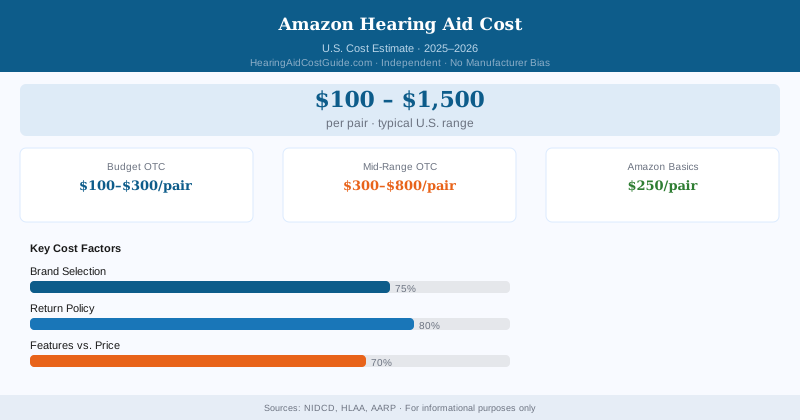
Most people assume Amazon is a reliable place to buy hearing aids — it’s the world’s largest retailer, and there’s a massive selection of devices. Here’s the reality: Amazon’s hearing aid category is a minefield of $30 amplifiers packaged to look like hearing aids, mixed in with a handful of genuinely legitimate FDA-registered devices. The price range runs from $15 to $1,299 for a pair. Knowing which is which takes about five minutes of due diligence — but only if you know what to look for.
Legitimate OTC Hearing Aids on Amazon (2025)
| Product | Price (Amazon) | FDA Status | HSA/FSA Eligible |
|---|---|---|---|
| Sony CRE-E10 | $999–$1,299 | FDA OTC Hearing Aid | Yes |
| Sony CRE-20 | $799–$999 | FDA OTC Hearing Aid | Yes |
| Lexie B2 (powered by Bose) | $849–$999 | FDA OTC Hearing Aid | Yes |
| Jabra Enhance Select 300 | $999–$1,099 | FDA OTC Hearing Aid | Yes |
| MDHearing VOLT | $299–$399 | FDA OTC Hearing Aid | Yes |
| Audien Atom Pro | $299–$349 | FDA OTC Hearing Aid | Yes |
| Lucid SERENITY | $349–$399 | FDA OTC Hearing Aid | Yes |
The 4-Step Check to Identify a Real Hearing Aid on Amazon
Amazon product listings don’t clearly label what’s a medical device and what’s a toy. You have to do your own vetting. Here’s how:
Step 1: Look for “FDA OTC Hearing Aid” language in the product description. Legitimate OTC hearing aids include this explicitly — they’re required to. PSAPs (personal sound amplification products, i.e., glorified microphones) do not use this language because they legally cannot.
Step 2: Check the Amazon product category. Navigate to the actual category tag on the listing. Genuine OTC aids often appear under “Hearing Aids” (classified as medical devices); amplifiers typically land under “Sound Amplifiers” or similar consumer categories.
Step 3: Search the FDA 510(k) database. Every cleared medical device carries a 510(k) clearance number. Go to accessdata.fda.gov and search the product name. If no record exists, it’s not a cleared medical device, period.
Step 4: Use price as a filter, not a guarantee. Under $100? Almost certainly a PSAP. $200–$400 is a gray zone — could be a basic OTC aid or a fancier amplifier. $600 and above is nearly always a legitimate FDA-registered hearing aid. Price is a starting screen, not a substitute for checking the FDA database.
Best overall value: Sony CRE-20 ($799–$999) — Invisible canal design, app-based self-fitting, FDA-registered, rechargeable. Available on Amazon with standard 30-day return.
Best budget legitimate option: MDHearing VOLT ($299–$399) — Basic OTC hearing aid, rechargeable, FDA-registered. Adequate for very mild high-frequency loss.
Best Bluetooth streaming: Jabra Enhance Select 300 ($999–$1,099) — App control, Bluetooth, strong noise management. Note: Jabra’s 100-day trial is only available on jabra.com, not Amazon.
Return Windows: Amazon vs. Buying Direct
Amazon’s standard 30-day return policy applies to hearing aids — and that sounds reasonable until you compare it to what you get buying directly from the brand:
- Jabra.com: 100-day trial (the best in the industry)
- Sony.com: 30 days
- Eargo.com: 45 days
If you’re going to spend $999 on OTC hearing aids, a 100-day trial from jabra.com is genuinely more valuable than Amazon’s convenience. You need more than two weeks to know if a hearing aid actually works for you in real life.
Third-Party Sellers: One More Risk
Amazon’s marketplace isn’t just Amazon — thousands of independent sellers list products there. For hearing aids, this matters:
- Condition may be unclear (are these new, returned, refurbished?)
- Warranty validation gets complicated with unauthorized resellers
- Dispute resolution is messier than dealing directly with Amazon
Fix: filter listings to “Sold by [Brand Name]” or “Sold by Amazon.com” explicitly. Don’t assume that because it appears in Amazon search results, Amazon is actually fulfilling the order.
5 Things a Legitimate Listing Has (Checklist)
When you’re evaluating an Amazon hearing aid listing, here’s what a real one will show:
- “FDA OTC Hearing Aid” or “FDA-registered medical device” in the title or bullet points
- A named companion app for self-fitting (real OTC aids have working apps — cheap amplifiers don’t)
- Frequency-specific programming mentioned in the features
- HSA/FSA eligible designation in product details
- The brand itself (not a random third-party) listed as the seller
The PSAP Trap: What Scam Listings Look Like
According to the HLAA (Hearing Loss Association of America), consumer confusion between legitimate hearing aids and cheap amplifiers remains one of the most common complaints they field. Watch for these warning signs:
- “Invisible ear hearing amplifier” language (not “hearing aid”)
- Prices under $100 for what claims to be a pair
- Generic brand names with no presence outside Amazon
- No app mentioned, no digital processing, just “amplifies sound”
- Vague claims like “hearing aids for seniors” without FDA classification language
Even if a product shows “FDA cleared” on Amazon, verify this independently. Some Amazon sellers have been found to misrepresent FDA clearance status. Go to fda.gov and search the device’s 510(k) number to confirm actual FDA clearance status for medical hearing devices.
Amazon vs. Best Buy: Which Is Better for OTC Aids?
Best Buy sells OTC hearing aids in-store and online, but their return window is only 15 days for hearing devices — shorter than Amazon’s 30. The genuine advantage at Best Buy is trying the device in-ear before purchasing, which matters for fit-sensitive canal devices.
Bottom line: for the longest trial, buy from the brand’s website. For convenience, Amazon is fine — if you stick to the brands in the table above and skip the marketplace sellers.