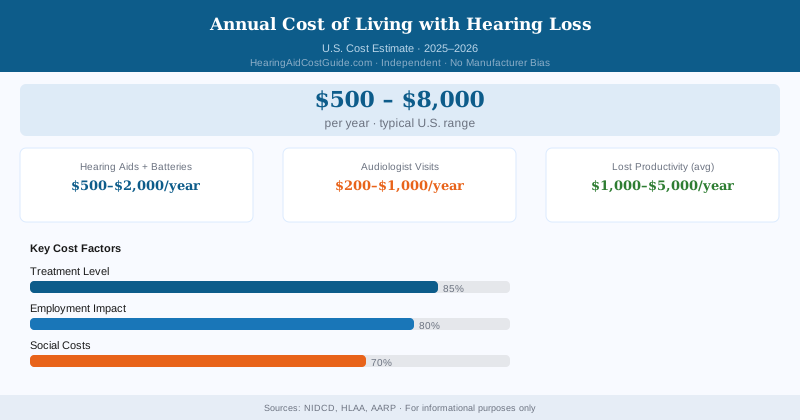
$133,000,000,000. That’s the NIDCD’s 2023 estimate for what untreated hearing loss costs the U.S. economy every year — in lost productivity, excess healthcare utilization, and downstream economic impacts. The total annual U.S. hearing aid market? About $5–6 billion. In other words, we spend roughly 25 times more on the consequences of untreated hearing loss than we’d spend on treating it.
Most people who hesitate on hearing aids are worried about the $2,000 upfront cost. Almost nobody is running the math on what they’re losing by not getting them.
The Economic Cost of Untreated Hearing Loss
| Cost Category | Annual Cost Per Individual | Source |
|---|---|---|
| Lost earnings (labor market impact) | $1,000–$30,000 | Sergeyenko et al., 2023 |
| Increased healthcare utilization | $2,122–$5,700 | Johns Hopkins JAMA study |
| Mental health treatment (depression, anxiety) | $800–$3,000 | NIDCD estimates |
| Workplace productivity loss | $1,500–$4,000 | Hearing Industries Assoc. |
| Increased fall-related medical costs | $3,000–$15,000 | Johns Hopkins balance research |
| Total estimated annual cost | $9,100–$58,000 | Combined estimates |
The Earnings Hit Is Real
A 2023 JAMA network analysis found that American adults with untreated hearing loss earn $1,000–$30,000 less annually than hearing peers with equivalent education and experience. The gap scales with severity. The Better Hearing Institute puts total annual U.S. labor force earnings losses from hearing loss at $26 billion.
The mechanism isn’t complicated: communication difficulty quietly erodes performance ratings, promotion rates, and the informal networking that drives career advancement. Phone-heavy roles, management positions, client-facing work — all disadvantaged. Remote work with captioning has helped somewhat. But anyone in a meeting, in a sales call, or managing a team is still exposed if they can’t follow the conversation.
Healthcare Costs: The Hidden Amplifier
A 2017 Johns Hopkins study in JAMA documented that adults with untreated hearing loss had annual healthcare costs $2,122–$5,700 higher than matched controls with normal hearing. The drivers:
- More hospitalizations: Communication failures in medical settings — missed discharge instructions, medication errors, inaccurate clinical histories — lead to complications and readmissions.
- Fall-related injuries: Johns Hopkins researcher Frank Lin found that people with hearing loss have triple the fall risk of normal-hearing peers. One hip fracture can cost $30,000–$50,000 in direct medical expenses, not counting rehab.
- Dementia care costs: Hearing loss is the single largest modifiable risk factor for dementia, per the 2020 Lancet Commission on Dementia Prevention — accounting for 8% of cases globally.
- Mental health treatment: Depression and anxiety rates are significantly elevated in people with untreated hearing loss. Therapy, medication, and lost work from mental health issues all add up.
The Dementia Multiplier — and Why It Dominates the Math
A 65-year-old who purchases $2,000 hearing aids at Costco and wears them for 5 years:
- Hearing aid cost: $2,000
- Estimated productivity/earnings benefit: $5,000–$50,000 over 5 years
- Estimated healthcare cost reduction: $10,000–$28,000 over 5 years
- Estimated fall risk reduction value: $15,000–$75,000 in avoided acute care (if even one fall prevented)
- Reduced cognitive decline risk: Value enormous (Alzheimer’s care exceeds $350,000 over disease course)
Even conservatively, the ROI on hearing aids is dramatically positive for most adults with significant hearing loss.
The 2023 ACHIEVE trial — published in The Lancet — found that hearing intervention reduced cognitive decline by 48% over 3 years in high-risk older adults. Set that against what dementia actually costs: $30,000–$100,000+ per year for moderate-to-severe cases, running for years. Full Alzheimer’s disease from diagnosis to end of life averages over $350,000 in care costs.
The comparison is almost absurd. A $1,499 pair of Costco hearing aids versus potentially hundreds of thousands in dementia care — and the hearing aids may reduce your risk by nearly half. That’s not a small thing.
The Cognitive Load Nobody Talks About
Even below the threshold of clinical dementia, untreated hearing loss extracts a cognitive toll. When your brain can’t process speech efficiently, it compensates by throwing more cognitive resources at the problem — resources that aren’t available for memory consolidation, executive function, or divided attention.
This isn’t theoretical. Studies have measured it: people with untreated hearing loss score lower on working memory and attention tasks while listening in noise, compared to hearing aid users with equivalent hearing thresholds. In practical terms, this affects job performance, social confidence, and the mental energy available for everything else you do.
The Costs That Don’t Show Up in a Study
Then there are the costs that are real but harder to quantify:
- Voluntary withdrawal from social situations — skipping gatherings because following conversation is too exhausting
- Relationship strain — the spouse who’s asked to repeat themselves dozens of times daily, the adult child who’s stopped calling because phone calls are too difficult
- Depression and anxiety that are measurably elevated in people with untreated hearing loss
- Reduced life satisfaction — consistently documented across population studies when comparing treated vs. untreated groups
If cost is the primary barrier to hearing aids, exploring every available option before concluding aids are unaffordable is important. VA benefits (if applicable), Medicaid, state VR programs, Starkey Foundation, Lions Club, Audient Alliance, Costco pricing, and OTC devices represent a spectrum from $0 to $1,499 that addresses most financial situations. The annual cost of untreated hearing loss almost certainly exceeds the cost of treatment.
What $133 Billion Means for Policy
The U.S. hearing aid market generates about $5–6 billion a year. Universal hearing aid coverage — getting aids to every American who needs them — wouldn’t even move the needle on that $133 billion cost, because the economic losses from untreated hearing loss dwarf what treatment would cost. This is one of the clearest examples in American healthcare of a massive gap between what’s cost-effective and what’s covered.
Until coverage changes, individual financial planning — Medicare Advantage hearing benefits, HSA funds, Costco, OTC devices — is the practical path forward. But knowing what inaction costs makes the decision easier.