TV. Phone calls. Sunday dinner with the whole family talking at once. Those aren’t the places hearing aids were designed for — and for many people, they’re exactly where the problem is worst. Hearing aids perform best in quiet, one-on-one conversations. Assistive listening devices (ALDs) pick up the slack everywhere else. Some of them cost under $50. One type is free.
The NIDCD estimates 28.8 million American adults could benefit from hearing assistance. Many of the most practical tools in this space aren’t hearing aids at all.
TV Listening Systems
The volume war is one of the most common household conflicts when one partner has hearing loss. One person wants the TV at 40; the other needs it at 75. TV listening systems end the argument without anyone compromising.
How they work: A transmitter plugs into your TV’s audio output. A receiver — either a headset or a neckloop that works with your hearing aids — sends sound directly to you at whatever volume you need, while the room volume stays where everyone else wants it.
| TV Listening Device | Price Range | Notes |
|---|---|---|
| Infrared headset (Sennheiser RS series) | $80–$200 | Room-bound, line-of-sight required |
| FM wireless headset | $50–$150 | Works through walls, minor interference possible |
| Bluetooth TV streamer (hearing aid companion) | $150–$250 | Streams directly to your hearing aids |
| Neckloop (telecoil-based) | $30–$100 | Requires T-coil in your hearing aid |
| Bone conduction TV headset | $100–$200 | Good for people with conductive loss |
If you already have hearing aids with Bluetooth, your brand probably sells a TV streamer that pairs directly with your devices. Phonak’s TV Connector runs around $200; Oticon’s TV Adapter 3.0 is similar. The sound comes straight to your aids — no extra headset to fiddle with.
Under the FCC’s Telecommunications Relay Services program, people with documented hearing loss can get a captioned telephone — one that shows real-time captions of what the caller says — at no cost.
Providers like CapTel and Hamilton CapTel participate in this program. You self-certify that you have a hearing loss; no doctor’s note required. These phones retail for $75–$200 but come free through the TRS program. Go to captionedtelephone.com or call your state telecommunications relay program to apply.
Amplified Phones and Personal Amplifiers
Amplified phones look like ordinary phones but put out 40–50 dB of gain — more than double what a standard phone delivers. Brands like Clarity, Panasonic, and Geemarc have popular models in every price range.
- Amplified corded phones: $40–$90
- Amplified cordless phones: $60–$150
- Phones with large buttons and visual ring alerts: $60–$120
Personal amplifiers (sometimes called pocket talkers) are handheld devices you hold near someone who’s speaking, then listen through earbuds. Williams Sound’s Pocketalker is the long-running favorite at around $130. They’re popular in care settings and for people who can’t wear hearing aids for medical reasons. Simple, durable, no fitting required.
FM and Loop Systems
FM systems transmit sound via radio frequency from a microphone to a personal receiver. The presenter wears a lapel mic; you listen through your own receiver or a hearing aid neckloop. Schools, churches, and theaters use them widely — and you can buy a personal FM system for home use too.
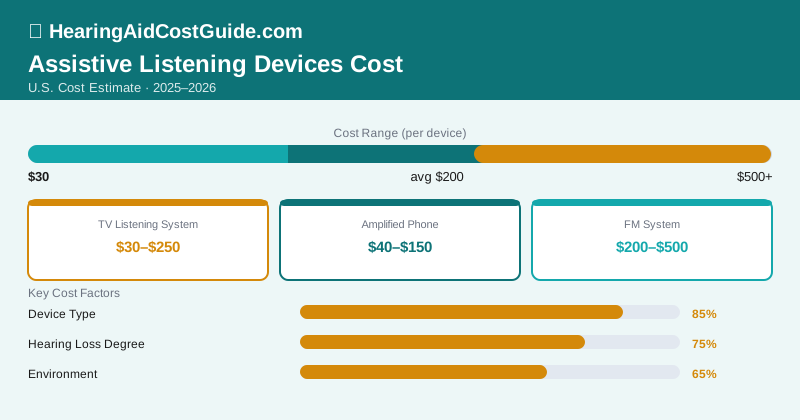
Personal FM systems run $200–$500. The Phonak Roger series (Roger Pen, Roger Select) extends this technology into everyday situations — though Roger accessories get expensive quickly, running $400–$800 for the microphone alone.
Hearing loops are installed in a room — a wire runs around the perimeter and generates a magnetic field. If your hearing aids have a telecoil (T-coil), you switch to T-coil mode and hear directly from the loop. No extra receiver, no neckloop. Home loop systems for a single room cost $100–$400 for basic DIY kits; professional installation runs $500–$1,500. Many churches, airports, and theaters already have them — look for the ear-with-T symbol posted at the entrance.
Not all hearing aids include a telecoil. Smaller in-the-canal and invisible models often leave out T-coils because of size constraints. If you plan to use loop systems in public spaces or at home, ask your audiologist specifically whether your model has a T-coil before you purchase. It’s worth requesting.
What Insurance and Medicare Cover
Most ALDs aren’t covered by Medicare Part B or standard health insurance. But there are real exceptions:
- Medicare Advantage plans with hearing benefits sometimes include an annual allowance for hearing aids and related accessories. Ask specifically about “assistive listening devices” — some plans include them under that benefit.
- Medicaid coverage varies by state. Some state programs cover specific ALDs with prior authorization.
- HSA/FSA funds can pay for most ALDs. They qualify as medical expenses under IRS Publication 502. See our HSA/FSA hearing aid guide for details.
- State assistive technology programs: Every state has an AT Act program offering device loans, low-interest financing, or equipment exchanges. Find yours at at3center.net.
Bottom Line
Assistive listening devices range from free (captioned phones through the FCC program) to $500 for FM systems. A $150 TV streamer often solves the one daily frustration that drives people to seek help in the first place — and it doesn’t require a new prescription. Figure out what causes the most friction in your day — TV, phone calls, or noisy conversations — and target that first. A specific solution to a specific problem usually beats a general one. Most of these options cost a fraction of a full hearing evaluation.