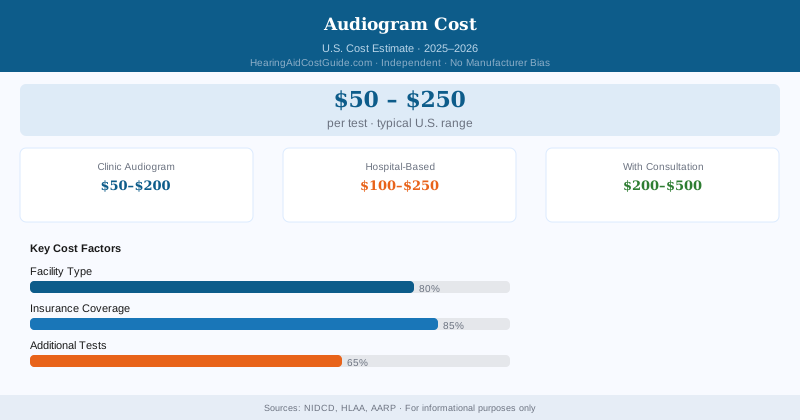
An audiogram is the definitive map of your hearing — a graph showing the softest sounds you can detect at frequencies from low (250 Hz) to high (8,000 Hz). It takes about an hour, tells your audiologist exactly what type and degree of hearing loss you have, and costs $150–$350 out-of-pocket, or just your specialist copay with insurance.
Audiogram Cost by Setting
| Setting | Cost (No Insurance) | With Insurance |
|---|---|---|
| Private audiology practice | $150–$350 | $0–$75 copay |
| Hospital audiology department | $200–$400 | $0–$100 copay |
| ENT office (includes audiogram) | $250–$450 | $0–$100 copay |
| Costco Hearing Center | Free | N/A |
| Online audiogram app (screening only) | Free–$20 | N/A |
| HLAA chapter clinics | Free–$50 | N/A |
What Actually Happens During a Full Audiological Evaluation
Here’s where a lot of people are surprised: a comprehensive audiogram isn’t just “raise your hand when you hear the beep.” A full evaluation has six distinct components, each revealing different information about how your hearing system works.
Otoscopy comes first. The audiologist looks into your ear canal with a scope — takes two minutes per ear. You’d be amazed how often this reveals an obvious culprit: earwax blockage, eardrum perforation, or visible middle ear fluid. Sometimes the hearing problem is solved right here before any testing begins.
Tympanometry comes next. A small probe in your ear canal varies air pressure while measuring how well your eardrum moves. This tells your audiologist about middle ear pressure, eustachian tube function, and whether there’s fluid behind the eardrum. Takes about five minutes.
Pure-tone air conduction audiometry is the core test — the one most people picture. You wear headphones and indicate when you hear tones at specific frequencies (250, 500, 1000, 2000, 3000, 4000, 6000, 8000 Hz). The softest level you can detect at each frequency becomes your “threshold,” plotted as an X or O on the audiogram graph.
Pure-tone bone conduction audiometry uses a vibrator placed behind your ear to send sound through bone directly to the cochlea, bypassing the ear canal and middle ear entirely. Comparing air and bone thresholds reveals whether your hearing loss is sensorineural (inner ear or nerve problem) or conductive (outer or middle ear problem). This distinction matters enormously for treatment decisions.
Speech reception threshold (SRT) measures the softest level at which you can correctly repeat 50% of two-syllable words like “baseball” or “hotdog.” This confirms what the pure-tone testing showed.
Word recognition score (WRS) is the one people don’t expect. At a comfortable listening volume, you repeat single-syllable words. Results are expressed as a percentage — normal is 88–100%. Scores below 72% may mean hearing aids alone won’t restore full speech clarity, which affects how aggressive treatment needs to be.
Hearing loss is classified by degree based on average thresholds across 500, 1000, 2000, and 4000 Hz:
- Normal: 0–25 dB HL
- Mild loss: 26–40 dB HL
- Moderate loss: 41–55 dB HL
- Moderate-to-severe: 56–70 dB HL
- Severe: 71–90 dB HL
- Profound: 91+ dB HL
OTC hearing aids are FDA-approved for mild-to-moderate loss (up to approximately 55 dB HL).
Extended High-Frequency Testing (6,000–16,000 Hz)
Standard audiograms test up to 8,000 Hz. Extended high-frequency testing adds $50–$100 to test the 9,000–16,000 Hz range. It’s not for everyone — but if you have significant occupational noise exposure or you’re on ototoxic medications like cisplatin or carboplatin, it can detect early cochlear damage before it reaches the speech frequencies. That’s valuable information for catching problems while you can still do something about them.
Getting Your Own Audiogram Copy
You’re legally entitled to a copy of your audiogram under HIPAA. Don’t leave without requesting one — printed or electronic. Your audiogram belongs to you, not the clinic, and you can take it anywhere: a second opinion, a different provider, an OTC retailer who wants your thresholds for fitting assistance.
Some hearing aid chains and retail dispensers won’t share your audiogram and instead issue a “coupon” or “certificate” that can only be redeemed at their locations. This is a predatory practice. Insist on a copy of your actual audiogram data, or consider going to an independent audiologist instead.
How Often Should You Get Tested?
- First test: Baseline in your early 50s — or sooner if you’re noticing difficulty in noise, turning up the TV, or asking people to repeat themselves
- After initial detection: Annually for the first few years to track progression
- With hearing aids: Every 1–2 years to verify your programming still matches your current thresholds
- After acoustic trauma: 2–4 weeks post-exposure (loud concert, industrial noise event, explosion)
- On ototoxic medications: Baseline before treatment, monitoring during, and follow-up after
What Insurance Actually Covers
Medicare Part B covers diagnostic hearing evaluations when ordered by a physician for a specific medical reason — not routine screening. You generally need a doctor’s referral, and the test must be investigating a defined complaint. The NIDCD estimates that 28.8 million U.S. adults could benefit from hearing aids, yet Medicare still doesn’t cover the aids themselves — making this initial diagnostic evaluation sometimes the only covered piece of the puzzle.
Most private insurers cover audiological evaluations at specialist copay rates when billed with appropriate diagnostic CPT codes. Ask your audiologist to bill code 92557 (comprehensive audiological evaluation) rather than a screening code — that distinction determines whether your insurance pays.