You just had a hearing test. The audiologist handed you a sheet of paper with X’s and O’s scattered across a grid and said something like “moderately sloped.” You nodded. You understood approximately nothing.
That piece of paper is actually important. It’s the prescription that drives every decision that comes next — whether you need hearing aids, what style fits your loss pattern, what technology level makes sense, and whether any of your hearing loss might be medically treatable. Once you know how to read it, the grid isn’t confusing at all.
The Grid: Two Axes, One Clear Picture
The audiogram is a graph. The horizontal axis (left to right) represents frequency — pitch — measured in Hertz (Hz). The vertical axis (top to bottom) represents loudness — measured in decibels of hearing level (dBHL).
Frequency axis: Ranges from 250 Hz on the left to 8,000 Hz on the right. Low numbers are low-pitched sounds — bass rumble, background hum. High numbers are high-pitched sounds — birds singing, consonants in speech, the high notes in music.
Loudness axis: This one trips people up. Zero dBHL at the top doesn’t mean silence — it means the softest sound a person with normal hearing can just detect. As numbers get larger going downward, you need louder and louder sound to hear them. A threshold at 60 dBHL means a sound has to be 60 decibels before you can barely detect it.
The practical implication: a dot plotted lower on the grid means worse hearing at that frequency. Dots clustered near the top? Near-normal hearing. Dots drifting down? That’s where the loss is.
The Symbols: O’s for Right, X’s for Left
Two sets of symbols appear on the audiogram:
- O (circles) — right ear
- X (crosses) — left ear
- [ (bracket) — right ear bone conduction
- ] (bracket) — left ear bone conduction
The bone conduction symbols are tested with a small vibrator placed on the bone behind your ear. This bypasses the outer and middle ear entirely and tests the cochlea directly. Comparing air conduction (O’s and X’s) to bone conduction (brackets) is how audiologists tell the difference between sensorineural hearing loss (inner ear damage) and conductive hearing loss (a middle-ear blockage or mechanical problem).
Where Speech Sounds Live on the Audiogram
This is the part that makes your results personally meaningful. Different speech sounds live at different frequencies, often illustrated on the audiogram as a “speech banana” — a banana-shaped zone where the sounds of spoken English cluster.
Low frequencies (250–1,000 Hz): Vowels — the “oo” in moon, “ah” in father, background voices, environmental sounds. These carry the energy and volume of speech.
Mid frequencies (1,000–2,000 Hz): Sounds like “m,” “d,” “b,” “n.” Important for overall speech clarity.
High frequencies (2,000–8,000 Hz): Consonants — “s,” “f,” “th,” “sh,” “p,” “k,” “t.” These are quiet, high-pitched, and carry most of the meaning in English.
This is exactly why people with age-related or noise-induced hearing loss — which kills high-frequency hair cells first — say the same thing: “I can hear talking, I just can’t understand the words.” Vowels come through. The consonants that define words disappear. On the audiogram, this looks like a ski-slope: normal in the low frequencies, dropping steeply in the highs. It’s the most common pattern audiologists see.
Degrees of Hearing Loss
The audiogram’s vertical axis defines the categories audiologists use to describe severity. These are based on thresholds averaged across key speech frequencies (500, 1,000, 2,000, and sometimes 4,000 Hz), called the Pure Tone Average (PTA).
| Degree | Threshold Range | What You Miss | Typical Recommendation |
|---|---|---|---|
| Normal | 0–25 dBHL | Very soft sounds only | No action needed |
| Mild | 26–40 dBHL | Whispers, soft speech | Monitoring; consider OTC or prescription aids |
| Moderate | 41–55 dBHL | Normal conversation | Hearing aids recommended |
| Moderately severe | 56–70 dBHL | Loud speech, TV at high volume | Prescription hearing aids needed |
| Severe | 71–90 dBHL | Shouted speech | Powerful hearing aids; CI evaluation |
| Profound | 91+ dBHL | Almost nothing unaided | Cochlear implant candidacy |
A mild loss might not interfere much in quiet settings. But in a restaurant, a group conversation, or a phone call, even a 30 dBHL loss makes communication significantly harder.
Audiogram Shapes: What They Tell You
The pattern of your thresholds across frequencies is as informative as the severity.
Flat loss: Thresholds are similar at all frequencies. Often associated with otosclerosis, Meniere’s disease, or some genetic conditions. Hearing aids can address all frequencies equally.
Ski-slope (high-frequency) loss: Normal or mild low-frequency hearing that drops sharply above 1,000–2,000 Hz. The most common pattern — classic presbycusis and noise-induced hearing loss look like this. Requires open-fit or receiver-in-canal hearing aids that amplify high frequencies while leaving low-frequency audibility alone.
Cookie-bite (mid-frequency) loss: A U-shaped curve where mid-frequencies are worse than low or high. Relatively uncommon; often genetic. Can be tricky to fit because standard hearing aid processing is optimized for the more common ski-slope pattern.
Low-frequency loss: Inverted triangle shape, worse in lows. Associated with Meniere’s disease and some early-stage conditions. Unusual; worth investigating for underlying causes.
Corner audiogram: Thresholds measurable only in the low frequencies; profound loss in the mids and highs. Usually indicates cochlear implant candidacy rather than conventional hearing aid fitting.
If you score well on the pure tone audiogram but struggle with speech understanding, ask your audiologist for word recognition scores — a speech test that measures how accurately you identify single-syllable words at a comfortable loudness level.
Normal word recognition: 90–100%. A score below 80% — even with thresholds that look mild — indicates reduced speech discrimination, often from cochlear hair cell damage or auditory nerve involvement. It also predicts how much benefit you’ll get from hearing aids: lower scores mean hearing aids may help less than expected. This is a critical data point that pure tone thresholds alone don’t capture.
When Do Audiologists Recommend Hearing Aids?
There’s no universal cutoff, but the common clinical threshold is a PTA of 40 dBHL or greater in the speech frequencies, or when hearing loss is demonstrably affecting daily life even at milder levels.
At 26–40 dBHL (mild loss), many audiologists recommend monitoring and patient education — helping people understand which situations will be hardest and what to watch for. At 41 dBHL and above, the evidence for hearing aid benefit is strong enough that most audiologists recommend proceeding.
The technology level — basic, mid-range, or premium — is a separate decision from whether to get hearing aids at all. That’s driven by lifestyle, budget, and what your typical listening environments look like. Someone who mostly watches TV in a quiet house has different needs than someone still attending grandkids’ soccer games and family dinners in crowded restaurants.
| Degree of Loss | Suggested Hearing Aid Tier | Typical Cost Range |
|---|---|---|
| Mild | OTC or basic prescription | $799–$2,500/pair |
| Moderate | Mid-range prescription | $2,500–$4,500/pair |
| Moderately severe | Mid-range to premium prescription | $3,500–$6,000/pair |
| Severe | Premium prescription or power aids | $5,000–$7,000/pair |
| Profound | Cochlear implant evaluation | $50,000–$100,000 (usually insured) |
What the Audiogram Doesn’t Tell You
The audiogram measures detection — the softest sound you can barely hear. It doesn’t directly measure:
- Speech understanding in noise — the most common real-world complaint; requires separate testing
- The quality of your auditory nerve — relevant for cochlear implant candidacy
- How well you’ll do with hearing aids — speech discrimination scores and lifestyle factors matter just as much
- Tinnitus — won’t appear on the audiogram, but a good audiologist will ask about it separately
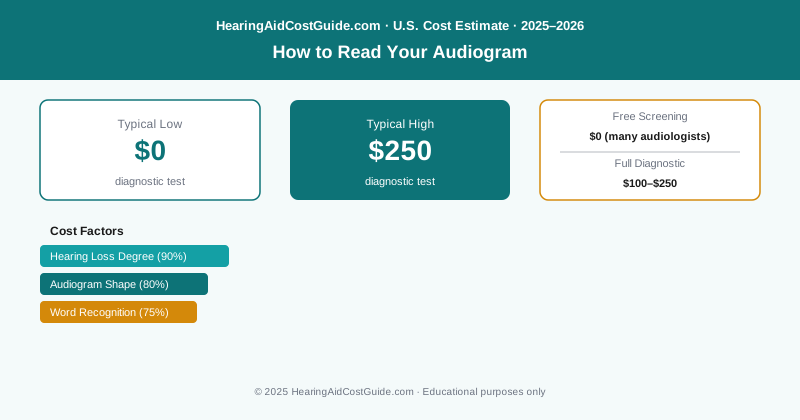
A thorough evaluation covers all of these. The full diagnostic audiogram runs $100–$250 without insurance, and many audiologists offer free screenings as a first step. The results of that one test set the direction for everything that follows — so it’s worth doing right, with a licensed audiologist, not an online quiz.
Online hearing tests — including the ones offered by hearing aid retailers — are screenings, not diagnostic evaluations. They can suggest the presence of hearing loss but can’t determine its type, cause, or severity with clinical accuracy. If an online test shows any concern, follow up with a licensed audiologist for a complete evaluation before spending money on hearing aids.