FAQ: Audiologist or ENT — Which One Do I Need?
Two types of specialists handle hearing problems in the US, and the confusion between them is universal. Below are the questions people ask most, with direct answers.
What’s the difference between an audiologist and an ENT?
An audiologist (AuD) has a doctoral degree focused on diagnosing and treating hearing and balance disorders. They can’t prescribe medications or perform surgery — but they’re the specialists who actually fit and program hearing aids, and they run the diagnostic tests that map your hearing precisely. An ENT (otolaryngologist) is a physician with a medical degree plus a five-year surgical residency. They can prescribe medications, perform ear surgery, and manage the medical conditions that cause hearing loss.
Think of it this way: the audiologist handles the hearing system itself — testing, devices, rehabilitation. The ENT handles the medical and surgical problems that affect the hearing system.
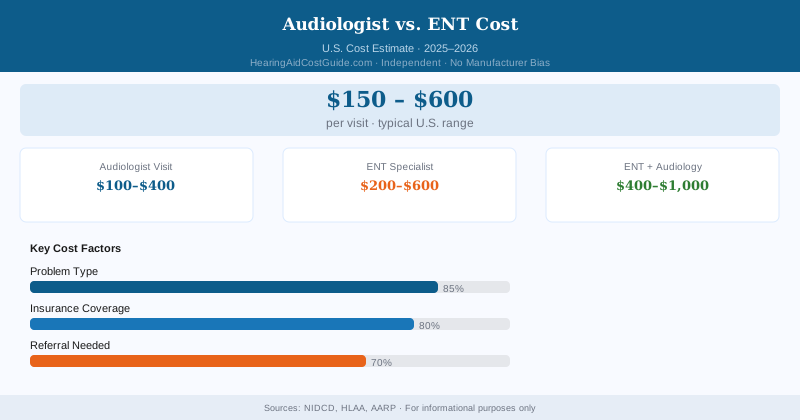
Which one costs less?
| Factor | Audiologist (AuD) | ENT (Otolaryngologist, MD/DO) |
|---|---|---|
| Training | Doctoral degree (AuD), 4 years post-grad | Medical degree + 5-year residency + optional fellowship |
| License type | Non-physician specialist | Physician specialist |
| First visit cost | $150–$350 | $200–$450 |
| Can diagnose ear conditions | Yes (auditory) | Yes (medical/surgical) |
| Can prescribe medications | No | Yes |
| Can perform surgery | No | Yes |
| Fits hearing aids | Yes | Some, but often refers to audiologist |
| Billable under medical insurance | Yes (diagnostic tests) | Yes |
| Required referral from PCP | Sometimes (HMO) | Sometimes (HMO) |
Audiologist appointments run $100–$200 less than ENT visits, and they’re typically easier to schedule quickly. For the most common hearing complaints — gradual bilateral loss, tinnitus without vertigo — the audiologist is both the more affordable and the more appropriate first stop.
When should I see an audiologist first?
Start with an audiologist when:
- You’ve noticed gradual hearing difficulty in your 50s, 60s, or 70s
- Both ears are affected equally — bilateral, symmetrical loss is almost always sensorineural and doesn’t need an ENT first
- You have tinnitus but no sudden changes, vertigo, or drainage
- You’re ready to discuss hearing aids — audiologists fit and program them, ENTs typically don’t
- You need annual audiograms for monitoring (occupational noise, ototoxic medication)
- You want balance or vestibular testing — audiologists often perform VNG and related tests
When should I go directly to an ENT?
Some situations shouldn’t wait for an audiology appointment:
- Sudden hearing loss in one ear (within 72 hours): This is a medical emergency. Call an ENT the same day. High-dose steroids given within 48–72 hours dramatically improve outcomes. Every hour matters.
- Ear pain, pressure, or fullness alongside hearing loss: Possible infection or middle ear disease — a physician needs to examine and treat it.
- Any discharge from the ear: Requires physician evaluation.
- One ear significantly worse than the other: Asymmetric hearing loss needs acoustic neuroma ruled out via MRI.
- Dizziness or vertigo combined with hearing changes: Possible Meniere’s disease or inner ear disorder.
- Recent head trauma or acoustic trauma
- Any bleeding from the ear
In practice, audiologists and ENTs work closely together:
- Audiologist detects asymmetric hearing loss → refers to ENT for acoustic neuroma workup
- ENT diagnoses otosclerosis → refers to audiologist for hearing aid fitting while patient decides on surgery
- ENT performs cochlear implant surgery → refers patient to audiologist for post-implant mapping and rehabilitation
- Audiologist programs hearing aids → patient also sees ENT for medically complex ear management
You may see both specialists — they address different aspects of the same patient’s hearing health.
What exactly can each one do for me?
The audiologist’s toolkit includes comprehensive hearing evaluation (audiogram, speech testing, tympanometry), tinnitus evaluation and management, hearing aid selection and fitting, cochlear implant post-surgical mapping, vestibular testing, auditory processing disorder evaluation, and auditory rehabilitation.
The ENT’s toolkit includes medical diagnosis and treatment of ear conditions, prescriptions (steroids, antibiotics, diuretics), in-office procedures like cerumen removal and intratympanic steroid injections, and surgery — ear tubes, tympanoplasty, stapedectomy, cochlear implants, bone-anchored hearing aids (BAHA), and acoustic neuroma removal.
What if I need both?
That happens — frequently. The combined cost without insurance runs about $350–$750 for a full audiological evaluation plus an ENT consultation. With specialist copays, it’s typically $60–$200 total.
The most efficient path for adults with gradual bilateral hearing loss: start with the audiologist. Get your full audiogram. If something unusual comes up — asymmetric loss, poor word recognition, abnormal findings — the audiologist will refer you to ENT with appropriate testing already done. That saves the ENT appointment time and gives the physician concrete data to act on immediately.
Be cautious about ENT or audiology offices that recommend purchasing hearing aids before completing a full diagnostic workup. Hearing aids should be the final step after confirming the diagnosis, confirming there’s no medically treatable cause, and determining the appropriate device for your specific audiogram. Any pressure to purchase before testing is complete is a red flag.
Quick Reference: Who to Call First
- Gradual bilateral hearing loss, no pain, no drainage → Audiologist
- Sudden hearing loss in one ear in the last 48–72 hours → ENT (urgent)
- Ear pain or drainage → PCP or ENT
- Hearing loss + vertigo → ENT
- Hearing loss + tinnitus, no other symptoms → Audiologist
- Child with ear infections and hearing loss → Pediatrician, then ENT if needed
- Ready to buy hearing aids, already diagnosed → Audiologist