The parents of a six-week-old who failed her newborn hearing screen sat in the audiologist’s office, anxious about what “refer” on the results slip meant. The audiologist explained they’d need an ABR — auditory brainstem response — to find out if there was actual hearing loss, and if so, how much. “She doesn’t have to do anything,” the audiologist said. “She just needs to sleep.”
That’s the distinctive thing about ABR testing: it measures how the brain responds to sound electrically, without requiring the patient to raise a hand, press a button, or answer a question. That’s why it’s essential for testing infants, young children, and anyone who can’t participate in standard behavioral audiometry. And it’s why it shows up in acoustic neuroma workups for adults too — because it can evaluate the auditory nerve pathway in ways a standard audiogram can’t.
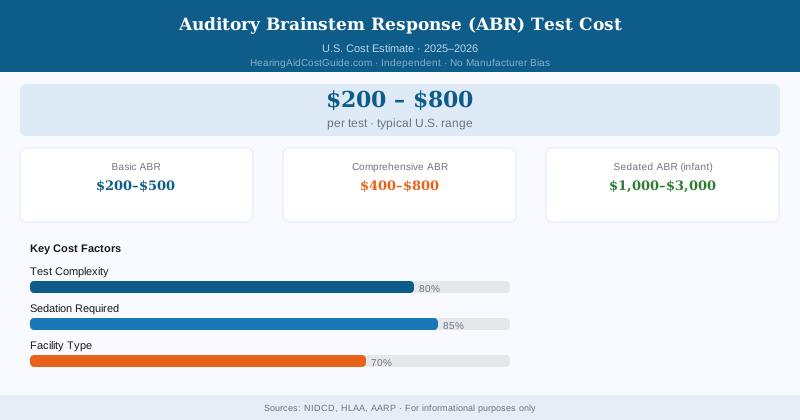
ABR Test Cost
| Setting | Cost (No Insurance) | Notes |
|---|---|---|
| Hospital audiology | $400–$900 | Often covered by insurance |
| Private audiology practice | $300–$700 | Less common than hospital ABR |
| Children’s hospital (diagnostic) | $500–$1,200 | May include sedation fee |
| Sedation (pediatric ABR, if required) | $300–$800 additional | Anesthesia billed separately |
| Newborn screening ABR (hospital) | $0–$50 (screening) | Included in newborn care at most hospitals |
What ABR Actually Measures
Here’s the basic mechanism: electrodes placed on the scalp and behind the ears pick up the brain’s electrical activity in response to clicking sounds and tones played through earphones. The pattern of brain wave responses reveals how well sound is traveling from the cochlea up the auditory nerve and through the brainstem.
No behavioral response required. The patient can sleep. The equipment records what’s happening neurologically.
Diagnostic ABR is used for:
- Estimating hearing thresholds in infants and people who can’t complete behavioral tests
- Detecting acoustic neuromas — benign tumors on the auditory nerve, and the most common reason adults get ABR testing
- Diagnosing auditory neuropathy spectrum disorder (ANSD) — a condition where the cochlea functions but the neural pathway is disordered
- Evaluating hearing in ICU patients or following trauma
- Confirming the degree of sudden hearing loss
Newborn screening ABR is a faster automated version — the aABR — performed before hospital discharge. It gives a pass/refer result (not a threshold estimate) and is bundled into standard newborn hospital care.
The 5-Step ABR Experience
- Scalp cleaning and electrode placement: 10–15 minutes of prep
- Patient settles in a recliner or exam table in a quiet room
- Earphones play a series of clicks and tone bursts at decreasing volumes
- No response required — the patient rests, relaxes, or sleeps
- Test duration: 60–90 minutes for a complete diagnostic ABR
For infants and young children (typically under 4–5 years old), a sedated ABR or ABR under natural sleep is performed to ensure the child stays still throughout. Sedation adds $300–$800 in anesthesia fees and requires a hospital setting. It sounds more alarming than it is — it’s a routine procedure at children’s hospitals — but the cost adds up.
Standard behavioral audiograms are the gold standard for cooperative adults and children old enough to follow instructions (typically 4+ years). ABR is used when behavioral testing isn’t reliable — for infants, young children, adults with cognitive or developmental conditions, or when the auditory pathway needs to be evaluated beyond just threshold testing. Your audiologist determines which is appropriate.
ABR for Acoustic Neuroma Screening
If you’re an adult who’s been referred for ABR due to one-sided hearing loss or unilateral tinnitus, the reason is likely acoustic neuroma screening. ABR is a sensitive tool for detecting auditory nerve tumors — though it’s not perfectly specific, and a normal ABR doesn’t completely rule one out.
Cost for acoustic neuroma-focused ABR: $400–$700 at a private audiology practice or hospital. Usually covered by medical insurance once a physician orders it.
Abnormal ABR results typically trigger MRI with gadolinium contrast of the internal auditory canals — cost $800–$2,000+ depending on facility, but routinely covered by insurance for this specific indication.
What Insurance Pays
ABR is a diagnostic medical test, which puts it in a different coverage category than routine hearing evaluations. It’s typically covered by:
- Medicare Part B when medically necessary and ordered by a physician
- Private insurance at specialist or procedure copay rates
- Medicaid in most states for pediatric ABR related to hearing loss evaluation
The CPT codes involved are 92585 (auditory evoked potentials), 92586 (limited), and related codes. Pre-authorization may be required for non-emergency adult ABR — ask the billing staff to confirm before your appointment to avoid a surprise.
Acoustic neuromas (now often called vestibular schwannomas) are usually benign and slow-growing, but they must not be missed. If you have hearing loss or tinnitus significantly worse in one ear, request ABR testing from your audiologist or ENT. The cost of a missed acoustic neuroma diagnosis is far higher than the cost of a diagnostic ABR.
ASSR: The ABR Cousin Worth Knowing About
Auditory Steady-State Response (ASSR) testing is sometimes used alongside or instead of ABR for hearing threshold estimation in infants. It uses continuous modulated tones rather than clicks and can provide frequency-specific threshold information more efficiently in some cases. Costs are similar — $300–$700 — and it’s typically performed in the same facilities that offer ABR. Your audiologist will choose which technique (or combination) is most appropriate based on the clinical question.