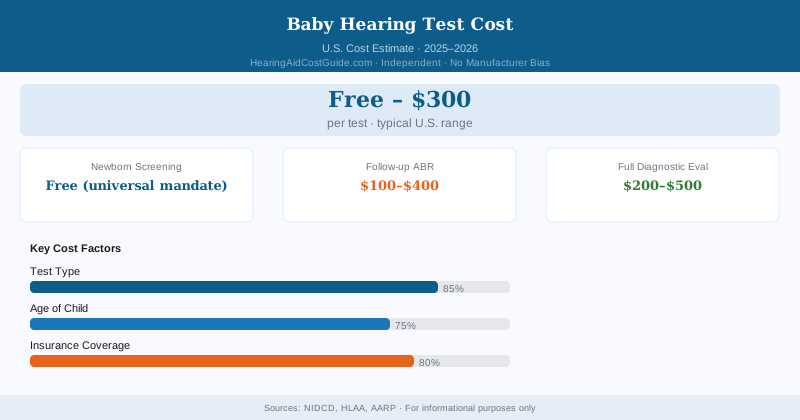
Every baby born in a U.S. hospital gets a hearing screening before going home. No extra charge, no separate appointment — it’s folded into standard newborn hospital care, mandated by law in 43 states and followed as standard practice everywhere else. The test takes 5–15 minutes, requires no response from the baby, and parents often don’t even know it happened.
What matters is what comes after a failed result — because that’s where the costs and the urgency begin.
Newborn Hearing Screening Costs
| Test Type | When Used | Cost |
|---|---|---|
| Newborn OAE/ABR screening (hospital) | Before hospital discharge | Included in birth hospitalization |
| Outpatient OAE rescreen | 2–4 weeks after failed initial screen | $75–$200 |
| Diagnostic audiological evaluation | 1–3 months (after two failed screens) | $200–$500 |
| Diagnostic ABR (if needed, awake infant) | Infants 0–6 months | $400–$800 |
| Sedated ABR (if needed) | Infants who can’t complete awake test | $700–$1,500 (includes sedation) |
How the Initial Screening Works
Two tests are used for newborn hearing screening, and hospitals use one or both:
OAE (Otoacoustic Emissions): A tiny microphone sits inside the ear canal and measures the cochlea’s own sound response to a stimulus. It’s quick — 5–10 minutes per ear — and tells you whether the outer hair cells in the cochlea are working. If they respond normally, the inner ear is almost certainly healthy.
Automated ABR (aABR): Electrodes on the scalp measure brainstem electrical activity in response to clicking sounds. Takes 10–15 minutes and evaluates the auditory pathway from cochlea to brainstem.
Both tests give you exactly two results: pass or refer (fail). They’re screening tools, not diagnostic ones. A failed result doesn’t mean your baby has hearing loss — it means more testing is needed. False-positive rates are significant, especially in the first 24–48 hours when amniotic fluid may still be present in the ear canal.
What “Refer” Actually Means — And What to Do Next
Getting a “refer” result on the hospital screening is scary for new parents. But here’s important context from the CDC’s Early Hearing Detection and Intervention (EHDI) program: most babies who fail the initial screen have normal hearing. The first step is simply a rescreen.
The JCIH (Joint Committee on Infant Hearing) 1-3-6 guidelines lay out the timeline:
- By 1 month: Complete inpatient screening before hospital discharge
- By 3 months: Complete diagnostic evaluation if referred
- By 6 months: Begin appropriate intervention if hearing loss is confirmed
Step 1 — outpatient rescreen ($75–$200): Scheduled 2–4 weeks after the failed hospital screen. A repeat OAE or aABR in a quieter environment with no amniotic fluid in the picture. The majority of false-positive hospital screens clear here.
Step 2 — comprehensive diagnostic evaluation ($200–$500): If the rescreen is also failed, a full pediatric audiological evaluation follows at a pediatric audiology center. This includes OAE, tympanometry, and ABR to start mapping what’s actually happening with the infant’s hearing.
Step 3 — diagnostic ABR ($400–$1,500): Frequency-specific ABR to estimate actual hearing thresholds at each frequency. For infants under 4–6 months, many can complete this while naturally asleep — parents often sleep-deprive the baby before the appointment and schedule it during the normal nap time. If the baby can’t complete it awake or asleep, sedation may be required, which adds $300–$800 in anesthesia fees.
Infant ABR tests estimate hearing thresholds — the softest sounds the child responds to at each frequency. Normal infant ABR thresholds are 30 dB nHL or better. Results are matched to audiological criteria for hearing aid candidacy.
For infants with confirmed hearing loss, hearing aids should be fitted as early as 1–3 months of age ideally — before 6 months — to leverage the critical period for auditory development and language acquisition. Early intervention dramatically improves long-term language outcomes.
Hearing Aids for Infants: Costs and Coverage
Once hearing loss is confirmed, the goal is to get hearing aids fitted as fast as possible — ideally within weeks. Pediatric hearing aids for infants:
- Cost: $3,000–$5,500 per pair (prescription BTE with custom earmolds; professional fitting required)
- Insurance: Covered under Medicaid and CHIP for all children. Private insurance coverage varies by state — many states now mandate it for children under private plans.
- Earmolds: Custom soft silicone molds need replacement every 3–6 months during rapid growth years. Plan for ongoing earmold costs.
- Early Intervention services: Children 0–3 years with hearing loss qualify for free early intervention services under IDEA Part C — speech therapy, developmental services, family guidance — regardless of income. This is federal law.
The HLAA (Hearing Loss Association of America) estimates that early-identified and early-treated children with hearing loss reach language development milestones similar to hearing peers at dramatically higher rates than children identified and treated late. The window matters.
Genetic Testing: Is Hearing Loss in the Family?
About 50–60% of childhood hearing loss has a genetic cause. After confirming hearing loss, genetic testing is typically recommended:
- What’s tested: Common hearing loss mutations including GJB2/connexin 26, GJB6, SLC26A4, and mitochondrial DNA variants
- Cost: $200–$800 depending on the panel, often covered by medical insurance
- Why it matters: Results tell you whether the loss is likely stable or progressive — enormously important information for educational planning. GJB2/connexin 26, the most common single cause of genetic hearing loss, is usually associated with stable loss.
All 50 states now have Early Hearing Detection and Intervention (EHDI) programs. If your baby fails a hearing screening, your state’s EHDI coordinator will contact you and help navigate the follow-up process. Do not delay follow-up out of hope that the baby will “grow into” normal hearing — the consequences of untreated hearing loss during the first years of life include delayed language development that can be very difficult to remediate later.
Resources for Families
Navigating infant hearing loss for the first time is overwhelming. These organizations are genuinely useful:
- National EHDI Program: cdc.gov/ncbddd/hearingloss
- Hands & Voices: handsandvoices.org — parent-led organization with state chapters, unbiased about communication approach
- Alexander Graham Bell Association: agbell.org — focused on spoken language outcomes
- American Academy of Audiology: Pediatric audiology resource center at audiology.org