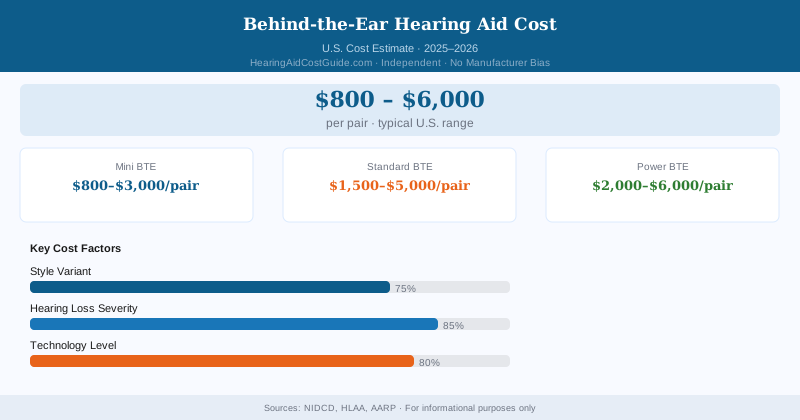
The $1,499 Costco Kirkland versus the $6,800 Oticon Intent — both are behind-the-ear hearing aids, both are receiver-in-canal style, and the performance gap between them is real but narrower than the price suggests for most users. Meanwhile, someone with profound hearing loss needs a standard BTE that neither of these devices can handle.
Need overall hearing aid prices? Our full hearing aid cost guide covers all styles from $200 OTC to $7,000 prescription pairs. This page focuses on BTE style breakdown specifically.
“Behind-the-ear” covers three distinct form factors with meaningfully different prices, power levels, and appropriate use cases. Here’s how they break down.
BTE Style Comparison and Costs
| Style | Full Name | Receiver Location | Price (Per Pair) | Loss Level |
|---|---|---|---|---|
| Standard BTE | Behind-the-ear | In device housing | $2,000–$6,500 | Moderate-to-profound |
| Mini BTE | Mini behind-the-ear | In device housing | $2,500–$6,000 | Mild-to-severe |
| RIC/RITE | Receiver-in-canal | In ear canal tip | $2,500–$7,000 | Mild-to-profound |
Standard BTE: The Power Option
In a standard BTE, everything lives behind the ear — the microphone, processor, and receiver (speaker). Sound travels down a tube into a custom earmold fitted to the ear canal.
Standard BTEs are the workhorses for severe and profound hearing loss. They’re also the preferred choice for pediatric fittings, because as a child grows, you only need to replace the earmold — not the entire device. People with frequent ear infections or unusual ear canal anatomy also do better with standard BTE than with in-canal styles.
Price range: $2,000–$6,500 per pair. Counterintuitively, standard BTEs aren’t more expensive than smaller styles — they sometimes cost less because less miniaturization is required.
Models to know:
- Phonak Naída Lumity (for severe-to-profound loss): $4,500–$6,500/pair
- Oticon Xceed SP: $4,200–$6,000/pair
- Signia Pure Charge&Go IX BTE: $3,600–$5,500/pair
Mini BTE: The Overlooked Middle Ground
Mini BTEs are smaller than standard BTEs but use the same behind-ear housing. They connect to the ear via a thin tube rather than a thick tube, leading to either a custom earmold or an open-fit dome in the canal.
Open-fit configurations are the main advantage here: the vented dome reduces the occlusion effect — that “plugged up” sensation, and the sound of your own voice echoing in your head, that many new hearing aid users find intolerable. If your low-frequency hearing is relatively preserved and you only need high-frequency amplification, open-fit works well.
Mini BTEs are often overlooked in favor of RICs, but they can be more durable and less prone to moisture damage in some configurations.
Open-fit configurations (thin tube with a vented dome) feel more natural and reduce your own voice’s hollow sound — but vent the low frequencies out, so they’re only appropriate for high-frequency hearing loss. Closed earmolds seal the ear canal and are required for any significant low-frequency loss. Your audiologist will determine which applies to your audiogram.
RIC/RITE: Why More Than 65% of Aids Sold Are This Style
Receiver-in-canal (RIC) — also called Receiver-in-the-Ear (RITE) — is the dominant hearing aid style globally, representing over 65% of U.S. hearing aid sales. The key design difference from standard BTE: the receiver (speaker) moves out of the housing and into a tiny tip that sits inside the ear canal itself, connected by a thin wire.
Why this matters:
- Smaller, lighter unit behind the ear — significantly more discreet
- Better acoustic performance, particularly for high frequencies
- Receiver placement reduces acoustic feedback issues
- Failed receivers are replaceable without sending the whole device in for repair ($100–$200 at clinic, or $40–$80 online for compatible brands if you’re handy)
What it costs you:
- The receiver tip sits in your ear canal, exposed to earwax and moisture daily. It requires regular cleaning and will fail more often than a protected receiver.
- May not provide adequate power for severe-to-profound loss without a custom closed earmold
Price range: $2,500–$7,000 per pair. Premium RICs are the most expensive devices in the market.
Top RIC models (2025):
- Phonak Audéo Lumity 90: $6,500/pair
- Oticon Intent 1: $6,800/pair
- ReSound Nexia 9: $6,200/pair
- Widex Moment Sheer 440: $6,400/pair
- Costco Kirkland Signature 10.0 (RIC): $1,499/pair
Receiver failure is the most common out-of-warranty repair for RIC hearing aids. The receiver tip sits in the ear canal, exposed to earwax and moisture. Replacing a failed receiver costs $100–$200 at an audiology clinic, or you can buy compatible replacement receivers for $40–$80 online for compatible brands and replace them yourself if comfortable doing so.
Tinnitus Features Across BTE Styles
Most premium RIC and standard BTE models include built-in tinnitus sound therapy — white noise, ocean waves, or fractal tones that run continuously to reduce tinnitus salience during waking hours. According to the American Tinnitus Association, sound-based tinnitus therapy is one of the most consistently effective management approaches for tinnitus with co-occurring hearing loss. If tinnitus is part of your picture, confirm with your audiologist that the model you’re considering has these programs and that they know how to activate and program them.
Durability: Standard BTE Wins
Standard BTE devices last longer. The receiver is protected inside the housing, away from the ear canal’s moisture and wax environment. A well-maintained standard BTE can reach 7+ years. RIC devices typically need receiver replacements every 1–2 years (a relatively inexpensive repair, but an ongoing one), and the overall device may need replacement closer to the 5-year mark.
If you’re the type who’ll forget to use the drying kit, skip the cleaning brush, and be rough on your equipment — consider that durability difference carefully.
The Bottom Line
For mild-to-severe hearing loss in most adults, RIC is the right starting point — better sound quality, more discreet, excellent features. The Costco Kirkland at $1,499 is the remarkable value play in this category. Standard BTE is the non-negotiable choice for severe-to-profound loss or pediatric fittings. Mini BTE is underappreciated and worth considering for people who want open-fit options without going all the way to RIC.
Frequently Asked Questions
BTE hearing aids typically cost $1,500–$7,000 per pair in 2025. Budget options like Costco's Kirkland brand start around $1,499 per pair, while premium models from manufacturers like Oticon can reach $6,800 per pair. The price difference often reflects features like wireless connectivity and processing power rather than fundamental hearing correction ability for most users.
Medicare does not cover hearing aids, though some Medicare Advantage plans offer limited benefits (typically $0–$2,000 annually). Private insurance rarely covers hearing aids, but some employers include them in supplemental plans or offer Health Savings Accounts (HSAs) that can be used for purchases. Most Americans pay out-of-pocket, though Costco memberships ($60/year) can reduce costs significantly through their in-house hearing aid services.
The initial fitting appointment typically takes 1–2 hours, including hearing tests, device programming, and adjustment training. After fitting, most users need 1–2 follow-up appointments over 4–6 weeks to optimize settings as they adjust to amplification. Total time from first appointment to fully adjusted devices is usually 4–8 weeks, though some retailers like Costco offer same-day or next-day fittings for faster access.