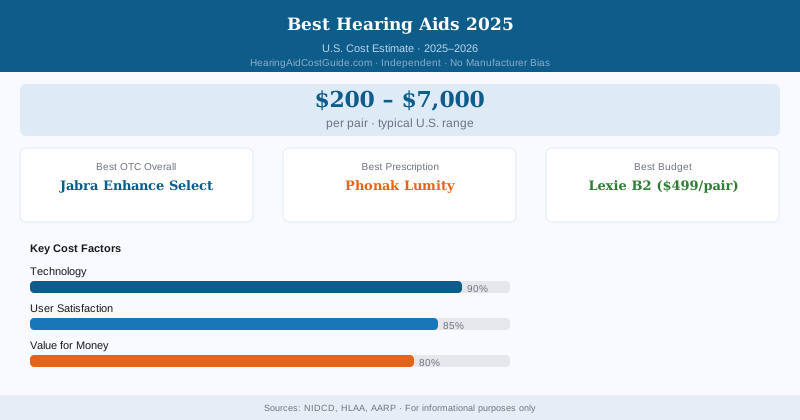
There’s no single best hearing aid. A 45-year-old who needs to follow conversations in loud restaurants has different needs than a 78-year-old with severe loss who wants to hear her grandchildren on speakerphone. The device that wins in one situation loses in another. Here’s how to cut through the brand marketing and match the device to the actual hearing picture.
Best Hearing Aids 2025: Top Picks by Category
| Category | Best Pick | Price (Per Pair) | Why It Wins |
|---|---|---|---|
| Best overall value | Costco Kirkland Signature 10.0 | $1,499 | Premium tech at discount price + 3-yr service |
| Best OTC overall | Jabra Enhance Select 300 | $1,099 | GN tech, Bluetooth, 100-day trial |
| Best invisible | Eargo 7 | $1,599 | Most comfortable canal design, OTC |
| Best for severe loss | Phonak Audéo Lumity 90 | $6,500 | World-class noise, widest fitting range |
| Best for iPhone users | ReSound Nexia 9 | $6,200 | Best iOS+Android simultaneous support |
| Best for music | Widex Moment Sheer 440 | $6,400 | Lowest processing delay in class |
| Best rechargeable OTC | Sony CRE-E10 | $1,299 | IP58 waterproof, Made for iPhone |
| Best for tinnitus | Widex Moment w/ Zen | $5,500–$6,400 | Fractal tinnitus therapy |
| Best for budget | Lexie Lumen | $599 | Audiologist coaching, rechargeable |
| Best for veterans | VA-supplied Phonak/Starkey | $0 | Prescription premium, no cost |
1. Best Overall Value: Costco Kirkland Signature 10.0 ($1,499/pair)
The Kirkland Signature 10.0 is the hearing aid industry’s most important value story. Manufactured by Sonova — the same parent company as Phonak — it uses platform technology derived from Phonak’s Audéo Lumity at roughly a quarter of what you’d pay at a private clinic. The three-year service period bundled into that $1,499 covers adjustments, repairs, and follow-up visits.
It’s not flawless: you work with a hearing instrument specialist rather than a doctoral audiologist, and Costco’s geographic footprint means it’s not accessible to everyone. But for the majority of adults with mild-to-severe hearing loss who live near a Costco Hearing Center, this is the recommendation.
The catch: Requires a Costco membership ($65–$130/year). If there’s no location near you, this option doesn’t exist.
2. Best OTC Hearing Aid: Jabra Enhance Select 300 ($1,099/pair)
Three years into the OTC market, Jabra Enhance Select 300 still leads the pack. GN Hearing’s decades of professional-grade development are visible in the automatic environment classification — the way the aids detect when you’re in a restaurant versus a quiet room and adjust accordingly without any input from you. The bilateral coordination between the two aids also outperforms most OTC competitors.
The 100-day trial from jabra.com is the best in the industry. No other OTC brand comes close. Buying from Amazon gets you 30 days — if you’re serious about this device, buy direct.
Who it’s for: Adults with mild-to-moderate bilateral hearing loss who are comfortable managing devices via smartphone app and want to avoid the clinical environment.
3. Best for Severe-to-Profound Loss: Phonak Audéo Lumity 90 ($6,500/pair)
For severe-to-profound loss, Phonak sets the standard. AutoSense 5.0 identifies over 200 acoustic environments in real time. The Roger wireless microphone system — which pairs with the Lumity line — is the most capable remote microphone ecosystem in the industry for challenging listening situations: classrooms, boardrooms, noisy restaurants.
This is a device that requires professional fitting from an audiologist experienced with complex audiograms. It’s not a Costco or OTC situation.
Who it’s for: Adults with severe-to-profound sensorineural loss who need maximum performance in demanding environments.
Independent audiologist data from real-ear measurement studies consistently shows that: fitting quality trumps device quality. A mid-tier hearing aid, properly fitted with real-ear measurement by a skilled audiologist, outperforms a premium hearing aid fitted without REM by an inexperienced dispenser.
The best hearing aid in the world, improperly fitted, will sound worse than a mid-tier device properly fitted. Before selecting the most expensive option, confirm your audiologist uses real-ear measurement as standard practice.
4. Best for Bluetooth and Connectivity: ReSound Nexia 9 ($6,200/pair)
ReSound pioneered Made for iPhone connectivity, and their Nexia line now handles both iOS and Android simultaneously — a genuine competitive advantage. The ReSound Smart 3D app offers the most detailed user-accessible fine-tuning of any premium platform.
Who it’s for: Tech-forward users who stream from both Apple and Android, or anyone who wants granular control over their own sound settings without waiting for a clinic appointment.
5. Best for Music: Widex Moment Sheer 440 ($6,400/pair)
Hearing aids process sound. All that processing introduces delay — typically 5–10ms for most devices. Widex’s Pure Sound mode runs at 0.5ms. For most people, that difference is invisible. For musicians, performers, and people for whom sound quality is a primary priority, it’s the difference between tolerable and excellent.
The SoundRelax tinnitus feature — based on the Zen fractal tones Widex developed specifically for tinnitus management — also makes this the most credible prescription option for users who need both amplification and tinnitus relief.
Who it’s for: Musicians, performers, audiophiles with hearing loss; anyone whose primary complaint is that hearing aids sound processed and artificial.
6. Best Health Tracking: Starkey Genesis AI ($6,200/pair)
Starkey’s Genesis AI platform includes fall detection, activity tracking, language translation, and health sensing — none of which are available on competing platforms at the same level. If wearing a fitness tracker and a hearing aid separately feels redundant, this is the device that collapses both into one.
Who it’s for: Active users who want hearing plus health monitoring; situations where fall detection alerts for family members are important.
7. Best Invisible OTC: Eargo 7 ($1,599/pair)
Among OTC options, Eargo leads on invisibility and comfort. Their floating bud design with petal-tip holder sits completely in the canal without a behind-ear component, and it addresses the occlusion problem more effectively than most dome-based alternatives.
Who it’s for: OTC buyers for whom invisibility is the top priority; adults with mild-to-moderate high-frequency loss who won’t tolerate anything visible.
Hearing aid brand rankings and “best of” lists change with each model generation — typically every 1–2 years. The recommendations above reflect 2025 platform performance. Always verify current model generation and pricing directly with the manufacturer or audiologist before purchasing, as new models or updated pricing may have been released since this guide was written.
How to Actually Choose: 5 Steps
Here’s a protocol that works for most adults with hearing loss:
Step 1: Get your audiogram. You can’t choose correctly without knowing your degree, type, and configuration of hearing loss. OTC aids are FDA-approved for mild-to-moderate loss — roughly up to 55 dB average thresholds. Beyond that, you need professional fitting.
Step 2: Know your channel. VA-eligible (free)? Medicaid (covered)? Medicare Advantage with hearing benefit? Costco member? Comfortable going OTC? Each channel has a different cost structure and product selection. Match your channel to your situation before falling in love with a brand.
Step 3: Rank your lifestyle priorities. Loud restaurant performance, Bluetooth streaming, phone clarity, TV, music quality, tinnitus management — different platforms genuinely excel in different areas. This ranking changes which premium device makes sense.
Step 4: Insist on real-ear measurement. Whichever device you choose, confirm your audiologist verifies the fitting with real-ear measurement (REM). According to data from the American Academy of Audiology, REM is the single strongest predictor of hearing aid outcome — stronger than brand or model. Clinics that skip it are taking shortcuts.
Step 5: Take the trial period seriously. Wear the aids every day for 4–6 weeks in your real environments before making a final judgment. Make at least two adjustment appointments. People who evaluate at two weeks are evaluating too early — the brain is still adjusting.
The Bottom Line
The NIDCD estimates 28.8 million U.S. adults could benefit from hearing aids. Most don’t need to spend $6,000 to hear well. The Kirkland at $1,499 or the Jabra Enhance 300 at $1,099 deliver genuinely excellent performance for most adults with mild-to-moderate loss. The $5,000–$7,000 tier provides real advantages — superior noise processing, broader fitting ranges, more sophisticated accessory ecosystems — but only for the user profile that actually needs them. Know your audiogram, know your options, and spend at the level your hearing loss actually requires.