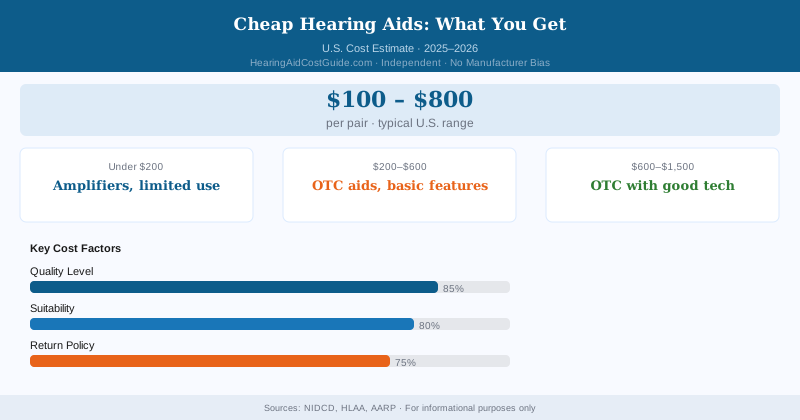
The $200 OTC device vs. the $6,000 prescription aid. It’s the loudest debate in hearing care — and honestly, a fair one. A modern smartphone packs more computing power than a hearing aid and costs $800. So why do prescription aids cost $4,000–$7,000 a pair?
The short answer: much of that cost is professional services, audiologist markup, and premium noise-processing technology. The good news is that FDA OTC rules — in effect since 2022 — opened the door to genuinely functional hearing aids under $500. The bad news is that not all of them work as advertised. Here’s what the sub-$500 market actually delivers in 2025.
Hearing Aids Under $500: What’s Available
| Product | Price (Per Pair) | Type | FDA Status |
|---|---|---|---|
| Audien Atom | $249 | OTC hearing aid | Registered |
| Audien Atom Pro | $349 | OTC hearing aid | Registered |
| Lucid Audio SERENITY | $399 | OTC hearing aid | Registered |
| MDHearing VOLT | $399 | OTC hearing aid | Registered |
| Sony CRE-E10 (sale prices) | $499–$999 | OTC hearing aid | Registered |
| Nuheara IQbuds2 | $399 | OTC hearing aid/hearable | Registered |
| Generic Amazon amplifiers | $15–$100 | PSAP (NOT hearing aids) | NOT hearing aids |
What You Get for Under $500
At this price point, you’re getting:
- Basic amplification across speech frequencies
- Limited or no directional microphone processing — aids amplify all directions equally
- Basic or no Bluetooth — most devices under $500 lack Bluetooth audio streaming
- Fixed programs — limited ability to customize via app
- Disposable batteries in most models
- Adequate but not excellent noise suppression
For quiet, one-on-one conversations and TV watching in quiet environments, budget hearing aids often work reasonably well. In noisy restaurants, group settings, or situations requiring directional hearing, performance drops off noticeably.
Audien Atom: The Best-Known Budget Option
The Audien Atom ($249/pair) has sold over a million units with thousands of Amazon reviews. It’s a simple ITE (in-the-ear) device that amplifies speech frequencies with preset programs.
Honest assessment: great for mild hearing loss in quiet environments. It struggles with background noise, has limited programming options, no app, no Bluetooth, no rechargeable option at the base price. The $349 Atom Pro adds rechargeability if that matters to you.
MDHearing: OTC at Mid-Budget with Audiologist Support
MDHearing sells OTC devices ($299–$799) and includes optional teleaudiology support through online audiologists. Their VOLT model ($399) is a rechargeable RIC-style device with limited Bluetooth. MDHearing’s hybrid approach — affordable device with some professional access — is a reasonable middle ground when you want a bit of guidance without paying full prescription prices.
Consider a hearing aid under $500 if:
- You’ve had a recent audiogram confirming mild, symmetrical hearing loss
- Your main issue is TV volume and quiet conversations
- You’re trying hearing aids for the first time and want to gauge benefit before investing more
- Cost is genuinely prohibitive for better options
Consider spending more if:
- You have moderate-to-severe loss
- You’re often in noisy environments
- Hearing aids are important for work or social participation
- You’ve had poor results with budget devices before
The $15–$100 “Hearing Aids” on Amazon: Avoid
Many Amazon listings in this range are PSAPs — Personal Sound Amplification Products — basically electronic volume knobs for the ear. They’re not hearing aids, and they shouldn’t be treated as such. PSAPs:
- Are NOT FDA-registered as hearing aids
- Amplify all sounds indiscriminately, including distorting background noise
- Have no frequency-specific processing
- Are NOT eligible for HSA/FSA reimbursement
- May actually worsen outcomes by delivering excessive amplification to frequencies you don’t need
If the price is under $200, there’s a high probability you’re looking at a PSAP. Check the product listing for “FDA-registered OTC hearing aid” language — that phrase matters legally.
OTC Hearing Aids $500–$1,000: The Better Budget Sweet Spot
The HLAA (Hearing Loss Association of America) estimates that only 1 in 5 people who need hearing aids actually use them — cost is the most commonly cited reason. The $500–$1,000 range is where OTC devices start adding features that make a real functional difference without hitting prescription-aid prices:
- Jabra Enhance Select 200 ($799): App-based self-fitting, Bluetooth streaming, basic noise management
- Lexie Lumen ($599): Rechargeable, app-based, audiologist coaching access available as add-on
- Sony CRE-20 ($999): Invisible design, app-based, FDA-registered
For most buyers, the jump from $399 to $799 buys features that meaningfully improve daily hearing performance. It’s worth the extra $400 if you can swing it.
If you buy cheap hearing aids and don’t see much improvement, don’t write off hearing aids entirely. Budget devices have genuine technological limitations. The issue may be the device tier, not the concept. Before concluding that hearing aids don’t work for you, try a better-quality device during a trial period — or get a professional fitting evaluation to understand what you actually need.
Hearing Aid Assistance Programs: Better Aids at No Cost
Before you settle for a $300 OTC device, check whether you qualify for free or heavily subsidized devices through programs you may not know exist:
- VA benefits (veterans — this one is substantial; the VA is the world’s largest hearing aid dispenser)
- Medicaid (income-qualifying adults and children)
- State vocational rehabilitation
- Starkey Hearing Foundation
- Lions Club hearing aid programs
- HLAA local chapter assistance funds
In many cases, qualifying for an assistance program means getting a mid-tier prescription device professionally fitted — far better than a $300 OTC device, at no cost to you.