Picture a 2-year-old who hasn’t spoken a word yet. Her parents have been told she has moderate hearing loss since the newborn screen, but the family’s insurance plan doesn’t cover hearing aids. Without amplification during this critical window, every month that passes is language development that doesn’t happen — and can’t fully be recovered later.
This scenario plays out thousands of times a year across the US. But here’s what many families don’t know: children have dramatically better hearing aid coverage than adults do. Between Medicaid, CHIP, and state mandate laws, most kids in this country qualify for coverage that adults can’t access. The device costs are real, but they’re largely solvable.
Pediatric Hearing Aid Costs
| Type | Cost Per Pair | Notes |
|---|---|---|
| Entry prescription (pediatric BTE) | $2,500–$3,500 | Typical for mild-moderate loss |
| Mid-tier prescription (RIC/BTE) | $3,500–$5,000 | Moderate-severe |
| Premium prescription | $4,500–$6,500 | Severe-profound, high-tech features |
| FM system add-on (for classroom) | $1,000–$3,000 | For educational use |
| Bone-anchored hearing aid (BAHA) | $5,000–$15,000 system | Conductive or SSD |
| Cochlear implant | $50,000–$100,000+ | Severe-profound loss |
Who Pays for Children’s Hearing Aids?
The NIDCD (National Institute on Deafness and Other Communication Disorders) estimates that about 2–3 per 1,000 newborns are identified with hearing loss through newborn screening. Those numbers climb as children age — roughly 15% of school-age children have some degree of hearing difficulty. That’s a lot of families navigating this question. Here’s how coverage actually breaks down:
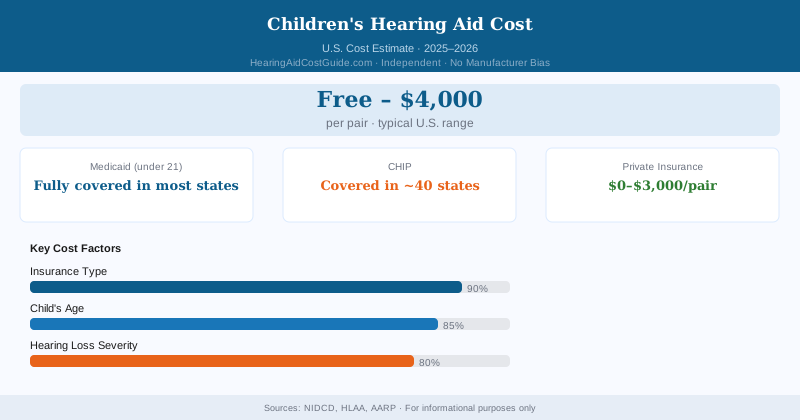
Medicaid (EPSDT): All states are required to cover hearing aids for children under 21 under the federal EPSDT mandate. Coverage includes both hearing aids, fitting, earmolds, batteries, and follow-up. This is the most important pathway for eligible families — it’s federal law, not optional.
CHIP: The Children’s Health Insurance Program covers hearing aids for income-qualifying children whose families earn too much for Medicaid. Both programs require that hearing aids be medically necessary, which for a child with documented hearing loss is essentially automatic.
Private insurance (state mandates): Over 25 states require private insurance plans to cover hearing aids for children. Coverage limits typically range from $1,000–$3,000 per ear every 2–3 years — not full coverage, but it significantly reduces out-of-pocket costs.
State programs: Many states run dedicated hearing aid programs for children, often funded by state EHDI (Early Hearing Detection and Intervention) programs. Your state health department is the right first call.
What Makes Pediatric Fitting Different
This is not an area where any audiologist will do. Children’s hearing aid fittings require specialized expertise — pediatric audiology is its own subspecialty for good reason.
Age-appropriate audiometry: A toddler can’t raise a hand when they hear a beep. Pediatric audiologists use testing methods calibrated to developmental age:
- ABR (Auditory Brainstem Response): Electrophysiological test for newborns, performed while the baby sleeps
- Visual reinforcement audiometry (VRA): For children 6 months–2 years — the child looks toward an animated toy when they hear a sound
- Play audiometry: For children 2–5 — drop a block in a bucket when you hear the tone
- Conventional audiometry: For children 5 and up, same as adult testing
RECD measurements: Children’s ear canals are physically smaller than adults’. Sound levels reaching the eardrum differ substantially from what the hearing aid is programmed to deliver. Pediatric audiologists take real-ear-to-coupler difference measurements to ensure hearing aids hit the correct target for each child’s specific ear canal size.
DSL targets: The Desired Sensation Level prescription protocol is specifically designed for children and sets different gain targets than adult prescriptions. A hearing aid fit with adult targets on a child’s ear is not optimally fit.
A child’s ear canal grows rapidly. A hearing aid earmold must fit the ear canal precisely — too loose means feedback (whistling); the wrong size means poor sound quality. For children under age 3, earmolds may need replacement every 3–6 months. From ages 3–8, every 6–12 months. From age 8 onward, approximately annually.
Earmold replacement cost: $50–$150 per mold. Medicaid and most children’s insurance covers earmold replacement — confirm this with your audiologist’s billing staff.
FM Systems and Classroom Technology
A classroom is acoustically brutal for a child with hearing loss. Background noise, distance from the teacher, echo, competing voices — hearing aids alone often aren’t enough. FM (frequency modulation) or Roger wireless microphone systems transmit the teacher’s voice directly to the hearing aid, cutting through classroom noise.
FM/Roger system costs:
- Roger Pen/Roger Table Mic (Phonak): $600–$1,200 each
- Roger On system: $900–$1,400
- FM transmitter-receiver system (generic): $500–$1,200
Here’s the thing most families don’t know: under IDEA (Individuals with Disabilities Education Act), schools are required to provide appropriate assistive listening devices for children with documented hearing loss when included in their IEP. The school district pays — not the family. If your child has an IEP and uses hearing aids, request a discussion about FM equipment at the next meeting.
Cochlear Implants for Children
For children with severe-to-profound hearing loss who don’t get adequate benefit from hearing aids, cochlear implants are FDA-approved from age 9–12 months. Earlier implantation — especially before 12 months — consistently shows better language outcomes in research than implantation at age 2 or later. The NIDCD notes that children implanted earlier achieve closer-to-typical language milestones.
Cochlear implants for children are covered by Medicaid and most private insurance. See our cochlear implant insurance coverage guide for details.
Never use OTC hearing aids for children. The FDA expressly prohibits OTC hearing aid sales for people under 18. Children’s hearing aids require professional audiological evaluation, fitting with pediatric-specific protocols (RECD, DSL targets), and ongoing audiological monitoring as the child develops. OTC devices are designed for self-fitting adults — they’re simply not appropriate here, regardless of price.
Finding a Pediatric Audiologist
Pediatric audiologists typically work at:
- Children’s hospitals
- Academic medical center audiology departments
- Early intervention programs (for children 0–3 years)
- School-based audiology services (limited scope)
The American Academy of Audiology (audiology.org) and American Speech-Language-Hearing Association (asha.org) maintain provider directories. When you call, specifically ask for audiologists who specialize in pediatric fitting — not all audiologists have this training.