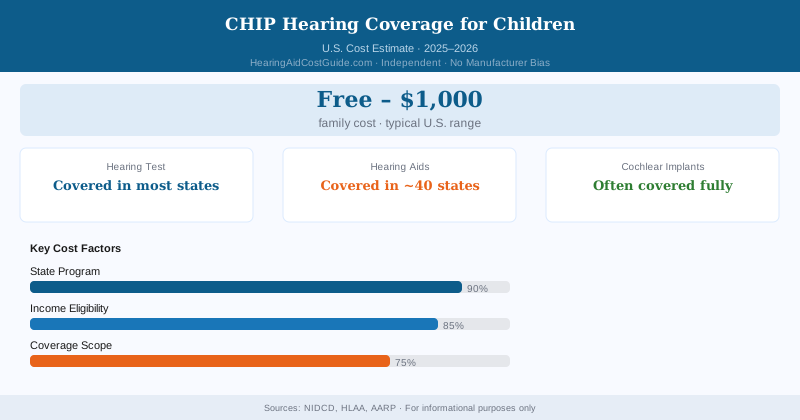
Most parents are shocked to discover this: private insurance often won’t cover a child’s hearing aids, but CHIP — the Children’s Health Insurance Program — does. Comprehensively. The NIDCD estimates that 2–3 of every 1,000 newborns are identified with hearing loss through hospital screening. CHIP exists precisely to make sure those children get the care they need, regardless of what their family’s private plan does or doesn’t cover.
Here’s exactly what CHIP pays for, how eligibility works, and what to do next if your child has hearing loss.
What CHIP Hearing Coverage Includes
| Service | CHIP Coverage |
|---|---|
| Newborn hearing screening | Included (also covered under birth care) |
| Audiological evaluation | Yes — comprehensive |
| Hearing aids (both ears when indicated) | Yes |
| Earmold replacement (as child grows) | Yes |
| Cochlear implant evaluation | Yes |
| Cochlear implant surgery and device | Yes |
| BAHA (bone-anchored hearing aid) | Yes |
| Hearing aid fittings and adjustments | Yes |
| Auditory rehabilitation/speech therapy | Yes |
| Hearing aid batteries | Yes (most states) |
CHIP vs. Medicaid for Children’s Hearing Care
CHIP and Medicaid serve different income bands but both mandate comprehensive pediatric hearing coverage.
Medicaid (EPSDT): Serves families at 0–138% federal poverty level (FPL). Coverage is mandatory and comprehensive by federal law — states don’t get to opt out of this one.
CHIP: Serves families at 138–300% FPL — higher in some states, up to 400% FPL in California. Coverage is also comprehensive under the CHIPRA minimum package, which specifically includes hearing services.
The coverage content is essentially identical between the two programs. The only difference is income eligibility. If you’re not sure which one applies to your family, it doesn’t matter much — apply and let the system sort it out.
Income Eligibility (2025)
CHIP income limits vary by state. As a rough guide for a family of 4:
- Federal poverty level: ~$31,200/year
- Medicaid-eligible: Below ~$43,000/year (138% FPL)
- CHIP-eligible: $43,000–$93,600/year (138–300% FPL) in most states
Higher limits apply in many states — and eligibility rules shift periodically. Use the Healthcare.gov eligibility screener or your state’s CHIP website to get an accurate answer for your situation.
How to Get Hearing Aids Through CHIP
Step 1: Enroll in CHIP. Apply through HealthCare.gov, your state Medicaid/CHIP office, or call 1-877-KIDS-NOW. Applications are accepted year-round — there’s no open enrollment period for CHIP.
Step 2: Find a CHIP-participating audiologist. Your state CHIP office has a provider directory. Children’s hospitals and pediatric audiology centers typically accept CHIP.
Step 3: Schedule an audiological evaluation. The audiologist performs a comprehensive evaluation appropriate to your child’s age — ABR for infants, behavioral audiometry for older kids.
Step 4: Prior authorization if required. Most CHIP programs require prior authorization for hearing aids. The audiologist handles the documentation; allow 2–4 weeks for the review process.
Step 5: Fitting and follow-up. Hearing aids are fitted by the pediatric audiologist, with regular follow-up for earmold replacement, reprogramming, and monitoring as your child grows.
Children’s ear canals grow rapidly. A hearing aid earmold that fit a 2-year-old won’t fit a 3-year-old. Ill-fitting earmolds cause feedback (that whistling sound), reduce sound quality, and can cause ear discomfort. CHIP covers regular earmold remakes — typically every 6–12 months for young children. Don’t skip these appointments; a poorly fitting earmold undermines everything the hearing aid is supposed to do.
CHIP and Cochlear Implants for Children
CHIP covers cochlear implant surgery and devices for children who meet candidacy criteria. According to the HLAA (Hearing Loss Association of America), cochlear implants are among the most effective medical interventions for severe-to-profound hearing loss in children — and CHIP makes this coverage accessible to families who couldn’t otherwise afford a $75,000+ procedure. Coverage includes:
- Pre-implant evaluation (audiological, medical, speech-language)
- Surgery and implant device
- Post-surgical mapping and auditory rehabilitation
- External processor upgrades (varies by state plan — confirm with your plan)
For families considering cochlear implants, CHIP eligibility can make this genuinely transformative technology financially accessible. Contact your state CHIP office and a pediatric cochlear implant center to start the evaluation.
State Variation in CHIP Benefits
Federal law sets minimum hearing coverage standards, but states have flexibility in how they structure their benefit packages. Most states cover:
- Both hearing aids (not just one)
- Premium or appropriately high-quality devices for the child’s specific type and degree of loss
- Annual audiological monitoring
- Accessories needed for school (FM system, hearing loop compatibility)
A small number of states have somewhat more limited coverage or require additional prior authorization steps for specific device tiers. Your state’s CHIP handbook — or a quick call to member services — will clarify what’s included.
School districts have separate obligations for children with hearing loss under IDEA (Individuals with Disabilities Education Act). Your child may be entitled to hearing assistive technology — FM systems, soundfield amplification — in the classroom, funded by the school district. This is separate from CHIP hearing aid benefits. Request an IEP evaluation from your school district’s special education coordinator if your child has documented hearing loss. You’re entitled to it.
Resources for Families
- Alexander Graham Bell Association (agbell.org): Financial assistance and educational resources
- Hands & Voices (handsandvoices.org): Family-to-family support for children with hearing loss
- BEGINNINGS for Parents of Children Who Are Deaf or Hard of Hearing: State-specific support organizations
- American Academy of Audiology (audiology.org): Provider directory and patient resources
- HLAA (hearingloss.org): Advocacy and resource directory