Most people assume cochlear implants are only for children born deaf. Wrong. The NIDCD reports that approximately 90,000 Americans currently use cochlear implants — and adults with progressive hearing loss, especially those who aren’t getting enough benefit from hearing aids, represent a growing share of new candidates. If you or someone you love has been told hearing aids “aren’t enough anymore,” a cochlear implant evaluation is the logical next step. Here’s what that evaluation costs and what it involves.
Cochlear Implant Candidacy Evaluation Cost by Component
| Evaluation Component | Typical Cost (No Insurance) |
|---|---|
| Audiological evaluation (comprehensive) | $200–$500 |
| Aided speech perception testing | $150–$350 |
| Medical evaluation (otolaryngologist) | $300–$600 |
| CT scan of temporal bones | $500–$1,500 |
| MRI of the inner ear and auditory nerve | $800–$2,000 |
| Psychological/cognitive assessment (if required) | $300–$800 |
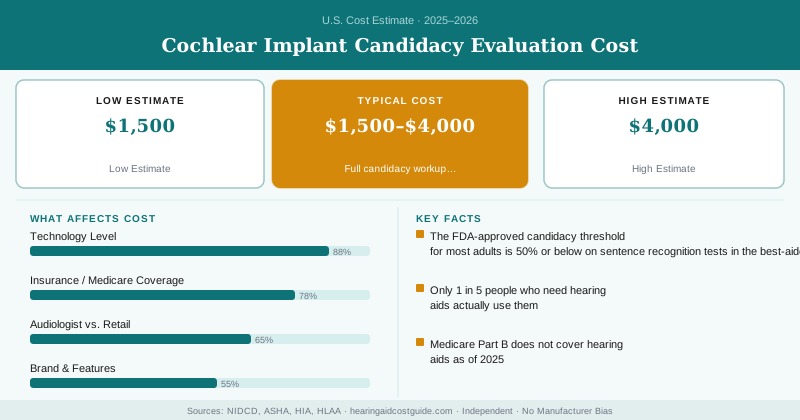
| Full candidacy workup (all components) | $1,500–$4,000 |
What the Evaluation Actually Tests
A cochlear implant candidacy workup isn’t a single appointment. It’s a coordinated series of evaluations, typically spread across two to four visits at a cochlear implant center, that answer one core question: will a cochlear implant give you meaningfully better speech understanding than you’re getting now?
Audiological testing is the foundation. Your audiologist will perform a comprehensive audiogram and, critically, aided speech perception tests — meaning you’re tested while wearing your best-fit hearing aids, not in silence. The FDA-approved candidacy threshold for most adults is 50% or below on sentence recognition tests in the best-aided condition. If you’re scoring below that, you’re likely a candidate.
Medical evaluation with an otolaryngologist (ENT) or neurotologist reviews your overall health, your history of ear disease, and whether there are anatomical or medical reasons a cochlear implant might not be suitable for you.
Imaging is non-negotiable. A CT scan of the temporal bones maps the bony anatomy of your cochlea — essential for surgical planning. An MRI may also be ordered to evaluate the auditory nerve and rule out acoustic neuroma or other structural issues. These imaging studies account for a large portion of the evaluation cost: $500–$2,000 each, depending on your facility.
Current FDA guidelines for adult cochlear implant candidacy:
- Severe-to-profound sensorineural hearing loss in both ears
- Sentence recognition score of 50% or lower (best-aided condition)
- Limited benefit from appropriately fit hearing aids
- No medical contraindications to surgery
- Realistic expectations about outcomes
Some cochlear implant centers now evaluate candidates with moderate-to-severe loss in the high frequencies — criteria continue to evolve as outcomes data improves.
Does Insurance Cover the Candidacy Evaluation?
Yes — more than most people expect. Medicare Part A and Part B cover cochlear implant candidacy evaluations and the surgery itself when medical necessity criteria are met. The audiological testing is covered under Part B; the medical evaluation and imaging fall under standard diagnostic coverage. You’ll typically owe your Part B deductible and 20% coinsurance — not the full $1,500–$4,000 sticker price.
Medicaid coverage varies by state but includes cochlear implants in most states. Private insurance is generally required by the ACA to cover cochlear implants for covered members, though prior authorization is almost always required. ASHA data confirms that cochlear implants have among the highest insurance coverage rates of any hearing technology precisely because outcomes evidence is so strong.
Where to Get the Evaluation Done
Cochlear implant evaluations are conducted at specialized cochlear implant centers — typically affiliated with university medical centers, major hospital systems, or large ENT practices with dedicated implant programs. Not every audiologist can perform this evaluation; you need a center that handles the full multidisciplinary workup.
Your audiologist or ENT can refer you. You can also use the cochlear implant manufacturer directories — Advanced Bionics, Cochlear Americas, and MED-EL all maintain searchable lists of certified centers.
How Long Does the Evaluation Take?
Plan for four to eight weeks from first appointment to final determination, including:
- Initial audiology visit (1–2 hours)
- ENT or neurotologist consult (45–90 minutes)
- Imaging appointments (CT and/or MRI)
- Team conference (your results are reviewed internally)
- Results/candidacy meeting with your care team
Some centers compress this into fewer visits. If you’re at a high-volume academic center, the process is often faster and more streamlined than at a smaller program.
Don’t delay the evaluation if your hearing aids have stopped working well for you. Cochlear implant outcomes are better when the auditory nerve remains active from regular sound stimulation. Extended periods of severe unaided hearing — particularly in one ear — can reduce the auditory nerve’s responsiveness. If you’re considering a cochlear implant, sooner is better than later.
After the Evaluation: What Comes Next
If you’re deemed a candidate, cochlear implant surgery itself is a separate cost — typically $30,000–$50,000 total including surgery, anesthesia, device, and initial programming, though Medicare and most insurers cover the large majority of that after deductibles and coinsurance. The evaluation is just the gate.
If you’re not a candidate yet — perhaps because your aided speech scores are still above the threshold — the team will usually recommend more aggressive hearing aid optimization and re-evaluation in 12–24 months. That’s not a no. It’s a “not yet.”
For the roughly 90,000 Americans already using cochlear implants, the candidacy evaluation was the moment that opened the door. If you’ve been told you’re getting limited benefit from your hearing aids, it’s worth walking through it.