More than 750,000 people worldwide are living with cochlear implants. Many of them spent years turning up their hearing aids, watching TV with subtitles, dropping out of group conversations — before they found out they qualified for a device that bypassed the problem entirely.
The word “implant” stops a lot of people cold. It sounds like major surgery, like something irreversible, like something only done for children born deaf. None of that is the whole picture. Here’s what cochlear implants actually are, who they help, and what the process looks like from evaluation through activation.
A Cochlear Implant Is Not a Hearing Aid
This distinction matters more than any other when someone is considering one.
A hearing aid amplifies sound and delivers it through the outer and middle ear to the cochlea. It depends on surviving cochlear hair cells to convert that amplified sound into an electrical signal. When too many hair cells are gone, even a powerful hearing aid can’t help — there’s not enough functional tissue left to receive the signal.
A cochlear implant skips the hair cells entirely. An electrode array is threaded surgically into the cochlea. The electrodes directly stimulate the auditory nerve with electrical pulses. The brain receives signals from the nerve without hair cells in the loop at all.
The sound quality is different — more processed, sometimes described as robotic in the early weeks after activation. But the brain adapts. Most people who received implants after learning language (post-lingual loss) achieve good speech understanding in quiet within a few months. The brain is remarkably good at learning to interpret the new signal.
How the System Works
A cochlear implant system has two parts:
The internal implant — placed surgically. Includes a receiver/stimulator under the skin behind the ear and an electrode array threaded into the cochlea. This part stays in permanently (or until an upgrade procedure is done).
The external processor — worn behind the ear, resembles a hearing aid. It contains a microphone, a sound processor (essentially a powerful computer), and a transmitter coil. The coil communicates wirelessly with the internal receiver through the skin via magnetic induction. No wires penetrate the skin.
The external processor does the heavy lifting: it captures sound, converts it to a coded signal, and transmits that signal through the skin to the internal implant, which then delivers the appropriate pattern of electrical pulses to the electrode array.
Processors can be upgraded when technology improves — often without surgery, since the internal implant doesn’t change.
Who Qualifies
Qualification criteria have evolved significantly. The FDA currently approves cochlear implants for:
Adults: Severe to profound sensorineural hearing loss in both ears, AND limited benefit from appropriately fitted hearing aids (typically defined as scoring 50% or below on sentence recognition tests in the better-aided ear).
Children: Profound bilateral sensorineural hearing loss at 12 months of age, or severe-to-profound loss at 24 months, when limited benefit from hearing aids is demonstrated.
In practice, audiologists are increasingly advocating for earlier consideration of cochlear implants — particularly in older adults who are slowly losing ground with hearing aids. If you’re consistently scoring below 50% on word recognition tests even with well-fitted premium hearing aids, a cochlear implant evaluation is worth pursuing.
Bilateral implantation — implants in both ears — is increasingly offered and covered. Research shows bilateral users outperform unilateral users in noise and have better sound localization. Some insurance plans still limit coverage to one implant at a time.
Two groups who frequently meet candidacy criteria but aren’t referred:
Older adults with progressive hearing loss. Many audiologists continue fitting progressively more powerful hearing aids as word recognition scores decline — even when those scores drop into cochlear implant candidacy range. If you’ve been in hearing aids for years and feel like they’re helping less and less, ask specifically for word recognition score testing with your current aids and ask your audiologist if cochlear implant candidacy evaluation makes sense.
People with single-sided deafness. The FDA approved cochlear implants for single-sided deafness in 2019. If you’ve lost hearing in one ear and CROS aids or bone-anchored devices haven’t been satisfactory, ask whether cochlear implant candidacy evaluation is appropriate.
The Evaluation Process
Before surgery, you’ll undergo a thorough evaluation:
- Complete audiological evaluation with aided and unaided testing
- CT scan or MRI of the temporal bone to assess cochlear anatomy
- Medical history review and surgical clearance
- Often: a visit with a surgeon (otologist or neurotologist) who performs the implantation
- In some centers: psychological or counseling assessment, especially for adults who lost hearing post-lingually (after learning language)
The evaluation team typically includes an audiologist, a surgeon, and sometimes a speech-language pathologist. Expect this process to take several months between the initial referral and surgery date.
The Surgery
Cochlear implant surgery is performed under general anesthesia and takes approximately 1–2 hours. The procedure:
- A small incision is made behind the ear
- The surgeon drills into the mastoid bone to access the middle ear
- A small opening (cochleostomy) is made in the cochlea
- The electrode array is carefully threaded into the cochlea
- The internal receiver is seated in a small recess drilled in the skull bone
- The incision is closed; no external sutures are typically visible
Most adults have the procedure as outpatient surgery or with one overnight hospital stay. Recovery is typically a few days of rest, with most patients resuming normal activities within a week. The implant is not activated at surgery — you go home in silence or using your old hearing aid in the unoperated ear.
Activation: Three to Four Weeks Later
About 3–4 weeks after surgery, the external processor is fitted and activated. The audiologist programs the device — setting the stimulation levels for each electrode — in a process called “mapping.”
The first activation is a striking moment for most patients. For some, speech is immediately intelligible. For others, it sounds like beeping, static, or distorted noise. Neither reaction predicts long-term outcome. The brain needs weeks to months to interpret the new electrical signal as meaningful sound.
What to expect in the months after activation:
- Processor mapping appointments every few weeks initially, then every few months
- Gradual improvement in speech understanding as the auditory system adapts
- Speech and listening rehabilitation, sometimes with a speech-language pathologist
- Music and environmental sounds may sound distorted or unpleasant at first and usually improve with time
Most adults who lost hearing after learning language achieve good open-set speech understanding within 3–6 months. Outcomes vary — some users reach near-normal speech understanding in quiet, while others plateau at functional-but-limited levels.
The Cost Picture
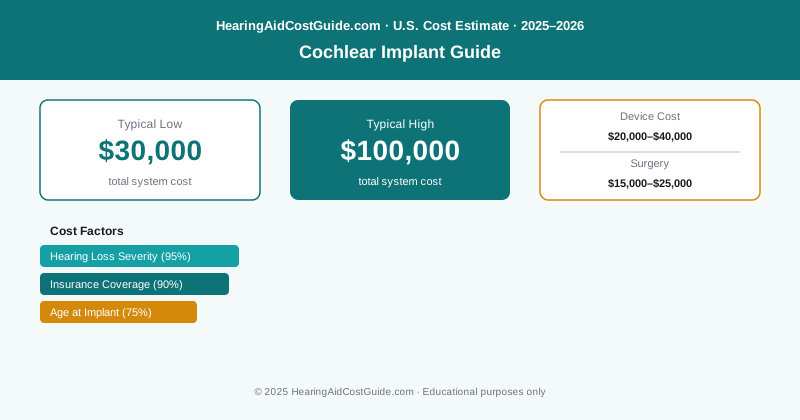
The sticker price before insurance is significant. But cochlear implants are one of the most consistently covered major procedures in all of hearing health care.
| Cost Component | Estimated Range | Notes |
|---|---|---|
| Device (implant + external processor) | $20,000–$40,000 | Brand and model dependent |
| Surgery (facility + surgeon fees) | $15,000–$25,000 | Outpatient vs inpatient affects cost |
| Pre-surgical evaluation | $1,500–$3,000 | Audiology, imaging, consultations |
| Post-surgical audiology (mapping, Year 1) | $2,000–$5,000 | Frequent appointments in first year |
| Rehabilitation (speech therapy, if needed) | $1,000–$5,000+ | Varies widely by need |
| Processor upgrade (every 5–10 years) | $5,000–$10,000 | Often partially covered |
| Total (pre-insurance estimate) | $50,000–$100,000 | Full first-year cost |
Insurance coverage: Medicare covers cochlear implants under Part A (hospital/facility) and Part B (physician and audiology services) for qualifying adults. Most commercial plans cover them as medically necessary when the candidacy criteria are met. Out-of-pocket costs under Medicare typically run $1,600–$9,000 depending on the plan year’s deductibles and coinsurance. Medicaid coverage varies by state.
All three major manufacturers — Cochlear Corporation, MED-EL, and Advanced Bionics — offer patient assistance programs that can help cover deductibles and copays for uninsured or underinsured candidates.
Cochlear Implant vs. Premium Hearing Aids: The Decision Point
| Factor | Premium Hearing Aids | Cochlear Implant |
|---|---|---|
| Best for | Mild to severe SNHL; functional aided speech understanding | Severe–profound SNHL; poor aided speech understanding |
| Cost (out of pocket) | $3,500–$7,000/pair | $1,600–$9,000 (insured) |
| Surgery required | No | Yes |
| Sound quality | Natural amplification of existing hearing | Electrical, processed sound — brain adapts |
| Upgrade path | Replace every 5–7 years | External processor upgrades; internal implant lasts decades |
| Reversibility | Fully reversible | Partially (residual natural hearing is typically lost) |
A cochlear implant usually destroys whatever residual natural hearing remains in the implanted ear. For many qualifying candidates, this is a reasonable trade — they’re gaining electrical access to sound in an ear that’s providing minimal useful hearing. But it’s an irreversible change. “Hybrid” devices (EAS — electric-acoustic stimulation) combine an electrode array with hearing aid amplification and can preserve low-frequency residual hearing in select candidates with good low-frequency thresholds. Ask your surgeon specifically about EAS eligibility if you still have any low-frequency hearing.
A cochlear implant evaluation doesn’t commit you to surgery. Going through the process gives you expert clinical opinion on whether you qualify, what outcomes are realistic for your specific hearing history, and what alternatives exist. That’s valuable information regardless of what you decide. A lot of people who’ve delayed getting evaluated say they wish they’d done it sooner — not because they necessarily needed an implant, but because they finally had a clear picture of where they actually stood.