Most people focus all their financial attention on cochlear implant surgery — the $30,000–$100,000 sticker price before insurance, the Medicare coverage question, the out-of-pocket estimate. What they underestimate is what comes after: the months of intensive programming, auditory therapy, and speech rehabilitation that determine how well you’ll ultimately hear.
Surgery gives you the hardware. Rehabilitation teaches your brain to use it. Skip the rehab, and you’ll have a $50,000 device delivering far less than it’s capable of.
What Cochlear Implant Rehabilitation Actually Involves
After your implant is activated — typically 4–6 weeks post-surgery — your brain begins the process of learning to interpret electrical signals from the cochlea as meaningful sound. This isn’t passive. It requires:
- Audiological mapping sessions — your audiologist fine-tunes the electrode stimulation levels (thresholds and comfort levels for each of 12–22 electrodes)
- Auditory-verbal therapy (AVT) — structured practice learning to recognize speech through listening alone
- Speech-language therapy — especially important if your speech production was affected by long-term hearing loss
- Self-guided home practice — listening exercises, phone calls, audiobooks, structured programs
The first 6–12 months are the most intensive and the most important. Research consistently shows that post-implant rehabilitation is one of the strongest predictors of speech understanding outcomes.
Cochlear Implant Rehabilitation Cost Breakdown
| Service | Cost Per Session | Typical Frequency (Year 1) | Estimated Year 1 Cost |
|---|---|---|---|
| Audiological mapping session | $150–$300 | 6–10 sessions | $900–$3,000 |
| Auditory-verbal therapy (AuD or SLP) | $100–$250/hr | Weekly for 3–6 months | $1,200–$6,000 |
| Speech-language therapy | $100–$200/hr | As needed | $500–$3,000 |
| Cochlear implant rehabilitation program (packaged) | $2,000–$5,000 | 3–6 month program | $2,000–$5,000 |
| Listening and Communication Enhancement (LACE) | $80 (software) | Self-paced | $80 |
| Subsequent year mapping (maintenance) | $150–$300/session | 1–3 sessions/year | $150–$900 |
Audiological Mapping: What It Is and Why You Need Multiple Sessions
Mapping (also called “programming” or “fitting”) is the process of setting the stimulation levels for each electrode in your implant. There’s no shortcut — your auditory cortex is literally learning a new sensory language, and the map needs to be adjusted as your perception changes.
In your first year, expect:
- Activation day: Initial map set conservatively
- Week 1–2: Adjustment as you report perceptions
- Month 1, 3, 6, 12: Standard check-ins
- Ad hoc: Whenever sound perception seems “off”
Six to ten mapping sessions in year one is typical. After the first year, most patients stabilize to 1–3 sessions annually. Each session runs $150–$300 at an outpatient audiology clinic.
The NIDCD notes that cochlear implant users who receive intensive post-activation auditory rehabilitation show significantly better speech recognition outcomes at 12 months than those who receive only standard programming visits.
AVT is structured listening training — not hearing tests. A therapist trained in auditory-verbal practice presents speech at varying levels, in different noise conditions, using context cues, then removes context cues. The goal is to train your brain to extract meaning from the new electrical signals without relying on lip-reading. Most CI centers recommend starting AVT within 2–4 weeks of activation. Teletherapy (video-based AVT) is widely available and can reduce costs significantly.
Does Insurance Cover Cochlear Implant Rehabilitation?
Yes — and this is one area where coverage is generally better than for hearing aids.
Medicare Part B covers cochlear implant programming/mapping as a medical service when ordered by your cochlear implant team. Standard Part B cost-sharing applies (20% after deductible). Auditory rehabilitation therapy provided by a qualified audiologist or speech-language pathologist is typically covered as well, subject to medical necessity documentation.
Commercial insurance generally covers cochlear implant programming as a medical procedure, not a “hearing service” — which matters because many plans that exclude hearing aids do cover post-cochlear implant audiological services. Speech-language therapy for CI rehabilitation is typically a covered benefit with standard cost-sharing.
Medicaid coverage varies by state. In most states, cochlear implant rehabilitation is covered for eligible beneficiaries.
Packaged vs. Pay-Per-Visit Rehabilitation
Many cochlear implant centers offer packaged rehabilitation programs — bundling mapping sessions, auditory therapy appointments, and speech therapy into a 3–6 month structured program for $2,000–$5,000. For people who prefer predictability, this can be more cost-effective than paying per visit. Ask your CI center what their program structure looks like and whether it’s included or add-on to surgery costs.
Your cochlear implant rehabilitation doesn’t end at 12 months. Most CI users continue to improve their speech perception for 2–3 years post-activation with consistent practice. Don’t treat the formal rehabilitation program as the full story. Home practice using structured listening programs, audiobooks, and challenging listening environments is free and matters significantly to your long-term outcomes.
Children vs. Adults: Why Rehab Looks Different
For adults with acquired hearing loss, the brain has a memory of sound to return to. The auditory cortex knows what speech is supposed to sound like — the implant just needs to deliver enough signal for that memory to activate. Rehabilitation for adults is intensive but typically faster.
For children, particularly those born with severe hearing loss, auditory-verbal therapy is the mechanism by which spoken language develops. AVT programs for children are more extensive, longer-duration, and may run $5,000–$15,000 per year depending on frequency and whether early intervention programs (which are often publicly funded) are involved.
The Bottom Line on Rehabilitation Costs
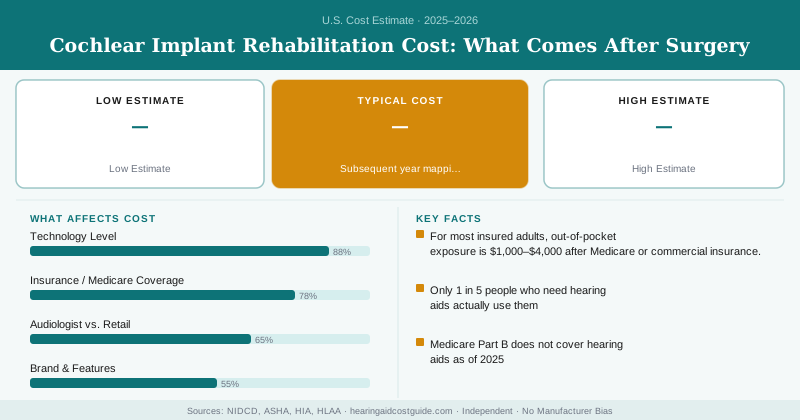
Budget $3,000–$10,000 for your first year of cochlear implant rehabilitation, depending on your therapy needs and what your insurance covers. For most insured adults, out-of-pocket exposure is $1,000–$4,000 after Medicare or commercial insurance. This is the investment that makes your implant work — don’t underestimate it, and don’t skip it.