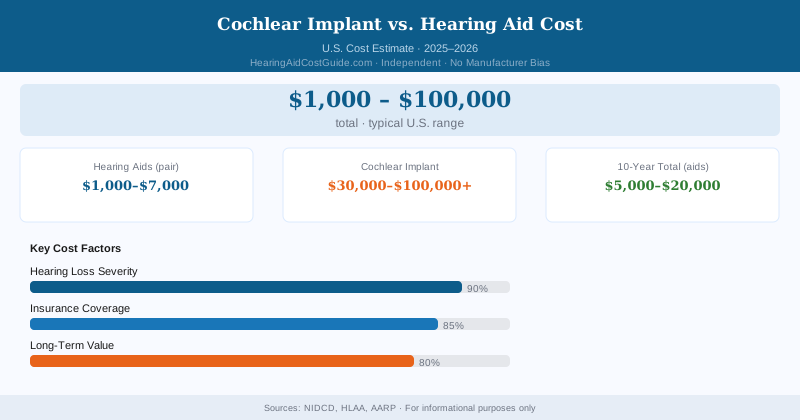
Most people assume hearing aids are the budget option and cochlear implants are the premium version of the same thing. That’s not quite right. They’re different technologies solving different problems — and for patients with severe hearing loss, a cochlear implant can actually cost less out of pocket over a lifetime than repeated hearing aid purchases. Let’s unpack both sides of the comparison.
Cost and Candidacy at a Glance
| Factor | Hearing Aid | Cochlear Implant |
|---|---|---|
| Total first-year cost | $2,000–$7,000 | $50,000–$100,000 |
| Insurance coverage | Rarely | Usually (for qualifying patients) |
| Out-of-pocket (typical, insured) | $2,000–$7,000 (not covered) | $1,600–$9,000 (OOP max) |
| Best loss range | Mild–severe | Severe–profound |
| Surgery required | No | Yes |
| Reversible | Yes | Partially (residual hearing may be lost) |
| Time to full benefit | 2–8 weeks | 6–18 months (rehabilitation required) |
| Device lifespan | 5–7 years | Internal: 15–20+ years; processor: 5–7 years |
When Hearing Aids Are Sufficient
Standard hearing aids handle a wide range of hearing loss effectively. Here’s how to think about where you fall:
- Mild hearing loss (26–40 dB HL): Well-addressed by mid-tier hearing aids at $1,500–$3,500/pair. Many people in this range also do well with OTC devices.
- Moderate hearing loss (41–55 dB HL): Good hearing aid candidates; most people achieve solid speech understanding with appropriately fitted aids.
- Moderate-to-severe loss (56–70 dB HL): High-power hearing aids can provide meaningful help, though speech understanding varies widely.
Key benchmark: if you can understand 50% or more of sentences in a quiet room with properly fitted hearing aids, you’re almost certainly in hearing aid territory.
The Candidacy Crossover Point
The NIDCD estimates there are approximately 28.8 million U.S. adults who could benefit from hearing aids, but cochlear implant candidacy is a subset of that population — specifically, those whose hearing loss has progressed to the point where aids aren’t delivering adequate speech understanding.
Cochlear implant candidacy per 2023 FDA guidelines begins when:
- Hearing loss is bilateral moderate-to-profound sensorineural
- Speech understanding with hearing aids is limited — specifically, sentence recognition in the better ear ≤40–60% in quiet conditions
- Benefits from hearing aids have plateaued
Point two is the critical one. Degree of hearing loss alone isn’t what drives candidacy — it’s functional performance with optimally fitted hearing aids. Some people with severe loss understand speech remarkably well with aids. Others with “moderate-to-severe” loss score poorly on sentence testing and are strong implant candidates. You won’t know which group you’re in until you’re tested.
The standard measure for cochlear implant candidacy is the AzBio sentence test — lists of recorded sentences played at a fixed level through a loudspeaker in a sound-treated booth. If you score ≤40–60% on AzBio sentences in your better ear with hearing aids, you formally qualify for cochlear implant candidacy evaluation at most major centers. Your audiologist can run this test as part of a standard evaluation.
The Out-of-Pocket Reality
Here’s the financial math that genuinely surprises most patients:
Hearing aids (moderate-to-severe loss): $4,500–$7,000 per pair at a private audiologist. Insurance rarely covers them — the full cost is out-of-pocket. With replacement every 5–7 years plus accessories, a 20-year total runs $18,000–$28,000+.
Cochlear implant (insured patient): Total system cost $50,000–$100,000. After insurance, the patient pays their plan’s out-of-pocket maximum — typically $3,000–$9,000 in the surgery year. Processor upgrades ($6,000–$10,000 per ear every 5–7 years) may or may not be separately covered.
Do the math: an insured patient who gets a cochlear implant may spend less total out-of-pocket over 20 years than a patient who continually replaces uninsured hearing aids. The HLAA has documented this paradox repeatedly — insurance coverage for implants but not for hearing aids creates a counter-intuitive cost advantage for implant recipients with good insurance.
Hybrid (EAS) Option: The Bridge Between the Two
Electro-Acoustic Stimulation (EAS) systems combine a cochlear implant electrode for high frequencies with acoustic amplification for preserved low frequencies. FDA-cleared since 2014.
- Cost: Similar to standard cochlear implant ($50,000–$100,000 total)
- Best for: Patients with severe high-frequency loss but preserved low-frequency hearing
- Benefit: Music appreciation and sound naturalness often notably better than standard CI
Getting a cochlear implant typically affects any remaining natural hearing in the implanted ear. For patients with some residual hearing, this is a real trade-off worth thinking through carefully. Hearing preservation surgical techniques have improved significantly — MED-EL and Advanced Bionics have the strongest hearing preservation track records — but no technique guarantees preserved residual hearing. Discuss this specifically with your surgeon, not just your audiologist.
Making the Decision: Getting a Second Opinion
If you’re anywhere near the borderline — moderate-to-severe loss, functional but limited performance with hearing aids — get evaluated at a cochlear implant center. Many large academic medical centers offer free initial consultations for candidacy. You’re not agreeing to surgery by showing up. You’re getting data.
Centers with high volume and strong outcomes include: Johns Hopkins Listening Center, UCSF Cochlear Implant Center, University of Michigan, NYU Cochlear Implant Center, Vanderbilt Bill Wilkerson Center, and House Ear Institute.