The quote shocked her. “$4,600 for something smaller than a pea?” That was Margaret’s reaction when her audiologist recommended completely-in-canal hearing aids last fall. She’s not alone — CIC prices catch a lot of people off guard. But once you understand what’s packed into that tiny shell, the number starts making more sense.
Here’s what you actually need to know before you spend a dime.
What Is a CIC Hearing Aid?
A completely-in-canal (CIC) hearing aid sits almost entirely inside your ear canal. Only a small removal cord stays visible. The design is subtle — most people won’t notice you’re wearing one — and that discretion is a big reason people choose them over larger behind-the-ear styles.
The tradeoff? CICs are custom-molded to your ear, require a professional fitting, and pack a lot of technology into very little space. All of that costs money.
What CIC Hearing Aids Cost
| Style / Tier | Cost Per Ear | What You Get |
|---|---|---|
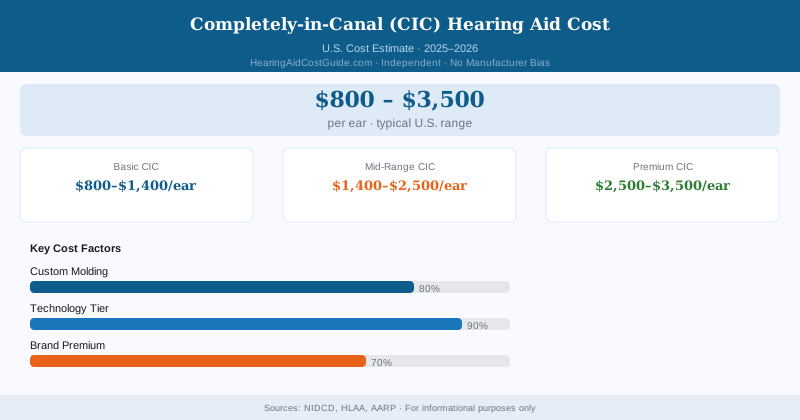
| Basic CIC (entry-level) | $800–$1,400 | Essential amplification, manual controls |
| Mid-range CIC | $1,400–$2,500 | Noise reduction, some program options |
| Premium CIC | $2,500–$3,500 | Bluetooth-adjacent features, advanced noise filtering |
| Bundled pair (mid-range) | $3,500–$5,500 | Both ears, fitting, follow-up visits included |
Prices vary by region, brand, and the professional fees bundled in. Audiologist practices in major metro areas tend to run 10–15% higher than smaller markets.
What Drives the Price Up
Custom molding. Every CIC is made from an impression of your ear canal. That custom work adds $150–$300 in lab fees before any technology costs.
Miniaturized components. Fitting directional microphones, a receiver, a processor, and a battery into a 1-cm shell requires precision engineering. Manufacturers pass that cost along.
Brand premium. Names like Phonak, Oticon, and Starkey carry higher margins. Boutique and house-brand options from audiologist chains can be 20–30% cheaper for similar specs.
Professional services. Most audiologists bundle fitting, programming, and 1–3 years of follow-up into the quoted price. Don’t confuse the device cost with the all-in cost.
CIC vs. Other Styles: A Quick Cost Comparison
Behind-the-ear (BTE) and receiver-in-canal (RIC) models are often $200–$600 less per ear because they use standard shells rather than custom molds. Over-the-counter hearing aids can run as low as $200–$1,500 for a pair — but OTC devices aren’t custom-fit and aren’t appropriate for every level of loss.
The National Institute on Deafness and Other Communication Disorders (NIDCD) estimates that approximately 28.8 million U.S. adults could benefit from hearing aids, yet fewer than one in three people who need them actually use them. Cost is frequently cited as the top barrier. If the CIC price is out of reach, a less discreet style at a lower price point may still deliver excellent hearing outcomes.
Will Insurance Pay for a CIC?
Probably not much. Traditional Medicare doesn’t cover hearing aids — including CICs. Some Medicare Advantage plans do offer a hearing benefit, but many cap reimbursement at $500–$1,500 per pair, which leaves a significant gap on premium CICs.
The American Speech-Language-Hearing Association (ASHA) notes that coverage varies widely by state for Medicaid, and most private insurance plans explicitly exclude hearing aids from standard benefits.
Your best options for reducing out-of-pocket costs:
- HSA or FSA funds — CIC hearing aids are always eligible
- Manufacturer financing — Phonak, Starkey, and others offer 0% plans through CareCredit or similar
- Trial periods — Reputable audiologists provide 30–60 day trials; don’t skip this step
- Is this price per ear or for the pair?
- What’s included — fitting, follow-ups, cleaning, warranty?
- What’s the trial-return policy if the fit isn’t right?
- Does this model come with a rechargeable option, or is it only battery-powered?
The Rechargeable Question
Most CIC models still run on size-10 disposable batteries — the smallest on the market. Changing them every 3–5 days can be challenging for people with dexterity or vision issues. A handful of newer premium CICs offer rechargeable versions, but they’re typically $300–$500 more per unit. If arthritis or fine motor control is a concern for you, ask specifically about rechargeable CIC models before committing.
Getting the Best Deal Without Sacrificing Quality
Shop at least two audiologists before buying. Prices for identical devices often vary by $300–$800 between practices. Ask each provider to itemize device cost vs. professional services — that transparency lets you compare apples to apples.
Consider a mid-range CIC over a premium one if your hearing loss is mild to moderate. The technology gap between tiers matters most in complex sound environments. For quieter lifestyles, a mid-range CIC at $1,800–$2,200 per ear often performs just as well day-to-day.
Avoid buying CIC hearing aids online without a professional fitting. CICs require a custom ear mold impression and precise programming for your audiogram. An ill-fitting CIC causes discomfort, feedback, and poor sound quality — and you won’t have recourse if something goes wrong.
Bottom Line
CIC hearing aids run $800–$3,500 per ear, with most people paying $1,400–$2,500 per ear for a solid mid-range model. The tiny size comes with a real cost premium over larger styles, but for people who want discreet, comfortable amplification, it’s often worth it. Get at least two quotes, confirm the trial period terms, and check your HSA balance before your next audiologist appointment.