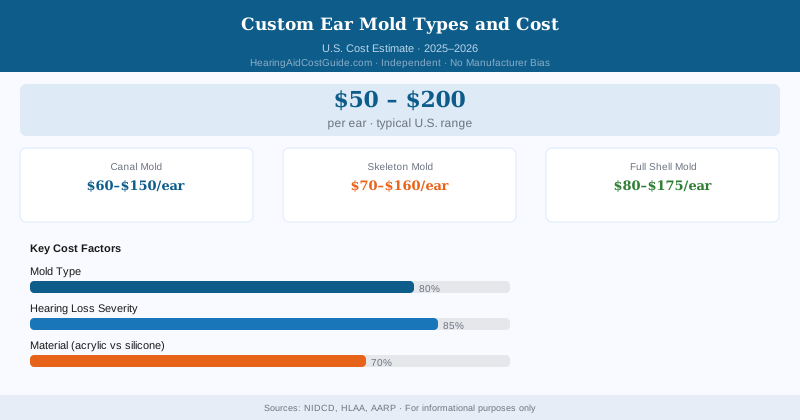
Most people don’t think about ear molds until they’re told they need one. Then they get a quote — $75 to $200 per ear — and wonder what exactly they’re paying for. The short answer: a custom-fitted silicone or acrylic coupling between your hearing aid and your ear canal that can make the difference between a hearing aid that whistles and one that actually works.
Custom Ear Mold Costs by Type
| Mold Type | Best For | Material | Cost Per Ear |
|---|---|---|---|
| Full shell (full concha) | Severe-profound loss, max retention | Acrylic or silicone | $80–$175 |
| Skeleton / half-shell | Moderate-severe loss, balance of retention and comfort | Acrylic | $70–$160 |
| Canal mold | Mild-moderate loss, discrete fit | Acrylic or silicone | $60–$150 |
| CIC shell | Deep-canal fit, very discrete | Hard acrylic | $75–$175 |
| Soft silicone mold | High-power BTEs, pediatric use | Silicone | $85–$200 |
| Musician’s earplug (custom) | Hearing protection, flat attenuation | Silicone + filter | $100–$250 |
| Swim plug | Water protection | Soft silicone | $50–$120 |
Why Ear Mold Type Matters
The four main types differ in how much of your ear they fill and how much sound they retain.
Full shell (full concha) fills the entire bowl of your outer ear. Maximum retention — nearly impossible to knock out — and maximum acoustic seal. This is the go-to for power BTE users with severe to profound hearing loss, because a poor seal at high gain levels causes feedback (whistling) that undermines everything.
Skeleton mold removes most of the bulk of a full shell, leaving a hollow frame. More comfortable for all-day wear, still provides a reliable seal. Most audiologists prefer this as a default for moderate-to-severe loss when the patient wants more comfort than a full shell provides.
Canal mold sits mainly in the ear canal itself, with a small portion extending into the concha for stability. More discrete and comfortable than a full shell. Works for mild-to-moderate loss and standard BTE or RIC aids where gain levels are lower and feedback risk is manageable.
Soft silicone molds are essential for children (ears change rapidly — silicone is more forgiving and easier to clean) and for high-power BTEs where vibration can loosen a hard acrylic mold. They feel different — softer, more pliable — but many adults prefer them long-term.
Most RIC/RITE hearing aids ship with dome ear tips — small silicone umbrellas in various sizes that don’t require impressions. Domes are fine for mild-to-moderate loss. You likely need a custom mold if you experience persistent feedback at comfortable volumes, if standard domes don’t stay put, if your loss is moderate-to-severe or worse, or if you’re using a power BTE. Your audiologist will recommend molds at fitting if they’re clinically indicated.
The Ear Impression Process
Getting a custom mold starts with an ear impression — a 5–10 minute in-office procedure. The audiologist:
- Inspects your ear canal visually to ensure no blockage or unusual anatomy
- Places a foam dam a few millimeters into the canal (this protects the eardrum)
- Injects impression material — a two-part silicone compound that sets in 3–5 minutes
- Removes the hardened impression intact
The impression is mailed to a lab (Westone, Microsonic, Starkey, and Widex all operate mold labs). Turnaround is typically 1–2 weeks. You’ll return for a fitting appointment where the audiologist trims, buffs, and checks the fit. A well-made custom mold should slide in without force and sit completely comfortably — no pressure points.
ASHA and Ear Mold Care Standards
According to ASHA guidelines on hearing instrument management, custom earmolds should be cleaned with a dry cloth daily and washed with mild soap and warm (not hot) water weekly. Remove the mold from the hearing aid tubing before washing. Do not submerge in alcohol — it degrades silicone and acrylic over time.
The NIDCD notes that approximately 1 in 3 adults between 65 and 74 has hearing loss, and the proportion rises steeply with age. Ear canals also change over time — they can enlarge slightly with age, or change in shape due to jaw changes. A mold that fit perfectly at 60 may need replacement by 68. Have your audiologist check the mold fit at annual appointments.
Ear Mold Lifespan and Replacement
Hard acrylic molds typically last 3–5 years for adults. Soft silicone molds last 1–2 years; silicone degrades faster, especially with heavy moisture exposure (sweating, swimming).
Signs you need a new mold:
- Persistent feedback that wasn’t there before
- Visible cracking or discoloration in the material
- Mold feels loose when it used to be snug
- Ear canal irritation or soreness from fit changes
Replacement molds require a new impression — you can’t reuse the old one. Budget $60–$175 per ear every 2–4 years as part of your total hearing aid maintenance cost.
Don’t attempt to modify a custom ear mold yourself by trimming, sanding, or filing it. Ear canals are complex, and what feels like minor material removal can create sharp edges, alter the acoustic seal, or compromise the retention fit. If the mold feels uncomfortable or fits poorly, return it to your audiologist for professional adjustment. Most audiologists include 1–2 mold modifications in the initial fitting fee — ask before the appointment.
Musician’s Custom Molds: A Separate Category
Musician’s earplugs use flat-attenuation filters that reduce sound evenly across frequencies — unlike foam plugs, which block high frequencies dramatically more than lows. This preserves sound clarity while reducing volume. Flat attenuation filters come in -9dB, -15dB, and -25dB strengths. The custom shell runs $100–$200 per pair; replacement filters run $30–$60.
If you play music, attend live performances regularly, or work in loud environments, musician’s earplugs are one of the highest-value hearing health investments available.