Myth: Earwax means your ears are dirty. Reality: Earwax is your ear canal’s self-cleaning system — and for most people, it works perfectly without any help.
The problem is impaction. When wax builds up faster than it migrates out — often triggered by narrow canals, hearing aid use, or habitual cotton swab use — it can cause 10–30 dB of hearing loss almost overnight. About 12 million Americans seek medical help for earwax impaction each year, according to the American Academy of Otolaryngology. Another 8 million manage it at home.
Here’s exactly what professional and DIY removal costs — and when each is appropriate.
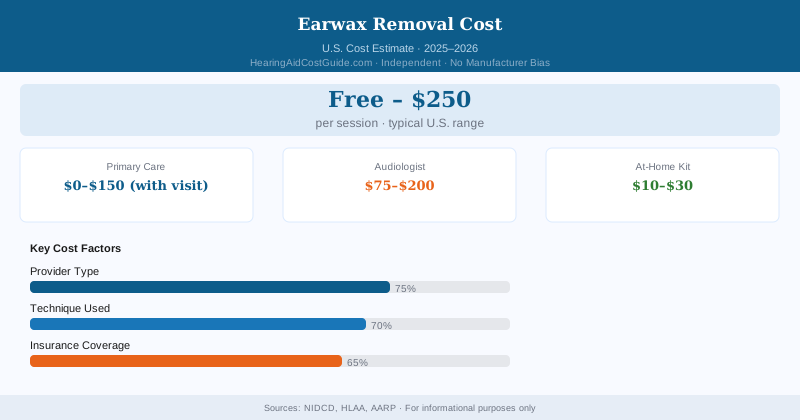
Earwax Removal Cost Comparison
| Method | Cost | Who Performs | Safe For |
|---|---|---|---|
| At-home drops (Debrox) | $6–$15 | Self | Healthy intact eardrum |
| Ear syringe kit (at-home) | $8–$20 | Self | Healthy intact eardrum |
| Audiologist irrigation | $50–$150 | Audiologist | Most patients |
| ENT microsuction | $100–$200 | ENT physician | All patients including perforations |
| Primary care irrigation | $40–$100 | PCP | Straightforward cases |
| Urgent care | $50–$150 | Urgent care provider | Straightforward cases |
| Ear candling | N/A — DO NOT USE | N/A | Not safe, no evidence |
At-Home Earwax Removal: When It’s Appropriate
Home removal is appropriate if:
- You have no history of eardrum perforation
- You don’t have ear tubes (tympanostomy tubes) in place
- You haven’t had recent ear surgery
- The hearing loss is mild and recent
Carbamide peroxide drops (Debrox, Murine): Place 5–10 drops in the affected ear, lie on your side for 5 minutes, then rinse with warm water. The bubbling action softens and loosens wax. Repeat twice daily for 4 days.
Cost: $6–$15 at any pharmacy. Effective for mild-to-moderate impaction.
Bulb syringe irrigation: After softening wax with drops, gently irrigate with body-temperature water using a rubber bulb syringe. Pull the pinna up and back to straighten the ear canal, then direct the water toward the posterior canal wall (not directly at the eardrum).
Cost: $8–$20 for a bulb syringe kit. Works well for softened wax after 2–4 days of drops.
A 2013 BMJ study found that regular olive oil drops are effective for preventing earwax buildup and softening impacted wax. Place 2–3 drops of room-temperature olive oil in the affected ear twice daily for 3–5 days before attempting removal. This approach is particularly gentle and safe for older adults and those with sensitive ear canals.
Professional Earwax Removal: The Options
Audiologist irrigation: The audiologist uses a specialized irrigation syringe or oral irrigator (often a WaterPik-type device modified for ear irrigation) to flush warm water against the posterior ear canal wall. Effective and commonly performed.
Cost: $50–$150 at most audiology practices. Often covered by insurance at the specialist or procedure copay level.
ENT microsuction: The preferred method for difficult cases. The ENT uses a microscope or headlight and a suction device to directly visualize and remove wax. No water is used — safer for patients with perforations or ear tubes.
Cost: $100–$200. Often done as part of an ENT office visit; may be included in the office visit charge.
Ear irrigation vs. microsuction: Irrigation is appropriate for most cases. Microsuction is preferred for:
- Hard, dry wax that doesn’t respond to softening drops
- History of eardrum perforation (confirmed or possible)
- Prior ear surgery
- Children who can’t tolerate irrigation
- Failed home or clinic irrigation attempts
Insurance Coverage for Earwax Removal
Earwax impaction removal is often covered by insurance when:
- Performed by an ENT or audiologist as a medically necessary procedure
- Billed under CPT code 69210 (removal of impacted cerumen by physician) or appropriate nursing/PA codes
Medicare Part B covers cerumen removal when performed by a physician (not nursing staff only). The CPT code 69210 is commonly used. Patient responsibility: 20% after deductible.
Many insurance plans cover professional earwax removal at specialist or procedure copay rates. Call your insurer to confirm coverage for “cerumen disimpaction” before assuming it’s out-of-pocket.
What NOT to Do
Cotton swabs: They push wax deeper into the canal, potentially impacting it against the eardrum. Even the cotton swab packaging says not to use them in the ear canal.
Ear candles: No evidence of effectiveness; multiple case reports of fire, burns, ear canal occlusion from melted wax, and eardrum perforation. The FDA has taken action against ear candle manufacturers for false claims. There’s no safe or effective use of ear candles.
Sharp objects: Hairpins, toothpicks, and other objects can perforate the eardrum. Never use anything pointed in the ear canal.
Cold water: Using cold water for irrigation can cause vertigo by stimulating the vestibular system (caloric response). Always use body-temperature water.
If professional earwax removal doesn’t fully resolve your hearing difficulty, proceed with audiological testing. About 30% of patients presenting for “earwax-related hearing loss” have underlying sensorineural hearing loss that was coincidentally masked by the wax. Removing the wax reveals, rather than causes, the underlying hearing loss.
Hearing Aids and Earwax
Hearing aid users accumulate earwax faster because the devices stimulate gland secretion in the ear canal and block the natural outward migration of wax. Plan for professional ear cleaning every 3–6 months — your audiologist can handle this during regular follow-up appointments.
Earwax-related hearing aid problems (reduced sound, feedback, or complete failure) are the most common reason hearing aids “stop working” and account for the majority of unnecessary in-clinic repair visits.