FAQ: ENT Visits for Hearing Concerns
Q: What does an ENT visit actually cost?
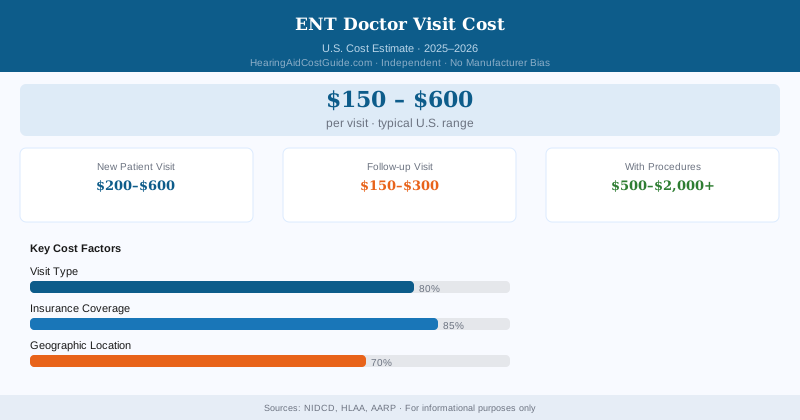
Without insurance, an initial ENT consultation runs $200–$450. Follow-up visits are typically $100–$250. Add $100–$300 for any in-office procedures (earwax removal, minor debridement), and potentially another $200–$400 if they scope your sinuses or throat.
With insurance, you’re looking at your plan’s specialist copay — usually $40–$150 — plus procedure copays if applicable.
ENT Visit Cost by Appointment Type
| Appointment Type | Cost (No Insurance) | Cost (With Insurance) |
|---|---|---|
| Initial consultation | $200–$450 | $40–$150 specialist copay |
| Follow-up visit | $100–$250 | $30–$75 specialist copay |
| In-office procedure (earwax removal, etc.) | $100–$300 additional | Procedure copay |
| ENT visit with in-house audiogram | $300–$500 | Specialist copay + possible test copay |
| Microscopic ear exam | $150–$350 | Specialist copay |
| Nasopharyngoscopy (scope exam) | $200–$400 additional | Procedure copay |
Q: What’s the difference between seeing an ENT and an audiologist?
ENTs are physicians — they can diagnose complex ear conditions, prescribe medications, order imaging, and perform surgery. Audiologists test and rehabilitate hearing but aren’t physicians.
For most straightforward hearing evaluations (annual audiogram, hearing aid fitting), an audiologist is what you need. When things get complicated — sudden hearing loss, one-sided symptoms, ear pain, drainage, suspected tumors — the ENT is the right call.
Q: What happens at a first ENT appointment for hearing loss?
A typical first visit includes:
- Complete history: Symptom onset, duration, character of hearing loss, associated symptoms (vertigo, tinnitus, ear pain, fullness, drainage), medical history
- Physical examination: Otoscopy of ear canal and eardrum using a microscope or otoscope; inspection of nose, throat, and lymph nodes
- Audiometric testing: Most ENT practices have on-site audiologists or audiology technicians who perform audiograms as part of the visit
- Interpretation and diagnosis: ENT physician reviews findings and establishes a diagnosis
- Treatment or referral plan
Q: Do I need a referral to see an ENT?
Depends on your plan. HMO plans typically require a PCP referral before seeing a specialist. PPO plans usually let you self-refer. Check your plan’s requirements before booking — skipping a required referral can result in higher out-of-pocket costs or claim denial.
Q: When should I go directly to an ENT rather than my primary care doctor?
See an ENT (not just a PCP or audiologist) for:
- Sudden hearing loss: Medical emergency — call ENT same day
- Asymmetric hearing loss: One ear significantly worse; rules out acoustic neuroma
- Ear pain: Ongoing pain requires physician evaluation for otitis, cholesteatoma, TMJ
- Ear drainage: Any discharge from the ear canal needs physician evaluation
- Vertigo or severe dizziness with hearing changes: Possible Menière’s, labyrinthitis, or perilymph fistula
- History of ear trauma or surgery: Prior surgical changes complicate simple audiological care
- Suspected conductive hearing loss: Requires physician evaluation to determine treatable cause
For simple ear infections and earwax, your primary care physician (PCP) is often sufficient and costs less than an ENT visit. For anything more complex — chronic problems, sudden changes, unilateral symptoms, or when the PCP is uncertain — a direct referral to ENT is appropriate.
Most insurance requires a PCP referral for ENT under HMO plans. PPO plans typically allow direct specialist access. Check your plan’s requirements before booking.
Q: What are the different ENT subspecialties?
General Otolaryngologist: Handles routine ear, nose, and throat conditions. Appropriate for most hearing concerns, ear infections, ear tube placement.
Otologist: An ENT who has completed additional fellowship training specifically in ear surgery and complex ear diseases. Preferred for stapedectomy, cochlear implants, acoustic neuromas, cholesteatoma surgery, and complex ear reconstruction.
Neurotologist: Subspecialty with additional training in surgery at the ear-brain interface (skull base). Handles acoustic neuromas, cochlear implants, vestibular nerve sections, and cerebrospinal fluid leaks.
Pediatric Otolaryngologist: ENT with pediatric subspecialty training. Preferred for children with complex ear disease, congenital ear anomalies, or recurrent ear infections.
Q: Does insurance cover ENT visits?
Yes. ENT visits are covered by all major insurance plans as specialist visits. Coverage includes:
- Initial consultation and follow-up visits (specialist copay)
- In-office procedures (procedure copay or deductible)
- In-house audiological testing (often as part of visit, sometimes separate)
- Imaging (CT, MRI) when ordered for medical indications
Medicare Part B covers ENT visits for medically indicated concerns. Audiological testing ordered by the ENT physician is covered under Part B’s diagnostic testing benefit.
Getting a physician (PCP or ENT) referral for audiological testing before the test can improve insurance coverage — “physician-ordered diagnostic audiological evaluation” has better coverage than “routine hearing screening.”
Q: How do I find a good ENT for hearing issues?
- Medical insurance directory: Search your plan’s provider directory for otolaryngologists in your network
- American Academy of Otolaryngology (AAO-HNS): entnet.org — member directory with subspecialty designations
- American Neurotology Society: americanneurotologysociety.org — find neurotologists and cochlear implant specialists
- University/academic medical centers: Best for complex or rare ear conditions; may require longer wait times
If you’re told by an ENT that nothing is wrong despite ongoing hearing difficulties or tinnitus, consider asking for a referral to an audiologist for a comprehensive audiological evaluation — or seek a second opinion at an academic medical center ENT practice. “Normal” hearing on a basic screening doesn’t rule out early sensorineural hearing loss, auditory processing disorder, or other conditions requiring more detailed testing.