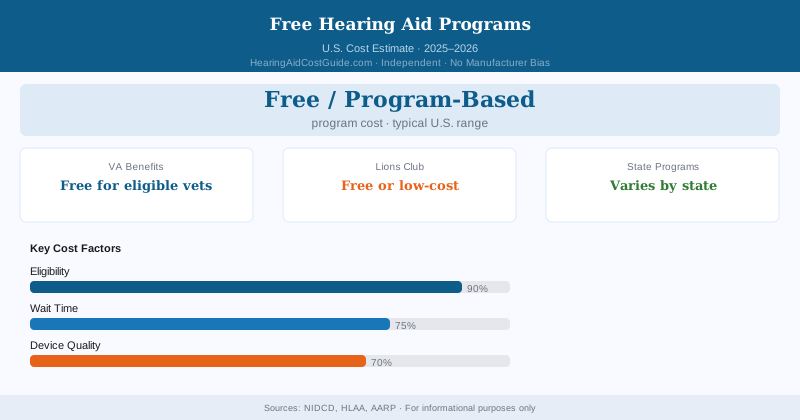
Hearing aids cost $2,000–$7,000 a pair at a private clinic. Most insurance won’t touch them. And yet millions of Americans are getting quality aids at no cost — through the VA, state Medicaid programs, vocational rehabilitation offices, and a handful of nonprofits most people have never heard of.
According to NIDCD data, nearly 29 million American adults could benefit from hearing aids. Of those, fewer than 30% have ever worn them. Cost is the barrier that comes up most often. That’s a solvable problem for a lot more people than currently know it.
Here’s where the free programs actually are — and who qualifies.
Free Hearing Aid Program Directory
| Program | Who Qualifies | What’s Provided |
|---|---|---|
| VA Audiology (veterans) | Veterans with service-connected conditions | Premium prescription aids, batteries, repairs |
| Medicaid (all children) | Children under 21 | Both aids + fitting + follow-up |
| Medicaid (eligible adults) | Low-income adults (~30 states) | Aids + basic fitting |
| State Vocational Rehabilitation | Working-age adults with hearing disability | Aids + services for employment |
| Starkey Hearing Foundation | Low-income, community referred | Mid-tier aids + fitting |
| Lions Club International | Low-income, local referral | Reconditioned aids + new in some regions |
| HLAA local chapters | Varies by chapter | Aid assistance, loaner programs |
| Easter Seals | Children and adults with disabilities | Varies by location |
| Sertoma International | Income-qualifying adults | Reconditioned aids in some areas |
| Audient Alliance | Income-qualifying | Discounted aids (not free) |
Veterans Administration: The Largest Free Hearing Aid Program in the US
The VA provides free hearing aids — including premium-tier rechargeable devices from Phonak, Starkey, Oticon, and Signia — to eligible veterans. Over 900,000 hearing aids were dispensed in FY2023 alone, making the VA the single largest purchaser of hearing aids in the world.
Who qualifies: Veterans with service-connected hearing loss or tinnitus (even at 0% disability rating), and veterans in VA priority groups 1–6 with functional hearing impairment. See our full VA Hearing Aid Benefits guide for details.
How to apply: Enroll in VA healthcare at va.gov/health-care/apply or call 877-222-8387. Request an audiology appointment. No cost to the veteran.
Medicaid: Universal Coverage for Children, Patchy for Adults
All state Medicaid programs cover hearing aids for children under 21 under EPSDT — both devices, fitting, batteries, and follow-up care. This is a federal mandate with no exceptions.
For adults, approximately 30 states cover hearing aids under Medicaid. Contact your state Medicaid office directly to confirm adult hearing aid coverage in your state.
State vocational rehabilitation (VR) agencies help people with disabilities enter or maintain employment. For working-age adults with significant hearing loss, VR can fully fund:
- Prescription hearing aids appropriate for your audiogram
- Professional audiological fitting and follow-up
- Assistive listening devices for the workplace
- Communication training
You don’t need to be on disability to qualify. If hearing loss affects your ability to work at your current level, VR may fund your hearing aids. Contact your state’s VR office at rsa.ed.gov (find your state agency). Applications are free.
Starkey Hearing Foundation
The Starkey Hearing Foundation (Starkey Mission) distributes free hearing aids through community partners domestically and internationally. In the US, aids are distributed through:
- Local health departments and community health centers
- HLAA chapters
- Lions Club partners
- Church and community organization partnerships
How to apply: Contact your nearest Lions Club, HLAA chapter, or community health center and ask about Starkey Foundation distribution events. These events occur throughout the year in various communities. Eligibility is income-based; devices are fitted on-site or through partnering audiologists.
Lions Clubs International: Hearing Aid Recycling Program
Lions Club chapters collect donated hearing aids, recondition them, and redistribute them to people in need at no charge or minimal cost. Quality varies — reconditioned analog aids are older technology — but for severe financial hardship, they provide access to amplification.
To find your nearest Lions Club with a hearing aid program:
- Visit lionsclubs.org
- Contact your local Lions Club chapter directly
- Ask specifically about hearing aid assistance programs
Not all Lions Club chapters offer this program — it varies by region. In some areas, Lions Clubs partner with audiologists to provide new (not just reconditioned) devices.
HLAA Local Chapter Assistance Programs
Many HLAA (Hearing Loss Association of America) chapters maintain emergency funds or assistance programs for members in financial need. Contact your local HLAA chapter through hearingloss.org/chapter-locator.
HLAA national also maintains a comprehensive assistance resource list updated annually.
Sertoma International
Sertoma is a service organization with chapters that specifically focus on hearing health. Some chapters provide refurbished hearing aids to individuals in financial need. Find a local chapter at sertoma.org.
Audient Alliance: Reduced-Cost, Not Free
Audient Alliance (audientalliance.org) isn’t a free program — it provides access to prescription hearing aids at significantly reduced cost ($400–$1,700/pair) for income-qualifying adults. While not free, it’s often the most accessible option for adults who earn too much for Medicaid but can’t afford retail pricing.
Eligibility requires income at or below 200% of federal poverty level. Devices are professionally fitted at participating audiologists.
Free hearing aid programs have limited capacity — devices aren’t unlimited. Apply early, be persistent if programs are currently full, and explore multiple programs simultaneously. Many programs have waiting lists; adding your name to several lists increases the chance of timely access.
For Children: Additional Resources
- AG Bell Association: Financial assistance for children with hearing loss
- Hands & Voices: Regional chapters often have assistance funds
- State children’s hospitals: Many have financial assistance programs for hearing care
- School district IDEA funding: Hearing aids for school use may be funded under Individualized Education Programs
How to Find Local Programs
The NIDCD (National Institute on Deafness and Other Communication Disorders) maintains a hearing aid assistance resource list at nidcd.nih.gov. Search for “hearing aid financial assistance” with your state name to find state-specific programs.