What do AB and Phonak have in common? They’re both owned by Sonova — the Swiss hearing technology giant that decided in 2009 that owning a cochlear implant company alongside its hearing aid brands made strategic sense. That connection matters for you: if you’re a Phonak hearing aid user with AB cochlear implant candidacy, the Naída CI sound processor can run in a bimodal configuration with your Phonak aid, sharing wireless streaming, a single remote, and coordinated processing.
Advanced Bionics (AB) holds roughly 15% of the U.S. cochlear implant market. It’s the FDA-approved option many surgeons prefer for specific patient profiles — including those who want the highest channel count available (120 spectral channels via HiRes 120 processing) and those who want tight integration with Phonak hearing aids in a bimodal setup.
What AB’s System Includes
The AB system has two primary components:
Internal implant: The HiRes Ultra or HiRes Ultra 3D implant. The Ultra 3D offers MRI compatibility at 1.5T with the magnet in place (3.0T with magnet removal, same as older CI designs). The implant itself is FDA-approved and placed during a 2–3 hour outpatient surgery.
External sound processor: The Naída CI M90 (behind-ear) and the Sky CI M90 (for children). Both connect wirelessly to Phonak-compatible accessories and streaming devices via Phonak’s SWORD chip — the same chip in Phonak’s premium hearing aid line.
According to the National Institute on Deafness and Other Communication Disorders (NIDCD), adults with cochlear implants generally recognize speech in quiet settings at rates of 80–90%, with significant individual variation. The specific processor’s processing strategy matters, but post-implant rehabilitation and individual neurology drive outcomes more than brand.
Advanced Bionics Cost Breakdown
| Component | Low | Typical | High |
|---|---|---|---|
| AB HiRes Ultra implant device | $18,000 | $24,000 | $28,000 |
| Surgeon fees | $3,500 | $6,000 | $10,500 |
| Anesthesia | $1,500 | $2,500 | $4,500 |
| Hospital/surgical facility | $8,000 | $16,000 | $26,000 |
| Pre-surgical audiological evaluation | $500 | $1,200 | $2,500 |
| Activation & mapping (first year) | $1,500 | $3,000 | $5,500 |
| Aural rehabilitation | $1,000 | $3,500 | $7,000 |
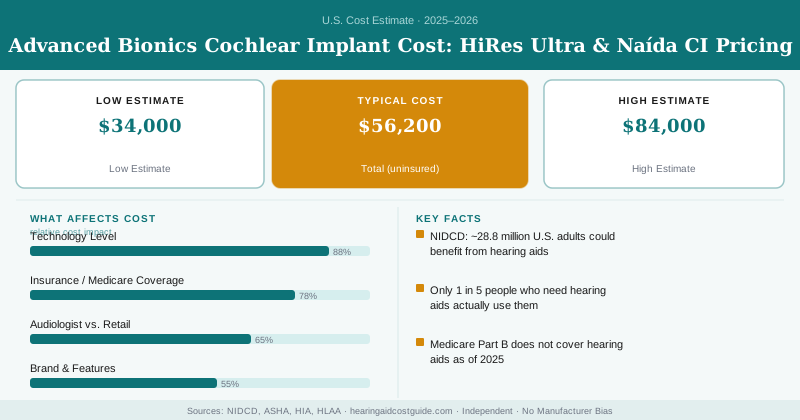
| Total (uninsured) | $34,000 | $56,200 | $84,000 |
The Phonak/AB Bimodal Advantage — and Its Cost Implications
This is AB’s clearest differentiator for certain patients. If you have hearing loss that’s asymmetric — one ear eligible for a CI, the other with usable residual hearing — bimodal fitting means wearing the AB Naída CI processor on the implanted side and a Phonak hearing aid on the other.
The Naída CI M90 and Phonak’s Lumity hearing aids share:
- A single smartphone app for both devices
- Coordinated AutoSense processing on both sides
- Shared Bluetooth streaming to a single audio source
- A single Roger receiver (Roger Direct) for both sides
This integration has real quality-of-life value, but it also creates a vendor lock-in consideration: upgrading your hearing aid will eventually mean staying in the Phonak ecosystem to maintain bimodal coordination. A Phonak Lumity 90 hearing aid for the non-implanted ear adds $3,000–$5,500 to your setup.
The American Speech-Language-Hearing Association (ASHA) reports that bimodal users typically show better speech understanding in noise than cochlear implant-alone users — the combined input from both ears provides spatial hearing cues that a CI alone can’t replicate.
Insurance Coverage
AB implants are covered by Medicare, Medicaid (in most states), and most commercial insurance plans under the same medical necessity criteria as other cochlear implants:
- Bilateral moderate-to-profound sensorineural hearing loss in the ear to be implanted
- Limited benefit from optimally-fit hearing aids (less than 50% sentence recognition in quiet)
- No medical contraindications
Out-of-pocket with insurance generally runs $2,000–$7,000 for the initial surgery when candidacy is properly documented. The bimodal hearing aid for the non-implanted ear is covered by separate hearing aid benefits — which may be limited or absent depending on your plan.
Submit the pre-authorization packet with: a complete audiogram, aided speech recognition scores (CNC word lists, AzBio sentences), a letter of medical necessity from your otologist, and the specific HCPCS codes for the AB HiRes Ultra (L8690 or L8691). Incomplete documentation is the #1 reason for initial denials — not categorical exclusions.
The AB Platinum Service Plan
Advanced Bionics offers the Platinum Service Plan, typically $300–$600/year, which includes:
- Loss-and-damage coverage for the external processor
- Priority shipping for repairs
- Reduced pricing on processor upgrades
- Loaner processor program during repairs (critical — don’t go weeks without sound)
If you’re uninsured or face high upgrade costs, the plan often pays for itself on the first major repair.
AB vs. Cochlear vs. MED-EL: How to Decide
In most cases, your surgeon’s preference and experience should guide brand selection. But here are the clearest differentiators:
Choose AB if: You wear Phonak hearing aids in the opposite ear and want seamless bimodal integration, or your surgeon specifically recommends the HiRes 120 spectral processing for your audiological profile.
Choose Cochlear if: You want the broadest global service network, the most installed-base surgeon experience, or the Nucleus 8 processor’s specific Bluetooth ecosystem.
Choose MED-EL if: You have unusual cochlear anatomy benefiting from FLEX electrode design, you’re a candidate for Electric-Acoustic Stimulation (EAS), or MRI compatibility at 3.0T without magnet removal is important for your medical situation.
Internal cochlear implants are permanent. The electrode array cannot be removed and replaced with a competitor’s device without surgical risk. Brand choice is a lifelong commitment for the internal hardware — choose based on your surgeon’s recommendation and your audiologist’s long-term support capability, not based on marketing materials.
Financial Assistance
- AB Care financial assistance: Advanced Bionics’ patient support program provides grants and payment plans for uninsured or underinsured patients. Contact their patient services at 1-800-678-2575.
- State vocational rehabilitation: Covers CI surgery as a workplace rehabilitation benefit for eligible patients.
- Social Security disability: Profound bilateral hearing loss may qualify for SSDI/SSI, which brings Medicare coverage.
- HLAA chapter grants: The Hearing Loss Association of America’s local chapters sometimes provide small grants for uninsured patients.
Bottom Line
Advanced Bionics cochlear implant surgery costs $34,000–$84,000 uninsured, with out-of-pocket after insurance typically $2,000–$7,000. AB’s main competitive advantage is the Phonak ecosystem integration for bimodal users, plus the HiRes 120 processing strategy that some audiologists prefer for specific patient profiles. The financial considerations are nearly identical to Cochlear Americas — the decision between brands should be driven by your clinical situation and surgeon recommendation, not by cost.
Frequently Asked Questions
Advanced Bionics cochlear implant surgery typically costs $35,000–$80,000, depending on the device model (such as HiRes Ultra or Naída CI), facility fees, and surgeon expertise. The device itself represents roughly $20,000–$40,000 of this total, with the remainder covering surgery, anesthesia, and facility costs.
Medicare and most major private insurance plans cover Advanced Bionics cochlear implants as medically necessary devices, typically covering 80–100% of approved costs after deductibles are met. Out-of-pocket costs usually range from $0–$15,000 depending on your plan, deductible, and whether your surgeon is in-network.
AB cochlear implant surgery typically takes 2–3 hours, and patients usually go home the same day or stay overnight for observation. Most patients experience 1–2 weeks of recovery before returning to normal activities, with full device activation and hearing restoration occurring 2–4 weeks after surgery.