$80,000. That’s a conservative starting point for an auditory brainstem implant — and the bill regularly climbs past $150,000 once you factor in the surgery, the device, and the months of rehabilitation that follow. If you or a family member has been told a cochlear implant won’t work, the ABI is often the only remaining surgical hearing option. Understanding its true cost up front makes the entire process less overwhelming.
What Is an Auditory Brainstem Implant?
An ABI bypasses both the cochlea and the auditory nerve entirely. Surgeons place a small electrode array directly on the cochlear nucleus in the brainstem — the relay station where sound signals first enter the brain. It’s used most often for people with neurofibromatosis type 2 (NF2), acoustic neuroma removal, severe inner ear malformations, or auditory nerve aplasia.
The FDA first approved the ABI for adults in 2000. As of the mid-2020s, fewer than 1,500 ABIs had been implanted in the U.S. — a tiny number compared to the roughly 118,000 cochlear implants activated each year, according to the National Institute on Deafness and Other Communication Disorders (NIDCD). That rarity means specialized expertise, specialized costs, and limited insurance experience at most carriers.
ABI Cost Breakdown
| Component | Low | Typical | High |
|---|---|---|---|
| ABI device (Cochlear, MED-EL) | $20,000 | $30,000 | $40,000 |
| Neurosurgery fees | $15,000 | $25,000 | $40,000 |
| Anesthesia | $3,000 | $5,000 | $8,000 |
| Hospital/facility fees | $30,000 | $55,000 | $80,000 |
| Audiologist activation & mapping | $2,000 | $4,000 | $7,000 |
| Aural rehabilitation (first year) | $3,000 | $6,000 | $12,000 |
| Travel & lodging (specialty center) | $1,000 | $3,500 | $10,000 |
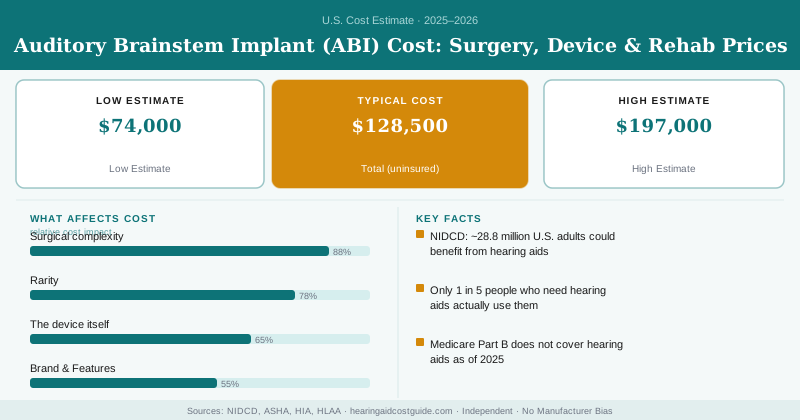
| Total (uninsured) | $74,000 | $128,500 | $197,000 |
These figures assume surgery at a U.S. academic medical center. International destinations (Germany, Italy, Austria) sometimes quote $40,000–$70,000 all-in, but you’ll need to weigh that against the lack of local follow-up care.
Why ABIs Cost More Than Cochlear Implants
Cochlear implant surgery typically runs $30,000–$50,000 total. ABIs cost two to four times more for three reasons:
Surgical complexity. ABI placement requires a neurosurgeon alongside an otologist or neuro-otologist. The brainstem approach — usually a retrosigmoid or translabyrinthine craniotomy — carries risks that cochlear surgery doesn’t, including facial nerve monitoring and brainstem proximity. OR time often exceeds five hours.
Rarity. Only a handful of U.S. centers perform ABIs regularly: Massachusetts Eye and Ear, House Ear Institute, and a few major academic programs. Low volume means fewer competing bids on surgical fees.
The device itself. Both Cochlear (Nucleus ABI24) and MED-EL (SYNCHRONY ABI) offer FDA-cleared systems in the U.S. Device costs mirror cochlear implant hardware, but the electrode arrays are custom-built for brainstem placement.
Insurance Coverage
Most commercial insurers and Medicare cover ABIs for approved indications — primarily NF2 and acoustic neuroma. The key hurdle is prior authorization and medical necessity documentation. According to the American Speech-Language-Hearing Association (ASHA), insurance appeals for brainstem implants succeed more often when candidacy letters come from a fellowship-trained otologist at a recognized ABI center.
What insurance typically covers:
- Device and implant surgery
- Audiologist activation and initial mapping sessions
- Hospital stay (usually 3–7 days for ABI vs. overnight for cochlear implants)
What you may still owe:
- Deductibles and out-of-pocket maximums (often $3,000–$8,000)
- Travel to specialty centers
- Long-term rehabilitation beyond the first year
- External processor upgrades every 8–12 years
Get a pre-authorization letter before scheduling surgery. Request an itemized quote covering the device (HCPCS code L8691 or L8692), facility fees, and professional fees separately. If denied, appeal with a letter of medical necessity from your neurosurgeon and audiologist together.
What to Expect in Terms of Hearing Outcomes
ABI outcomes are more variable than cochlear implant results, and that affects how you think about rehab costs. NIDCD research shows that most ABI recipients perceive sound and benefit from lip-reading support — improved speech understanding in noise — but fewer than 30% achieve open-set speech recognition without visual cues. Children implanted for non-NF2 indications tend to do better than adults with NF2-related implantation.
That means you should budget seriously for:
- Weekly auditory therapy for 6–18 months post-activation
- Assistive devices (captioned phones, visual alert systems)
- Annual mapping tune-ups at the implant center
Processor Upgrades Over Time
Your ABI device stays inside your head for life, but the external sound processor needs replacing every 8–12 years. Replacement processors currently run $8,000–$15,000 and often receive less insurance support than the original surgery. Factor that into lifetime cost planning.
ABI candidacy is highly specialized. Not every ENT or cochlear implant center performs ABIs. Seek evaluation at a center that implants at least 5–10 ABIs per year — surgical volume directly affects outcomes and complication rates.
Financial Assistance Options
- Cochlear Americas Patient Support: Manufacturer assistance programs sometimes cover device costs for uninsured patients.
- MED-EL financial assistance: Similar programs exist; contact their patient services team directly.
- NF2 foundations: The NF Network and Children’s Tumor Foundation have grant programs for device costs.
- University hospital charity care: Academic centers that perform ABIs often have sliding-scale charity care for patients below certain income thresholds.
- Clinical trials: Occasionally ABI expansion studies cover surgery costs for qualified candidates — check ClinicalTrials.gov.
Bottom Line
An auditory brainstem implant is one of the most expensive hearing interventions available, but for the right candidate it’s the only path to regaining sound perception. Total out-of-pocket after insurance typically runs $5,000–$20,000 when coverage applies. Without insurance, expect $75,000–$200,000. Get your candidacy evaluated at a high-volume ABI center, request itemized cost estimates before signing anything, and start the insurance pre-authorization process months before any scheduled surgery date.
Frequently Asked Questions
ABI surgery and the device typically cost $80,000–$150,000 or more in the U.S., with the surgeon's fees, hospital facility charges, and the implant device itself making up the bulk of that expense. Additional rehabilitation and follow-up appointments can add $5,000–$15,000 over the first year post-surgery. Total out-of-pocket costs depend heavily on your insurance plan and deductible.
Many major insurance plans, including Medicare and Medicaid in most states, do cover ABI surgery when the patient meets strict candidacy criteria (typically bilateral deafness and failed or unsuitable cochlear implants). However, you may face a deductible of $1,000–$5,000 or coinsurance requiring you to pay 10–20% of the total cost, with some plans imposing annual out-of-pocket maximums of $5,000–$15,000.
Most patients spend 1–2 days in the hospital after surgery, with initial healing taking 2–4 weeks before activation of the device. Full rehabilitation and auditory training typically last 6–12 months as your brain learns to interpret the implant's signals, and meaningful hearing benefit often develops gradually over this timeframe rather than immediately after activation.