“Your hearing test is normal.” If you’ve heard that sentence and still struggle to understand what people say — especially in noisy rooms, on the phone, or when someone speaks quickly — auditory processing disorder (APD) might be what’s actually going on. The standard audiogram doesn’t catch it. A specialized evaluation does. And that evaluation costs more than most people expect.
Here’s what the testing involves and what it’s likely to cost you.
What Is Auditory Processing Disorder?
APD (also called central auditory processing disorder, or CAPD) is a condition in which the ears work normally but the brain doesn’t process what it hears efficiently. People with APD often have normal audiograms but struggle with:
- Following conversations in background noise
- Distinguishing similar-sounding words (“bat” vs. “pat”)
- Understanding rapid or accented speech
- Following multi-step verbal instructions
APD is diagnosed through a specialized battery of auditory tests — not a standard hearing test. Only an audiologist trained in APD evaluation can diagnose it.
What an APD Evaluation Costs
| Evaluation Type | Typical Cost | Notes |
|---|---|---|
| Standard audiogram (baseline) | $100–$350 | Usually done first; often covered by insurance |
| Full APD evaluation (adult) | $400–$1,200 | Comprehensive battery; 2–3 hours |
| Full APD evaluation (pediatric) | $500–$1,500 | Often longer; may involve school coordination |
| Speech-in-noise testing (subset) | $150–$400 | Shorter; used when APD is one of several possibilities |
| Follow-up interpretation visit | $100–$250 | Review of results and treatment recommendations |
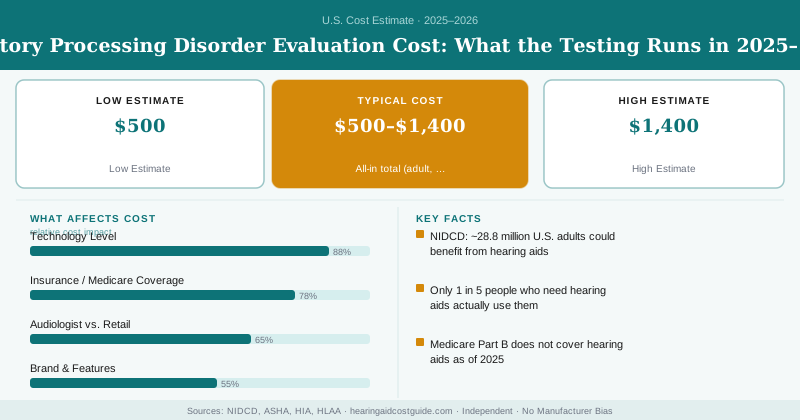
| All-in total (adult, full eval) | $500–$1,400 | Audiogram + APD battery + follow-up |
Geographic location matters substantially. APD specialists in major metro areas typically charge $800–$1,200 for a full battery. In smaller markets or university audiology clinics, the same evaluation may run $400–$700.
What the Testing Actually Involves
A full APD evaluation isn’t a single test — it’s a battery of 6–10 subtests, each measuring a different aspect of auditory processing. Common components include:
- Dichotic listening tests — different words or sentences played simultaneously to each ear; measures binaural integration
- Temporal processing tests — gap detection, pattern recognition
- Speech-in-noise tests (HINT, QuickSIN) — how well you understand speech with competing noise
- Monaural low-redundancy speech tests — understanding filtered, time-compressed, or reverberant speech
Plan for a 2–3 hour appointment. The audiologist will compile results into a profile that identifies which specific processing areas are weak — which then guides treatment.
Does Insurance Cover APD Evaluations?
Sometimes. The billing codes used for APD evaluations (primarily CPT 92620 and 92621 for central auditory processing assessments) are recognized by most insurance carriers, but coverage is inconsistent.
Medicare generally does not cover APD evaluations as a standalone service unless there’s a documented medical referral from a physician linking the testing to a specific diagnosis or treatment plan. Some Medicare Advantage plans have better audiology coverage — check your plan’s Summary of Benefits.
According to the American Speech-Language-Hearing Association (ASHA), APD is recognized as a distinct condition, but coverage disputes are common because some insurance reviewers classify APD testing as educational rather than medical. If your claim is denied, appeal with clinical notes from your referring physician emphasizing the medical (not educational) context.
- Get a physician referral specifically mentioning difficulty understanding speech in noise
- Choose an audiologist who bills with CPT 92620/92621 (APD-specific codes, not general audiometry)
- Ask your audiologist to document functional impact — work difficulties, communication challenges — in the clinical notes
- If denied, file a clinical appeal with supporting documentation from your physician
APD vs. Other Causes of Poor Speech Understanding
Before spending $500–$1,200 on a full APD evaluation, it’s worth ruling out other explanations for poor speech understanding:
- High-frequency hearing loss — even mild loss at 3,000–6,000 Hz makes understanding in noise difficult. A standard audiogram catches this.
- Cognitive changes — difficulty following conversation is also a symptom of mild cognitive impairment. Your physician may want to evaluate this first.
- Hearing aid fit — if you already wear hearing aids, poor programming for your speech-in-noise environment can mimic APD symptoms.
A good audiologist will screen for these before launching into a full APD battery. The NIDCD notes that APD diagnosis requires ruling out peripheral hearing loss and cognitive factors before attributing processing difficulties to a central auditory mechanism.
Treatment Costs After Diagnosis
An APD diagnosis opens several treatment tracks, each with its own costs:
- Auditory training programs (e.g., LACE, Earobics): $80–$400 for home-based software
- Formal audiological auditory training: $100–$200/session, 6–12 sessions ($600–$2,400 total)
- Classroom/workplace accommodations (FM systems, remote mic technology): $500–$2,000 for the device
- Speech-language therapy (for associated language processing): $150–$250/session
Many adults with APD benefit significantly from remote microphone technology — a small mic worn or placed near the speaker transmits directly to the listener’s ear, cutting out background noise. These devices run $500–$1,500 but can transform speech understanding in difficult environments.
Finding an APD Specialist
Not every audiologist performs APD evaluations. You’re looking for an audiologist with specific training and testing equipment for central auditory processing. University hospital audiology departments and children’s hospitals typically have specialists; private practices vary. ASHA’s “Find a Professional” directory lets you filter by specialty.
APD is sometimes over-diagnosed and sometimes missed entirely. Be cautious of any provider who diagnoses APD after a single short test, or who immediately recommends an expensive device or program. A thorough evaluation takes 2–3 hours. If you’re being rushed through, seek a second opinion.
Bottom Line
A full APD evaluation runs $400–$1,400 all-in, depending on your location and whether you have a physician referral to support insurance coverage. It’s a specialized test that requires a trained audiologist and 2–3 hours of your time. If you’ve been told your hearing is normal but you still can’t follow conversations in noisy environments, APD evaluation is a reasonable next step — and it may finally give you an answer.
Frequently Asked Questions
APD evaluations typically cost between $400 and $1,500 out of pocket in 2025–2026. The final price depends on the complexity of testing, your location, and whether the audiologist performs additional assessments like speech-in-noise tests or cognitive screening.
Most insurance plans do not cover APD evaluations because they are considered specialized diagnostic testing rather than standard hearing care. Medicare and many private insurers classify APD testing as non-covered, leaving you responsible for the full cost unless your plan specifically includes audiology benefits.
A complete APD evaluation typically takes 2–3 hours and includes tests that measure how your brain processes sound in quiet and noisy environments, such as speech-in-noise tests, dichotic listening tasks, and temporal processing assessments. These specialized tests go beyond a standard audiogram to identify whether your difficulty understanding speech is a processing problem rather than a hearing loss problem.