You can pass a standard hearing test with flying colors and still struggle to follow a conversation in a noisy restaurant. If that’s you, the issue might not be your ears — it might be how your brain processes sound. Auditory processing disorder (APD) is usually framed as a childhood diagnosis, but plenty of adults have it, sometimes undiagnosed for decades. Getting it evaluated and treated as an adult runs roughly $500 to $3,500. Here’s the breakdown.
Adult APD Costs
| Service | Cost |
|---|---|
| Standard hearing test (rules out hearing loss first) | $0–$250 |
| Full APD diagnostic battery | $300–$1,500 |
| Auditory training program (clinic-based) | $1,000–$3,000 |
| Computer/app-based training | $0–$300 |
| Personal FM / remote-mic system | $700–$1,500 |
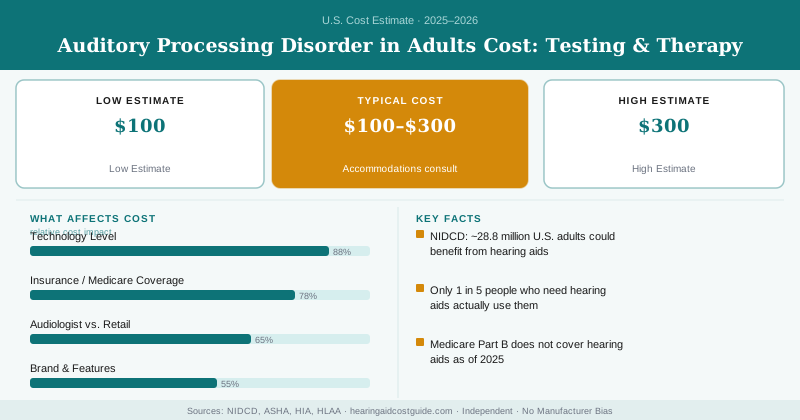
| Accommodations consult | $100–$300 |
The diagnostic battery is the big first cost because APD testing is more involved than a routine hearing screen — it measures how you handle speech in noise, competing sounds, and degraded signals.
Why Adults Get Overlooked
APD often hides behind other labels — “I just have trouble concentrating,” “everyone mumbles,” “I’m bad on the phone.” ASHA describes auditory processing disorders as difficulties in how the central nervous system uses auditory information, separate from the ears themselves. Because a basic hearing test can come back normal, adults frequently get told nothing’s wrong. That’s why the right testing matters: it looks at processing, not just detection.
Adult APD evaluation and therapy total roughly $500–$3,500. The first step is ruling out actual hearing loss with a standard test — then a specialized APD battery ($300–$1,500) confirms the diagnosis. Many adults benefit most from affordable accommodations and a remote-mic system rather than expensive training alone.
What Treatment Looks Like
There’s no pill. Management for adults usually combines three things:
- Auditory training — exercises (clinic or app-based) that sharpen how you process speech, especially in noise.
- Environmental strategies — facing speakers, reducing background noise, using captions.
- Assistive technology — a remote-microphone system that sends a speaker’s voice straight to your ears, which can be a game-changer in meetings and restaurants.
The NIDCD points out that listening in noisy environments is one of the most common real-world hearing complaints, and that’s precisely where APD bites hardest.
APD is not the same as hearing loss, and hearing aids alone won’t fix it. But the two can coexist. If a hearing test shows hearing loss, treating that first may resolve much of the difficulty — so don’t skip that step or buy training programs before you know what you’re dealing with.
Keeping Costs Down
- Get the basic hearing test first. It’s cheap or free and rules out the simpler explanation.
- Try app-based training before clinic programs. Some adults improve with $0–$300 software before paying thousands for guided sessions.
- Prioritize the remote-mic system. For working adults, this single tool often delivers the biggest day-to-day payoff.
- Check workplace accommodations. Captioning and assistive tech may be covered by an employer.
How It Connects to Hearing Care
Start with a thorough audiologist visit and a hearing test to separate APD from hearing loss. If hearing loss turns up alongside it, hearing aid cost becomes part of the conversation, and many modern aids include the same speech-in-noise tech that helps APD. Structured rehab overlaps with aural rehabilitation cost, which can be adapted for adult processing difficulties.
The Bottom Line
Adult APD is real, often missed, and treatable. Budget $500 to $3,500 across diagnosis and management — but you may spend far less if app-based training and a remote-mic system do the heavy lifting. Step one is always ruling out plain old hearing loss before assuming it’s a processing problem.
Frequently Asked Questions
A comprehensive APD evaluation typically costs $300–$800, depending on whether you see an audiologist in private practice or at a hospital clinic. The full diagnostic workup usually includes hearing tests, speech-in-noise testing, and cognitive screening, which accounts for the variation in price across regions and provider types.
Many insurance plans cover APD evaluation if ordered by a physician, though coverage varies widely and some plans classify it as experimental for adults. Out-of-pocket costs typically range from $100–$500 per visit after your deductible, and therapy sessions (usually $75–$150 each) may require prior authorization or may not be covered at all depending on your plan.
APD therapy usually involves 8–16 sessions over 2–4 months, costing $600–$2,400 total for the therapy phase alone. Sessions focus on auditory training, coping strategies, and environmental accommodations, with most patients seeing measurable improvement in speech-in-noise understanding within 3 months of starting treatment.