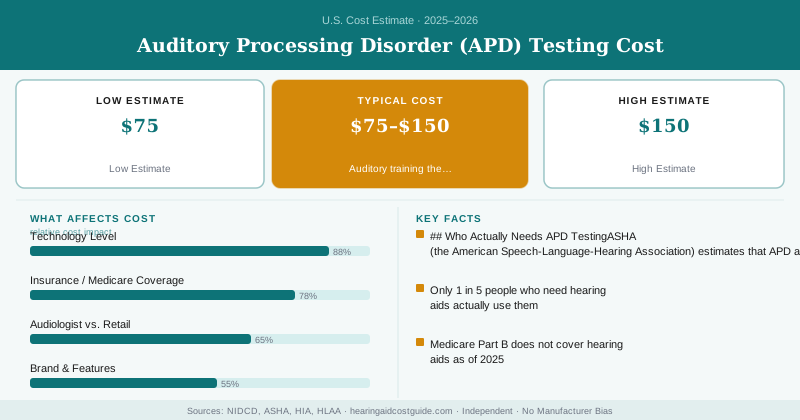
Most patients assume a normal audiogram means their hearing is fine. Wrong — at least when auditory processing disorder is involved. APD isn’t about whether you can detect a soft tone in a quiet booth. It’s about whether your brain can make sense of what it hears when things get complicated: background noise, multiple talkers, fast speech, distorted signals. A standard audiogram misses it entirely. The evaluation that catches it costs $500–$2,000 and takes most of an afternoon.
Here’s what you’re actually paying for, and how to make the most of it.
APD Testing Cost
| Test / Service | Typical Out-of-Pocket Cost | Notes |
|---|---|---|
| Baseline audiogram (prerequisite) | $100–$350 | Usually ordered before APD battery |
| Full APD evaluation (audiologist) | $500–$1,500 | 2–4 hours; comprehensive subtest battery |
| Neuropsychological APD evaluation | $1,200–$2,000 | Includes cognitive and processing measures |
| Speech-in-noise screening (partial) | $150–$400 | Shorter subset; rules in/out APD as a factor |
| FM system (treatment device) | $200–$1,500 | Most common first treatment after diagnosis |
| Auditory training therapy | $75–$150 per session | 6–12 sessions typical; $500–$1,800 total |
University hospital audiology clinics tend to run $500–$900 all-in. Private practices in major metro areas often charge $900–$1,500 for the same battery. If you also need a neuropsychological evaluation — more common when ADHD or learning differences are suspected alongside APD — budget $1,200–$2,000 for that piece alone.
What the Evaluation Actually Covers
APD isn’t diagnosed with a single test. It’s a battery of six to ten subtests administered over two to four hours, each one probing a different aspect of how your brain handles sound. The most commonly used tools include:
- SCAN-3 — the most widely used commercial APD battery; covers filtered speech, competing words, and figure-ground listening
- Dichotic listening tests — two different words or sounds played simultaneously, one to each ear; measures how well your brain integrates or separates competing signals
- Temporal processing tests — gap detection and pattern recognition for frequency and duration; measures timing accuracy in the auditory system
- Speech-in-noise tests (HINT, QuickSIN) — how well you follow a sentence when a voice or noise competes with it
- Monaural low-redundancy speech — understanding speech that’s filtered, time-compressed, or reverberated
Results aren’t pass/fail. Your audiologist produces a processing profile — where your auditory system breaks down and where it holds — and uses that to guide targeted treatment recommendations.
Who Actually Needs APD Testing
ASHA (the American Speech-Language-Hearing Association) estimates that APD affects 2–7% of school-age children. It also occurs in adults, often showing up as age-related changes in auditory processing speed, or following head injury or neurological illness. Many adults over 55 experience processing difficulties that go well beyond what their audiogram reflects.
You’re a reasonable candidate for APD testing if you:
- Have a normal or near-normal audiogram but consistently struggle to follow conversation in noise
- Frequently mishear words even in quiet environments
- Lose the thread of conversation when more than one person talks at once
- Have difficulty following multi-step verbal directions
- Have been told you have “listener fatigue” — understanding speech fine initially, but losing ground as a conversation continues
APD and ADHD overlap in symptoms — trouble following instructions, difficulty in noisy environments, seeming inattentive — and the two conditions can coexist. The distinction matters for treatment: ADHD management typically centers on behavioral strategies and medication; APD management focuses on auditory training, environmental modifications, and FM technology. A thorough evaluation by both a neuropsychologist and an audiologist is the most reliable path to sorting out what’s what. Budget $1,500–$3,000 if both evaluations are needed.
Insurance Coverage: Inconsistent, but Worth Pushing For
Insurance coverage for APD testing is genuinely variable. The same evaluation, billed identically, gets covered by one plan and denied by another.
The relevant CPT codes are 92620 (central auditory function evaluation, first 60 minutes) and 92621 (each additional 15 minutes). Most commercial insurers recognize these codes, but some classify APD testing as “educational” rather than medical — which can trigger a denial regardless of clinical need.
Medicare generally doesn’t cover standalone APD evaluations unless there’s a documented physician referral tying the testing to a specific medical diagnosis. Medicare Advantage plans vary; check your Summary of Benefits before scheduling.
For children flagged with school-based listening difficulties: the Individuals with Disabilities Education Act (IDEA) requires schools to evaluate children suspected of having disabilities that affect learning, at no cost to the family. School-based testing is free, though it’s designed for educational planning, not full clinical characterization.
To improve your odds of getting coverage:
- Get a physician referral that specifically documents speech understanding difficulties
- Ask your audiologist to note functional impact in the clinical record (work challenges, safety concerns, daily communication barriers)
- Confirm your audiologist bills 92620/92621, not standard audiometry codes
- If denied, appeal with a physician letter framing the testing as medical — not educational
After the Diagnosis: What Treatment Costs
The most effective first-line intervention for adults with APD is an FM system or remote microphone device. A small mic worn or placed near the speaker transmits audio directly to a receiver in your ear, cutting out the background noise and distance that tax your processing system. These run $200–$1,500 depending on whether the device integrates with hearing aids or works standalone.
Auditory training — structured exercises that improve the brain’s ability to process speech — runs $75–$150 per session at a clinic, or $80–$400 for home-based software such as LACE. Six to twelve sessions is a standard initial course.
APD can be over-diagnosed by providers who use a single brief test or who immediately recommend an expensive device or training program. A thorough evaluation takes 2–4 hours and covers multiple processing domains. If you receive an APD diagnosis after a short appointment without a full battery, ask for the complete evaluation before committing to any treatment protocol.
Bottom Line
APD testing costs $500–$2,000 depending on whether you’re seeing an audiologist or adding a neuropsychological component. If your audiogram is normal but you can’t follow conversation in noise, APD evaluation is worth pursuing — it identifies specifically what’s breaking down in your auditory processing and points toward targeted treatments that can genuinely help.
Frequently Asked Questions
APD testing typically costs $500–$2,000, depending on the provider type (hospital audiology center, private practice, or ENT clinic), your location, and the number of subtests included in the evaluation. Complex cases requiring extended or specialized testing may exceed $2,000.
Many insurance plans cover APD testing when ordered by a physician, though you may pay a copay ($25–$75) or meet your deductible first. However, some insurers classify APD testing as experimental or require prior authorization, which can result in partial or no coverage; out-of-pocket costs for uninsured or underinsured patients typically range from $500–$2,000.
A complete APD test battery usually takes 2–3 hours and includes multiple subtests that measure how your brain processes sound in challenging conditions like background noise and rapid speech—not just standard audiogram testing. The evaluation is non-invasive and painless, performed in a soundproof booth by a licensed audiologist.