Auditory processing disorder isn’t a hearing loss — audiograms come back normal. That’s exactly why it’s so often missed, and why it needs a completely different evaluation. If you or someone you love struggles to follow conversations in noisy rooms, mishears words constantly, or seems to “hear but not understand,” APD may be the explanation that a standard hearing test will never find.
What Is Auditory Processing Disorder?
APD is a condition in which the ears function normally but the brain struggles to accurately interpret auditory information. The signal arrives — it just doesn’t get processed reliably. Common symptoms include:
- Difficulty understanding speech in background noise
- Trouble following multi-step verbal instructions
- Frequently asking people to repeat themselves
- Confusion with similar-sounding words (“fifteen” vs. “fifty”)
- Listening fatigue — exhaustion after conversations in busy environments
ASHA’s 2005 technical report on APD — still the field’s foundational clinical document — defines it as a deficit in the neural processing of auditory information in the central auditory nervous system. It’s not attention deficit, not cognitive decline, not peripheral hearing loss. It’s a distinct condition requiring specific evaluation.
APD is most often associated with children, but it’s common in adults too — particularly after traumatic brain injury, stroke, or as part of age-related changes in auditory pathway processing that show up even when the pure-tone audiogram remains normal.
Diagnosis: Why a Standard Hearing Test Won’t Work
An audiogram measures whether your ear can detect tones at various frequencies. It tells you nothing about how your brain processes speech in complex environments. To diagnose APD, an audiologist with specialized training must administer a multi-component test battery.
Research published in JAMA Otolaryngology has documented APD in a meaningful proportion of adults over 55 who present with hearing complaints but show normal or near-normal audiograms — a population that’s frequently dismissed or misdiagnosed without APD-specific testing.
A full APD evaluation typically includes:
- Dichotic listening tests: Two different sounds played simultaneously to each ear; measures how well the brain handles competing auditory input
- Temporal processing tests: Assesses the brain’s ability to detect gaps, sequences, and timing patterns in sound
- Binaural interaction tests: Evaluates how the two ears coordinate with each other during listening
- Speech-in-noise testing: Measures word recognition when background noise is present
Not every clinic performs all components. Ask before scheduling whether the practice offers a full APD battery.
APD Evaluation and Treatment Costs
| Service | Typical Cost | Notes |
|---|---|---|
| Standard audiogram (prerequisite) | $100–$300 | Required before APD testing; often already done |
| Full APD diagnostic battery | $500–$1,500 | Specialist audiology clinic; 2–3 hours |
| Individual auditory training session | $100–$200 | Weekly, with audiologist or SLP |
| Full therapy course (10–20 sessions) | $1,000–$4,000 | 3–6 months typical |
| FM/DM system (classroom/meeting use) | $200–$500 | One-time device cost |
| Computer-based home program (LACE, Earobics) | $50–$200 | One-time; less intensive |
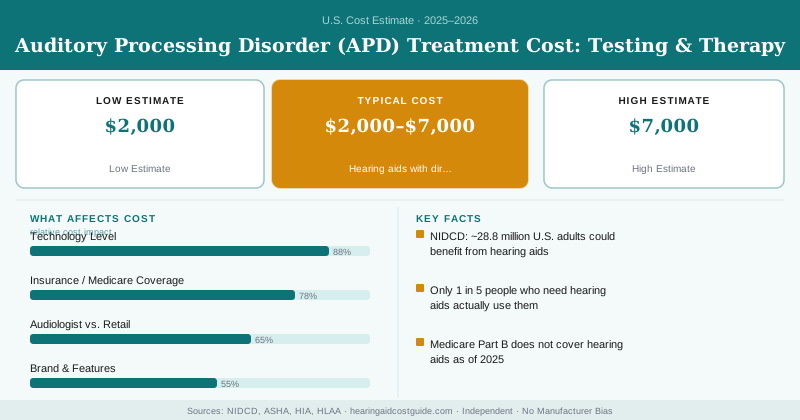
| Hearing aids with directional mics | $2,000–$7,000/pair | Helps signal-to-noise ratio even without true hearing loss |
Treatment Options
Treatment for APD isn’t one-size-fits-all. Your audiologist will typically recommend a combination of approaches based on the severity of your deficits and your daily environment.
Environmental modifications are usually the first step — and often the lowest cost. Simple changes like preferential seating (closer to the speaker, away from noise sources), reducing background noise during conversations, and using written follow-up for complex instructions can significantly reduce the burden on the auditory processing system.
Auditory training therapy is the most direct intervention. Sessions with a trained audiologist or speech-language pathologist target the specific processing deficits identified in your evaluation. Programs like LACE (Listening and Communication Enhancement), Fast ForWord, and Earobics provide structured exercises that help the brain build more efficient auditory processing pathways. Most courses run 10–20 sessions over three to six months.
Computer-based home programs are a lower-intensity option. LACE, for example, is available as a self-guided program for around $100–$200 and is appropriate for mild APD or as a maintenance tool after completing formal therapy.
FM/DM systems transmit a speaker’s voice directly to the listener via radio signal, dramatically improving signal-to-noise ratio. They’re most associated with classrooms, but they work for meetings, restaurants, and any situation where background noise is the core problem. A personal FM system runs $200–$500 for the device.
In peripheral hearing loss, the problem is in the ear itself — hair cells in the cochlea are damaged and can’t detect certain frequencies. Hearing aids amplify sound to compensate.
In APD, the ear detects sound normally — the problem is upstream, in the neural pathways that process and interpret what was heard. Amplification alone doesn’t fix a processing problem. That’s why someone with APD often says “I can hear you, I just can’t understand you” — and means it literally.
Some people have both conditions simultaneously, which is why a complete evaluation matters. The treatment plans are meaningfully different.
Insurance Coverage
Diagnostic APD evaluations are often covered by health insurance when billed under the appropriate audiology CPT codes — 92620 (auditory processing evaluation, first 60 minutes) and 92621 (each additional 15 minutes). Prior authorization may be required. Call your insurer before the appointment.
Auditory training therapy sessions may fall under a speech therapy benefit if a speech-language pathologist is billing for them. Coverage is inconsistent. Some plans cover it with a referral; others exclude it outright.
Home computer programs are generally not covered under any insurance benefit.
Adults With APD: The Underdiagnosed Population
Children with APD are increasingly identified through school evaluations. Adults — particularly those over 50 — are far less likely to receive a diagnosis. Many spend years believing they have memory problems, attention issues, or social anxiety when the underlying issue is auditory processing.
The cognitive load of listening fatigue is real and measurable. Adults with APD frequently report exhaustion after social situations, withdrawal from group conversations, and a pattern that friends and family misread as disinterest or cognitive decline. A correct diagnosis and treatment plan can change the trajectory significantly.
If you’ve had a normal hearing test but still struggle to understand speech in noise, it’s worth asking your audiologist specifically about APD evaluation.
APD cannot be diagnosed by an online quiz, a teacher’s observation, or a standard hearing test alone. Only a qualified audiologist with specialized training and access to an APD-specific test battery can make this diagnosis. Practices that don’t offer the full multi-component evaluation aren’t equipped to rule APD in or out.
Frequently Asked Questions
A full APD diagnostic battery at an audiology clinic typically costs $500–$1,500 out of pocket. This includes multiple subtests: dichotic listening, temporal processing, and binaural interaction tests. Many insurance plans cover the evaluation when billed with appropriate diagnostic CPT codes. Call your insurer before scheduling and ask specifically about diagnostic audiology coverage.
No — and that's the most common misconception about APD. A standard audiogram in someone with APD usually comes back completely normal. The ears are physically working fine. The problem is in how the brain interprets what it hears. APD is a processing disorder, not a peripheral hearing loss. That's why a regular hearing test won't catch it and why a specialized APD test battery is necessary.
Diagnostic evaluation is often covered under your health insurance's specialist or audiology benefit when billed with the correct CPT codes (such as 92620 or 92621 for auditory processing). Therapy sessions may be covered under a speech therapy benefit, but coverage varies widely by plan. Home-based computer programs are generally not covered. Check with your insurer before your appointment to confirm coverage and prior authorization requirements.