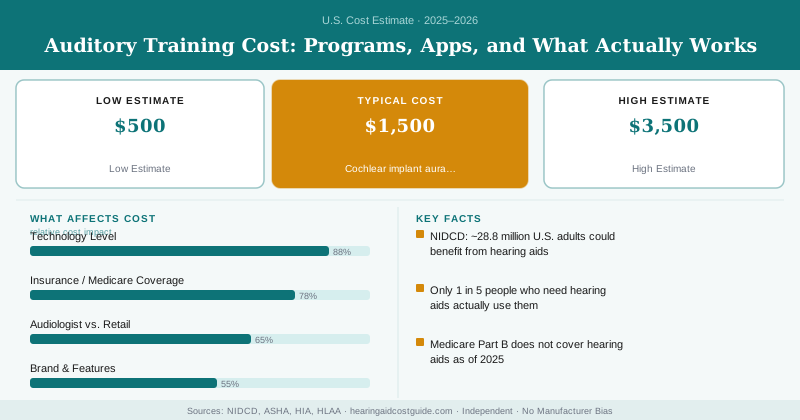
NIDCD estimates 28.8 million Americans could benefit from hearing aids — but only about one in five who need them actually uses one. The gap between “needs hearing help” and “actually getting help” is enormous, and auditory training sits squarely in that space. It’s not a hearing aid. It’s not just “listening harder.” It’s structured practice that genuinely rewires how your brain processes sound — and it costs a fraction of a new pair of hearing aids.
Auditory training is a set of exercises that improve your brain’s ability to decode speech and other sounds, particularly in noisy environments. It matters because hearing loss isn’t just a volume problem. The brain adapts to reduced auditory input in ways that make speech clarity worse — and that brain-level change doesn’t automatically reverse when you start wearing hearing aids. Training accelerates the brain’s re-adaptation.
Auditory Training Costs at a Glance
| Program Type | Low | Typical | High |
|---|---|---|---|
| Self-guided apps (LACE, Angel Sound, etc.) | $0 | $80 | $200/yr |
| Online self-directed programs | $0 | $150 | $400 |
| Group aural rehabilitation (per session) | $25 | $60 | $120 |
| Group aural rehab (full 6-week program) | $150 | $400 | $800 |
| One-on-one auditory training with SLP or AuD | $100 | $200 | $350/session |
| Full individualized program (10-15 sessions) | $1,000 | $2,000 | $4,000 |
| Cochlear implant aural rehab (post-surgery) | $500 | $1,500 | $3,500 |
Most new hearing aid users benefit from 4–10 sessions of guided auditory training, typically costing $400–$2,000. Self-guided digital programs work well for motivated, tech-comfortable users and cost dramatically less.
What Auditory Training Actually Is
Auditory training isn’t passive listening. Structured programs ask you to actively discriminate between sounds, recognize words in increasingly difficult backgrounds, identify phonemes, or follow rapidly changing speech patterns. Think of it as physical therapy for your hearing brain.
The American Speech-Language-Hearing Association (ASHA) defines auditory training as “practice in listening to speech and non-speech stimuli with the goal of improving auditory perception and communication.” Research published in peer-reviewed audiology journals consistently shows that trained listeners perform better on speech-in-noise tasks than untrained hearing aid users with comparable audiograms.
The Best-Studied Programs
LACE (Listening and Communication Enhancement) — One of the most researched auditory training programs for adults. Originally developed at UCSF, LACE is now available as a $75–$120 digital subscription. Studies show that LACE users average a 40% improvement in difficult listening conditions after completing the program.
Angel Sound — A free computer-based auditory training program developed at Tiger Speech Technology. It’s targeted toward cochlear implant users but works well for hearing aid users and anyone with mild-to-moderate hearing loss. Free to use.
ReadMyQuips and HearCoach — Smartphone apps focused on speech reading and auditory discrimination. Most cost $0–$5/month.
Ida Institute’s group programs — Evidence-based group aural rehabilitation programs designed for audiologists to facilitate. Includes Living Well with Hearing Loss and similar curricula. Typically offered through audiology clinics at $50–$120 per session.
Self-Guided vs. Clinician-Led: Which Is Worth the Premium?
Self-guided digital training works well for people who:
- Have good baseline technology skills
- Are motivated to practice 20–30 minutes daily
- Have mild-to-moderate hearing loss
- Are recent hearing aid users still adjusting
Clinician-led training is worth the higher cost for people who:
- Have cochlear implants (the auditory system is literally learning new signals)
- Have auditory processing disorder alongside hearing loss
- Have tried self-guided programs and plateaued
- Have complex listening needs (musicians, teachers, heavy phone users)
- Are post-sudden hearing loss with significant brain adaptation required
One-on-one sessions with a speech-language pathologist (SLP) or audiologist run $100–$350 per session. Most insurance plans cover SLP visits as a medical service when ordered for hearing loss rehabilitation; audiology-delivered aural rehab billing varies more by payer.
Auditory training (aural rehabilitation) is covered by many commercial insurance plans and by Medicare under specific conditions:
- The service must be billed by an in-network audiologist or SLP
- The diagnosis code must be a hearing loss or related condition (ICD-10 codes H90.x–H91.x range)
- Medicare covers aural rehab as a Part B benefit when medically necessary
- Cochlear implant post-surgical auditory training is almost always covered
Ask your audiologist to check your specific plan’s aural rehabilitation benefit before starting a paid program.
Auditory Training for Cochlear Implant Users
If you’ve had cochlear implant surgery, auditory training isn’t optional — it’s essential. The cochlear implant delivers electrical signals that your brain must learn to interpret as meaningful sound. That learning process can take weeks to months and is dramatically accelerated by structured auditory training.
Most cochlear implant centers provide some degree of post-activation auditory training as part of the implant program. What’s included varies widely — some centers provide 5 sessions, others provide 20+. Ask your implant center specifically what’s included in your surgical package and what additional sessions cost.
Typical cochlear implant auditory training programs run $500–$3,500 for the full post-activation period. Many cochlear implant manufacturers (Cochlear, Advanced Bionics, MED-EL) also provide free online training resources for implant recipients.
How Many Sessions Do You Actually Need?
For new hearing aid users without cochlear implants, research suggests 6–10 hours of structured auditory training produces measurable improvement in speech understanding. That translates to:
- About 6 weeks of a self-guided program at 30 minutes/day
- 6–10 one-on-one sessions with an audiologist or SLP
- One 6-week group aural rehabilitation program (typically 90 minutes/week)
Improvement doesn’t stop at 10 hours — it continues with practice. But the steepest gains happen in the first 6–10 hours for most adult learners.
Auditory training is a supplement to, not a replacement for, properly fitted hearing aids. Trying to “train your way” out of amplification doesn’t work for moderate-to-severe hearing loss. The most effective approach combines well-fitted hearing technology with structured listening practice.
Free Resources Worth Using First
Before spending money on a paid program, try these no-cost options:
- Angel Sound (angelsound.tigerspeech.com) — Free, comprehensive auditory training for adults
- HearCoach app (free from Starkey) — Daily hearing exercises in smartphone format
- Cochlear Hearing Tracker — Free for cochlear implant users
- Veterans Affairs LACE Program — Free for VA-enrolled veterans
- ASHA’s Aural Rehabilitation resources — Free educational materials at asha.org
If you go through the free programs and want more structured, personalized guidance, that’s the right time to invest in clinician-led sessions. Don’t skip the free tier — there’s genuinely good science behind it.
Frequently Asked Questions
Auditory training programs range from $0–$3,000 depending on format. Self-guided apps and online programs typically cost $0–$300 per year, group-based aural rehabilitation programs run $500–$1,500 for a full course, and one-on-one professional auditory training with an audiologist can cost $1,500–$3,000 or more.
Insurance coverage for auditory training varies widely; some plans cover it as part of hearing aid fitting and follow-up care, while others classify it as rehabilitation and cover 50–80% of costs if prescribed by an audiologist. Most standalone apps and self-guided programs are not covered by insurance and must be paid out-of-pocket, though some employers offer hearing wellness benefits that may include access to auditory training platforms.
Most auditory training programs require 4–12 weeks of consistent practice (typically 15–30 minutes per day) before you notice measurable improvements in sound discrimination and speech understanding. Results vary by individual and program intensity, but research shows that structured auditory training can rewire how your brain processes sound within 8–12 weeks of regular use.