Most parents of children with hearing loss encounter auditory-verbal therapy within weeks of diagnosis. Many adults post-cochlear-implant activation encounter it too. The recommendation is almost universal. The cost structure, much less so.
AVT sessions run $100–$300 each. Frequency is high in the early intervention period — often weekly or twice weekly. Insurance may cover it as speech-language therapy, deny it as an audiology service, or split the difference in ways that are genuinely hard to predict. Here’s what you’re looking at.
Auditory-Verbal Therapy Cost Overview
| Service | Typical Cost |
|---|---|
| AVT session (45–60 minutes, certified LSLS Auditory-Verbal Therapist) | $150–$300 |
| AVT session (SLP with hearing loss specialization, not LSLS-certified) | $100–$200 |
| Initial evaluation and goal-setting session | $200–$400 |
| Teletherapy AVT session | $100–$200 |
| Group AVT / listening and spoken language therapy | $75–$150 per session |
| Early intervention AVT (age 0–3, IDEA-funded) | $0 — federally mandated |
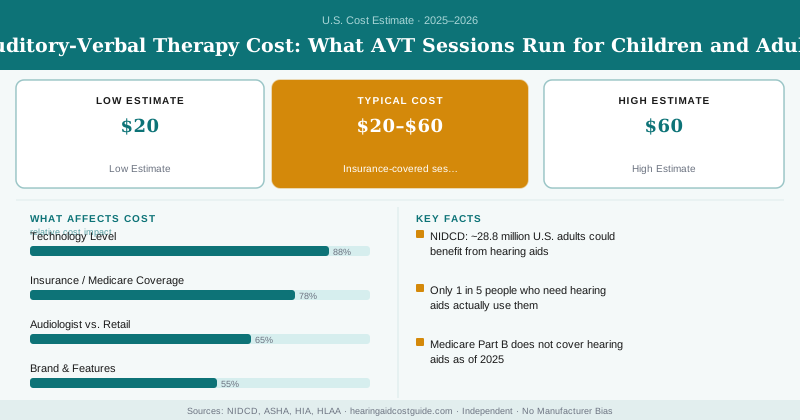
| Insurance-covered sessions (when covered as SLP) | $20–$60 copay |
What Auditory-Verbal Therapy Actually Is
AVT teaches children with hearing loss — and adults post-implant — to listen and speak rather than rely primarily on sign language or lip-reading. It’s a specific approach within the broader “listening and spoken language” (LSL) methodology. The distinguishing feature of AVT is its coaching focus: parents and caregivers participate in every session and are taught to create a listening-rich environment at home.
The highest standard of practice is delivered by an LSLS (Listening and Spoken Language Specialist) with an AVT certification — a credential administered by the Alexander Graham Bell Academy for Listening and Spoken Language (AG Bell). There are approximately 1,000 LSLS Auditory-Verbal Therapists worldwide, with concentration in major metropolitan areas. Scarcity drives some of the pricing.
ASHA reports that approximately 2–3 in 1,000 children in the United States are born with detectable hearing loss — and early intervention outcomes depend heavily on therapy intensity and timing. Research consistently shows that children who begin auditory-verbal intervention before age 6 months achieve significantly better spoken language outcomes than those who start later.
An LSLS Auditory-Verbal Therapist has completed specific mentored hours, passed a board exam, and maintains certification through continuing education. An SLP who specializes in hearing loss but isn’t LSLS-certified may provide excellent AVT-informed therapy at a lower rate — or less rigorous therapy, depending on the individual’s training. Both types appear in insurance networks. Ask any therapist about their specific training in AVT and cochlear implant rehabilitation before booking.
Who Needs Auditory-Verbal Therapy
AVT is primarily recommended for:
- Infants and young children with hearing loss who’ve been fitted with hearing aids or received cochlear implants and whose families want them to develop spoken language
- School-age children working on speech discrimination and spoken language skills in parallel with hearing device use
- Adults post-cochlear-implant activation who need to retrain auditory pathways to interpret electrical hearing signals as speech
- Adults with new hearing aids who are struggling significantly with speech understanding even after appropriate fitting
The therapy is not a requirement for hearing device use. Many children and adults do very well without formal AVT — particularly those with milder losses or those who receive intensive support in other educational contexts. But for cochlear implant recipients and children identified with significant hearing loss in infancy, AVT is typically recommended as the primary rehabilitation vehicle.
Insurance Coverage: The Unpredictable Variable
Whether insurance pays for AVT depends on how the claim is coded and how your insurer categorizes it:
- Billed as speech-language therapy (CPT 92507 or 92508): Many commercial plans cover this with a specialist copay. ASHA recommends this coding for AVT delivered by SLPs.
- Billed as audiological rehabilitation (CPT 92626 or V5020): Coverage is inconsistent. Some plans exclude “hearing-related” services explicitly.
- Billed by an LSLS-AV Therapist who is also a licensed SLP: More likely to receive coverage as SLP services.
Medicaid coverage for AVT in children varies by state and falls under Early Intervention (Part C, ages 0–3) and then school-based services (Part B, ages 3–21) under IDEA. These programs don’t require specific AVT practitioners — but they’re funded services you’re entitled to access.
Early intervention services for children under age 3 are federally mandated and provided at no cost under the Individuals with Disabilities Education Act (IDEA). If your child has documented hearing loss, contact your state’s Early Intervention program immediately. The service is free and the intensity of support during this window significantly impacts language outcomes.
| Age Group | Primary Funding Source | Expected Out-of-Pocket |
|---|---|---|
| Birth to 3 (Early Intervention) | IDEA Part C / state programs | $0 |
| Ages 3–21 (school-based) | IDEA Part B / school district | $0 for IEP services |
| Adults / not in school system | Private insurance + self-pay | $20–$300/session |
| Adults post-cochlear-implant | Medicare / commercial insurance | Copay or 20% coinsurance |
Teletherapy: The Geographic Access Solution
Access to certified LSLS Auditory-Verbal Therapists is a genuine geographic problem — they’re concentrated in major cities and university medical centers. Teletherapy has substantially expanded access since 2020.
Teletherapy AVT sessions run $100–$200, roughly 20–30% less than in-person rates at many practices. Several specialized AVT programs — including the Listen Foundation and AG Bell–affiliated providers — offer teletherapy as a primary service delivery model. State licensure requirements for SLPs complicate cross-state billing, but most providers have adapted to serve patients across multiple states.
If your child has hearing loss and isn’t yet connected with Early Intervention services, contact your state’s Part C program today. Every state has one. Services are available regardless of income, and the therapy window from birth to age 3 is clinically the most important period for language development. Don’t wait for a referral from a pediatrician — you can self-refer.
Reducing Costs
- Invoke IDEA rights: Children 0–21 are entitled to free appropriate public education that includes related services like speech-language therapy. An IEP can include AVT-aligned goals.
- University training clinics: Programs training LSLS therapists often see clients at reduced cost ($30–$80/session) under certified supervision.
- AG Bell financial assistance: The Alexander Graham Bell Association offers grants and lists scholarship resources for families who qualify.
- HSA/FSA: AVT sessions prescribed by a physician qualify as medical expenses. Use pre-tax dollars if you’re self-paying.
- Appeal insurance denials: Document the functional necessity of AVT with your audiologist’s notes and cochlear implant team’s records. AVT for cochlear implant rehabilitation has strong insurer acceptance when framed as post-surgical rehabilitation.
The Bottom Line
Auditory-verbal therapy costs $100–$300 per session out of pocket, but children under 3 receive it free through federal early intervention programs, and school-age children may receive it through their IEP. For adults post-implant, insurance often covers it as speech therapy with a specialist copay. The earlier therapy begins, the greater the spoken language outcomes — so the priority is access and timing, not finding a cheaper provider.
Frequently Asked Questions
AVT sessions typically cost between $100 and $300 per session, depending on the therapist's credentials, location, and clinic setting. Families in early intervention phases often attend weekly or twice-weekly sessions, which can total $400–$2,400 per month before insurance.
Insurance coverage is inconsistent—some plans cover AVT as speech-language pathology services under speech therapy benefits, while others deny it as an audiology service outside their scope. Your out-of-pocket responsibility depends on your plan's classification and whether you meet your deductible, but uninsured families typically pay the full $100–$300 per session.
Children diagnosed with hearing loss and fitted with hearing aids or cochlear implants usually begin AVT within weeks of diagnosis, as do most adults after cochlear implant activation. Duration varies widely, but intensive early intervention typically spans 12–24 months, with frequency decreasing as listening and speech skills improve.