Walk into a Beltone center and you’ll notice immediately it’s a different experience than most audiology practices. Beltone is a franchise retail hearing aid network — more than 1,500 locations across the U.S. — and their model is built around accessibility and service as much as the devices themselves. That’s a feature for some buyers and a sales funnel for others. Understanding which it is for you starts with knowing what you’re paying for.
Beltone Hearing Aid Price Ranges
| Model / Tier | Price Per Pair | Technology Level | Key Features |
|---|---|---|---|
| Beltone Imagine (entry) | $2,500–$3,500 | Essential | Basic amplification, directional mics |
| Beltone Amaze (standard) | $3,500–$4,800 | Standard | Noise reduction, Bluetooth, app control |
| Beltone Serene (advanced) | $4,800–$6,000 | Advanced | Better speech-in-noise, music mode |
| Beltone Achieve (premium) | $6,000–$7,200 | Premium | Full feature set, AI processing, fall alerts |
| Beltone Boost (BTE power) | $3,000–$5,500 | Standard–Advanced | Severe-profound loss, powerful BTE |
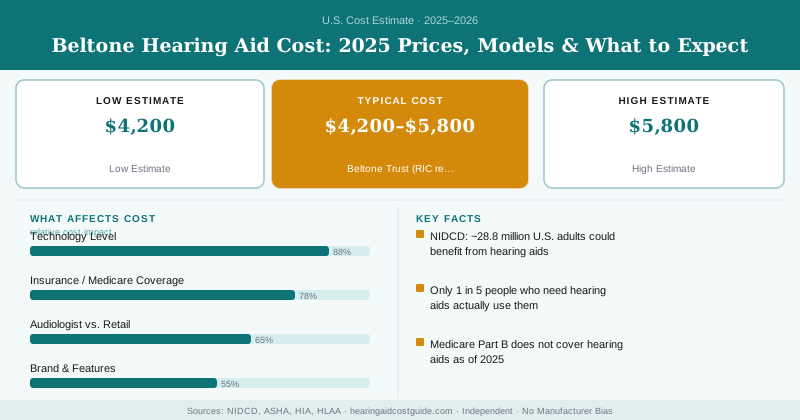
| Beltone Trust (RIC rechargeable) | $4,200–$5,800 | Advanced | Rechargeable, slim RIC, streaming |
The Beltone Brand and Ownership
Beltone is a wholly owned subsidiary of GN Hearing (same parent company as ReSound). That’s significant because Beltone and ReSound devices share the same underlying hearing aid chip platform — the OMNIA and Nexia platforms are Beltone-branded versions of ReSound technology with a different retail model and service overlay.
In practice, you’re buying equivalent hearing aid technology to a mid-tier ReSound product but paying a slight premium for the Beltone franchise service model: more locations, longer business hours, and a more structured follow-up care program than many independent audiologists.
Whether that service premium is worth it depends on how much you value in-person support and follow-up availability. If you travel frequently and want to get your aids adjusted at a Beltone center in another city, the nationwide franchise network is a genuine advantage.
What’s Included With a Beltone Purchase
Beltone’s pricing model is typically bundled, meaning the purchase price includes:
- Comprehensive hearing evaluation at the Beltone center (by a hearing instrument specialist, not always an audiologist — verify credentials at your specific location)
- Hearing aid fitting and programming session
- 30–60 day trial period with a return policy
- 1–3 years of follow-up adjustments
- 2–3 year manufacturer warranty
- HearMax app (iOS/Android) for remote control and adjustments
Beltone centers are staffed by licensed hearing instrument specialists (HIS), not always audiologists (AuD). For most adults with typical sensorineural hearing loss, a HIS can fit hearing aids effectively. If you have complex hearing loss, cochlear disorders, or have never been evaluated, an audiologist at a medical audiology practice provides more comprehensive diagnostic capabilities. Beltone centers do refer to ENT/audiology when needed.
Beltone’s Remote Fine-Tuning
All current Beltone models support remote fine-tuning via the HearMax app. Your Beltone specialist can push updated settings to your aids from any location with an internet connection. This is functionally similar to Starkey’s TeleCare and Signia’s TeleCare system — real-time remote adjustment between in-person visits.
For patients who moved away from their original Beltone center or live in rural areas where driving for an adjustment isn’t practical, this is a legitimate benefit.
Is Beltone Overpriced?
The common criticism of franchise hearing aid retailers — Beltone, Miracle-Ear, and similar chains — is that they charge more than independent audiologists for comparable technology. That’s sometimes true and sometimes not.
At the entry and standard levels ($2,500–$4,800), Beltone pricing is roughly in line with independent audiologist pricing for equivalent technology tiers. At the premium level ($6,000–$7,200), you can find comparable ReSound-platform technology at independent audiology practices for slightly less.
Where Beltone often wins: consistent service availability, standardized trial periods, and transferability of service agreements between locations. Where they sometimes lose: the hearing evaluation is conducted by a HIS rather than an AuD, and upselling to higher technology tiers is a common franchise complaint.
How Beltone Compares to Costco
A common question: Beltone vs. Costco. Costco sells ReSound aids (same parent company as Beltone) at $1,500–$2,500 per pair with audiologist fitting. That’s $1,000–$3,000 less than Beltone for similar technology.
What Costco doesn’t offer: franchise network coverage, remote fine-tuning in same-brand locations when you travel, or Beltone’s specific service model. If you live near a Costco and value low upfront cost over broad service access, Costco is the better financial choice for most buyers.
The NIDCD Perspective
NIDCD data consistently shows that cost is the number-one reason adults with treatable hearing loss don’t use hearing aids — affecting approximately 4 in 5 adults who could benefit. Beltone’s franchise model, for all its upsell potential, does put professional hearing care within geographic reach for many communities that lack independent audiology practices. For older adults in smaller cities, Beltone may be the most accessible option within driving distance.
The right choice is the hearing aid you’ll actually wear consistently. If Beltone’s service model and location access mean you’re more likely to get your aids adjusted when needed and less likely to leave them in a drawer, the extra cost over generic alternatives may be worth it.
Frequently Asked Questions
Beltone hearing aids range from $2,500 to $7,200 per pair, depending on the model and technology level you choose. Entry-level models start around $2,500, while premium models with advanced features can exceed $7,000 per pair.
Most traditional Medicare and private insurance plans do not cover hearing aids, leaving you responsible for the full out-of-pocket cost at Beltone. However, some Medicare Advantage plans and employer-sponsored insurance may offer partial coverage; you should contact your insurer directly to confirm your specific benefits.
The fitting process typically takes 1–2 visits over the course of 1–2 weeks, starting with a hearing test and consultation followed by device fitting and adjustments. Most patients receive their devices within 2–4 weeks from the initial appointment, depending on whether custom molds are needed.