Here’s something a lot of hearing aid shoppers don’t know: Bernafon is owned by the same parent company — Demant — as Oticon. That matters because it means Bernafon devices share research infrastructure with one of the most respected names in audiology, while often carrying a lower price tag. If your audiologist mentions Bernafon as an alternative, don’t dismiss it.
Who Makes Bernafon?
Bernafon is a Swiss hearing aid brand founded in 1946. Since 2000 it’s operated under Demant A/S, the Danish conglomerate that also owns Oticon, Sonic, and several other hearing care brands. Bernafon tends to be less marketed to consumers directly, so many buyers haven’t heard of it — which is exactly why audiologists sometimes recommend it for value-conscious patients who want performance close to the Oticon tier at a lower price.
Current Bernafon Lineup
Bernafon’s two main current platforms are:
- Alpha: The current flagship, launched in 2021–2022, with DECS (Dual Engine Controller System) processing.
- Viron: An entry-to-mid platform positioned for cost-sensitive buyers.
Bernafon Alpha Prices
| Model | Per Device | Per Pair (Est.) |
|---|---|---|
| Alpha 9 (premium) | $2,200–$4,200 | $4,400–$8,400 |
| Alpha 7 (advanced) | $1,700–$3,000 | $3,400–$6,000 |
| Alpha 5 (standard) | $1,400–$2,200 | $2,800–$4,400 |
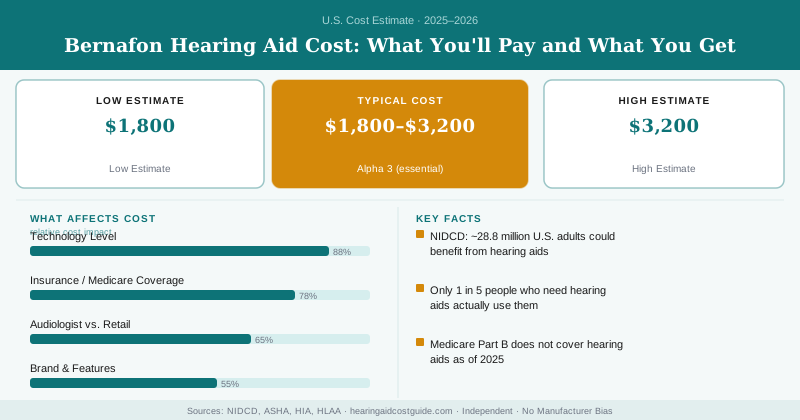
| Alpha 3 (essential) | $900–$1,600 | $1,800–$3,200 |
Viron models typically run $800–$2,000 per device — a meaningful step below Alpha.
What DECS Processing Does
Bernafon’s DECS (Dual Engine Controller System) runs two processing engines simultaneously. One handles the acoustic environment; the other focuses on speech clarity. The system decides in real time how to balance between them based on what’s happening around you.
In quiet settings, DECS prioritizes the full, natural sound environment. In noisy settings, it shifts to maximize speech audibility. Independent audiologists who’ve tested Bernafon Alpha describe its sound as “natural” and “less processed-sounding” than some competitors — a quality some wearers, especially music lovers, strongly prefer.
Some premium brands use aggressive directional microphone systems that dramatically narrow what you hear in order to focus on speech. Bernafon takes a more conservative approach: it preserves more of the surrounding sound environment. Whether that’s a feature or a drawback depends entirely on your hearing loss profile and listening preferences. Ask your audiologist for a demonstration in a restaurant-like environment to compare.
Style Options
Bernafon Alpha comes in several styles:
- DECS: miniRITE rechargeable (most popular)
- CIC: Completely-in-canal (battery-powered, smallest profile)
- BTE: Behind-the-ear for more severe losses
- Custom ITE/ITC: In-the-ear custom-fit styles
Rechargeable versions add roughly $150–$300 to the base price.
How Bernafon Compares to Oticon
Since both brands are under Demant, there’s real overlap in underlying technology. The Bernafon Alpha 9 draws on some of the same neural processing research that powers Oticon’s platform — though Oticon’s devices receive newer feature updates first and typically push the technology further. Think of Bernafon as the value tier of the Demant family: solid, well-engineered, and priced to be accessible.
According to the ASHA (American Speech-Language-Hearing Association), audiologists recommend individualized selection based on audiogram type, lifestyle, and budget — which means there’s no single “best” brand, only the best fit for the individual.
Bernafon App and Connectivity
The Bernafon App (iOS and Android) provides volume and program control, a remote control for caregivers, and hearing fitness tracking. Bluetooth streaming works with iPhones directly; Android streaming requires the SoundClip-A accessory on some models, adding $150–$250.
Reducing the Cost
- Insurance: Bernafon is accepted by most hearing insurance networks and many Medicare Advantage hearing benefit programs.
- HSA/FSA: Fully qualified medical expense under IRS rules.
- Ask about prior-generation models: Bernafon keeps older platforms (like the Viron) in production at reduced prices.
- Costco: Bernafon doesn’t currently sell through Costco, but some independent networks offer comparable pricing.
The NIDCD reports that untreated hearing loss is associated with accelerated cognitive decline — a finding that underscores the real health cost of delaying treatment for financial reasons. Choosing Bernafon Alpha 5 at $2,800–$4,400 per pair may be the decision that makes treatment financially viable.
Bernafon isn’t carried by as many audiologists as Oticon or Phonak. If your current audiologist doesn’t offer it, ask for a referral or search the Bernafon provider locator. The device works best when fitted by someone experienced with the platform.
Bottom Line
Bernafon Alpha delivers premium-tier performance — rooted in the same Demant research platform as Oticon — at prices that typically run 10–20% less. If you’ve been quoted $7,000+ for a pair of Oticon devices, it’s worth asking whether Bernafon Alpha 9 or 7 might meet your needs at a lower price. For wearers who prioritize natural sound quality over aggressive noise cancellation, Bernafon deserves serious consideration.
Frequently Asked Questions
Bernafon hearing aids typically cost $1,400–$4,200 per device, depending on the model and technology level. The Alpha and Viron lineups span this price range, with advanced features like DECS signal processing found in higher-priced models. Most patients purchase two devices (one for each ear), so total out-of-pocket costs can range from $2,800–$8,400 before insurance.
Medicare does not cover hearing aids, including Bernafon devices, leaving most seniors responsible for the full cost. Some private insurance plans and employer-sponsored benefits offer partial coverage of $500–$2,000 per device, though many plans exclude hearing aids entirely. You'll need to check your specific policy or contact your insurer to determine your out-of-pocket responsibility.
Bernafon is owned by Demant, the same parent company as Oticon, one of the most respected hearing aid manufacturers in audiology. This ownership means Bernafon devices benefit from shared research and development while typically carrying a lower price tag than Oticon's comparable models. If your audiologist recommends Bernafon, it's backed by the same scientific credibility and infrastructure as a major industry leader.