Single-sided deafness is one of the most underdiagnosed and undertreated hearing conditions in the U.S. — partly because so many patients assume that with one working ear, they’re fine. But the Hearing Health Foundation estimates that 60,000 Americans develop single-sided deafness each year, and the reality of living with it — the constant head-turning, the exhaustion in group conversations, the struggle in noise — pushes many people toward a solution they’ve never heard of: BiCROS.
If CROS (Contralateral Routing of Signals) is for people with one completely deaf ear and one normal ear, BiCROS is for people with one completely deaf ear and one ear with some hearing loss — a more common real-world scenario. Understanding the cost difference, and why BiCROS systems are priced the way they are, makes the path to better hearing a lot clearer.
CROS vs. BiCROS: The Key Difference
In a CROS system: A microphone on the deaf side transmits sound wirelessly to a receiver on the hearing ear. The hearing ear needs no amplification — it just receives the signal from the bad side.
In a BiCROS system: Same concept, but the receiver on the hearing side is also a full hearing aid — because that ear also has some hearing loss that needs amplification. You’re getting two functions from the hearing-side device: the routed signal from the deaf side plus amplification for that ear’s own needs.
This distinction matters for cost: a BiCROS system is essentially two hearing aids, not one. The transmitter sits on the deaf side, and the hearing aid (doing double duty as a receiver and amplifier) sits on the hearing side.
BiCROS Cost by Technology Tier
| Technology Tier | BiCROS System Cost | Per Device |
|---|---|---|
| Entry-level (basic wireless) | $2,000–$3,500 | $1,000–$1,750 |
| Mid-range (Bluetooth, rechargeable) | $3,500–$5,500 | $1,750–$2,750 |
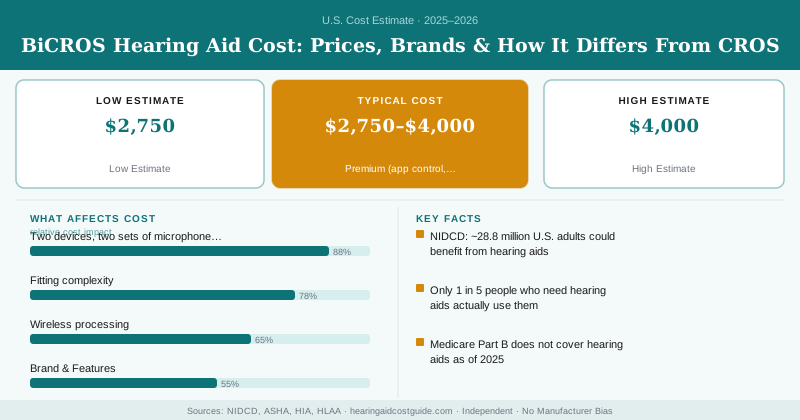
| Premium (app control, AI processing) | $5,500–$8,000 | $2,750–$4,000 |
Note: “per device” pricing is how audiologists often quote it, but you always buy both sides — the transmitter on the deaf side and the hearing aid on the hearing side.
Major BiCROS Brands and Models
Phonak Audéo Paradise/Lumity CROS B-R: Phonak’s BiCROS system uses a CROS B transmitter paired with any Phonak Lumity or Paradise receiver hearing aid. The Phonak system benefits from automatic environment classification (AutoSense), rechargeable batteries, and Roger Direct compatibility. Pair cost: $3,500–$6,500.
ReSound CROS with Jabra/Nexia: ReSound’s CROS transmitter pairs with compatible ReSound hearing aids on the hearing side. The All Access Directionality feature on the hearing side is particularly well-regarded for BiCROS users in noise. Pair cost: $3,200–$6,000.
Signia CROS Pure: Signia’s BiCROS system includes their e2e wireless 3.0 technology. The Signia app allows streaming and remote adjustments. Pair cost: $3,000–$5,500.
Widex CROS: Widex CROS transmitter pairs with MOMENT or MAGNIFY hearing aids. Known for natural sound quality. Pair cost: $3,500–$6,500.
Starkey BiCROS: Starkey’s CROS transmitter works with Genesis AI hearing aids. Includes Starkey’s health tracking features. Pair cost: $3,800–$7,000.
BiCROS fitting is more complex than standard hearing aids. The brain needs time to integrate the routed signal from the deaf side — most new BiCROS users report it sounds “strange” for the first 2–6 weeks. Always get at least a 30-day trial with return policy before committing. The 45–75 day trial offered by many audiologists is ideal for BiCROS.
What Drives BiCROS Costs Higher Than Standard Hearing Aids
Two devices, two sets of microphones and batteries: Even though the CROS transmitter on the deaf side doesn’t amplify, it’s a sophisticated wireless device with directional microphones, real-time transmission, and its own battery management.
Fitting complexity: BiCROS programming requires more audiological expertise. The hearing aid on the hearing side must be optimized for both the patient’s own hearing loss AND the incoming CROS signal. Multiple follow-up appointments are typical.
Wireless processing: Low-latency, high-quality wireless transmission between the two sides adds processing cost. Cheap wireless introduces a noticeable delay that’s disorienting — premium BiCROS systems prioritize minimal latency.
The American Speech-Language-Hearing Association (ASHA) notes that BiCROS users benefit most when the hearing side hearing aid is fit to real-ear-verified targets — not just programmed by formula. Make sure your audiologist performs real-ear measurement (REM) as part of the fitting.
Insurance Coverage
BiCROS systems run into the same insurance challenges as standard hearing aids — most commercial plans provide limited or no hearing aid coverage. But there are exceptions worth pursuing:
- Medicare Advantage: Many Medicare Advantage plans include hearing aid benefits. Some specifically cover BiCROS as a pair; others cover only the hearing aid side. Confirm with your plan.
- State Medicaid: Coverage varies widely. Some states cover one hearing aid; BiCROS may be approved as a two-device medical necessity.
- VA benefits: Veterans with service-connected single-sided deafness often receive BiCROS systems through the VA at no cost.
- Children under 21: CHIP and Medicaid generally cover BiCROS for children with documented need.
For the hearing aid component (the hearing side device), HCPCS codes V5260 (behind-ear hearing aid) or appropriate codes for the specific style apply. The CROS transmitter is sometimes billed separately under V5267 (hearing aid accessories) — ask your audiologist to confirm accurate billing.
Don’t confuse BiCROS with CROS or with bone-anchored systems (BAHA/Osia). BAHA is a surgically implanted option for single-sided deafness that works very differently. If you’re comparing BiCROS to BAHA, your audiologist can run a trial with a BAHA softband before committing to surgery — that comparison is worth doing before choosing either system.
Alternatives to BiCROS Worth Knowing
- BAHA/Osia (bone-anchored implant): Surgically anchored device that routes sound through bone conduction. Better for some patients with conductive loss in the hearing ear. Surgery cost: $15,000–$35,000.
- Transcranial CROS: A very powerful hearing aid on the deaf side, loud enough for bone conduction to carry sound to the other cochlea. Works for some patients; awkward fit for others.
- Cochlear implant: For some single-sided deafness cases, a cochlear implant on the deaf side is now FDA-approved and insurance-covered. This is an increasingly viable option that BiCROS patients should discuss with their surgeon.
Bottom Line
BiCROS systems cost $2,000–$8,000 depending on technology tier, with most premium systems from Phonak, ReSound, and Widex landing in the $4,000–$6,500 range. Insurance coverage is limited for most commercially insured patients, but VA benefits, CHIP, and Medicare Advantage plans are all worth checking before paying out of pocket. Always take advantage of a 30–60 day trial period — BiCROS fitting has a real adjustment curve, and making sure it works for your specific lifestyle before committing is essential.
Frequently Asked Questions
BiCROS hearing aids typically cost between $2,500 and $7,000 per pair, depending on the brand, technology level, and features included. Premium models from leading manufacturers may exceed $7,000, while basic models start around $2,500. Prices often vary by audiologist or hearing aid provider.
Coverage varies significantly by insurance plan; Medicare does not cover hearing aids, leaving most seniors with out-of-pocket costs. Some private insurance plans and Medicaid programs in certain states may cover 50–80% of BiCROS costs, though many plans exclude them entirely or cap coverage at $500–$2,000 per pair. Check your specific plan details with your insurance provider to determine your coverage and out-of-pocket responsibility.
BiCROS hearing aids are designed for people with single-sided deafness or severe hearing loss in one ear and normal to mild hearing loss in the other ear. Your audiologist will conduct a hearing test and assess your specific situation to determine if BiCROS is appropriate or if CROS (for normal-hearing ears) would be better suited. Most candidates can be fitted within 1–2 weeks of the initial evaluation.