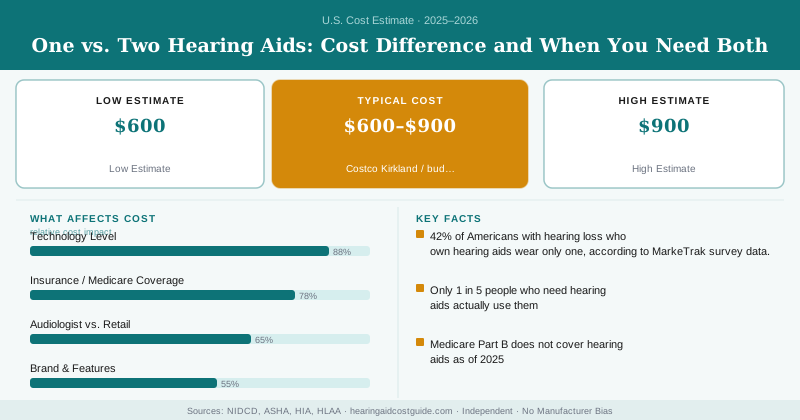
42% of Americans with hearing loss who own hearing aids wear only one, according to MarkeTrak survey data. For some, that’s a clinical decision. For many, it started as a way to cut the cost in half.
The math seems obvious: hearing aids run $2,500–$8,000 per pair, so one hearing aid costs roughly half. But “roughly half” turns out to be more complicated than it looks — and for most people with bilateral loss, the long-term cost of starting with one aid ends up higher than the upfront savings suggest.
Here’s how the numbers actually break down, and how to tell whether a monaural fitting makes clinical sense for your situation.
Hearing Aid Cost: One vs. Two
| Hearing Aid Category | Cost — One Aid | Cost — Two Aids | Difference |
|---|---|---|---|
| OTC / Entry-level | $400–$800 | $800–$1,600 | $400–$800 |
| Basic prescription (entry) | $1,200–$1,800 | $2,400–$3,600 | $1,200–$1,800 |
| Mid-range prescription | $1,600–$2,500 | $3,200–$5,000 | $1,600–$2,500 |
| Premium prescription | $2,000–$4,000 | $4,000–$8,000 | $2,000–$4,000 |
| Costco Kirkland / budget bundle | $600–$900 | $1,200–$1,800 | $600–$900 |
Note: Most audiologists price hearing aids per pair. If you request one aid, you typically pay approximately half the pair price, though some clinics charge a fitting fee regardless of how many aids are dispensed.
The Clinical Case for Two Aids (Bilateral Fitting)
Most adults with hearing loss have it in both ears — NIDCD data shows that bilateral hearing loss accounts for roughly 80% of all adult hearing loss cases. For this group, here’s why audiologists almost universally recommend bilateral fitting:
Binaural summation. Two ears working together provide 3–6 dB better signal-to-noise ratio than one. That’s not trivial — 3 dB represents a doubling of acoustic power. In noisy environments, this translates to meaningfully better speech understanding.
Sound localization. Your brain determines where sounds come from by comparing tiny timing and volume differences between your two ears. With one aided ear, you lose directional hearing almost entirely. You won’t hear a car approaching from the unaided side. You can’t identify which direction someone’s calling you from.
Auditory deprivation. An unaided ear with hearing loss continues to receive poor sound input — and the auditory cortex responds by gradually becoming less efficient at processing speech. This “use it or lose it” effect is well-documented and means a later attempt to add the second aid may yield less benefit than if both were fitted from the start.
Research published in Ear and Hearing found that unaided ears in adults with bilateral hearing loss show measurable decline in word recognition scores after 4–5 years compared to aided ears. If you start with one aid intending to “add the second one later,” the window for full benefit from the second aid is not unlimited. Most audiologists recommend not waiting longer than 12–18 months after the first fitting.
When One Hearing Aid Is Clinically Appropriate
There are genuine situations where a monaural fitting is the right call:
- Unilateral hearing loss: Only one ear has significant loss. The other is normal or near-normal. This is a clear case for one aid.
- Significant asymmetric loss: One ear has much worse speech discrimination. Sometimes a second aid provides no functional benefit and can even create confusion.
- Single-sided deafness (SSD): One ear has profound-to-total hearing loss. In this case, a conventional hearing aid on the deaf ear won’t help — a CROS system or bone-anchored device is a different solution.
- Contraindication in one ear: Chronic ear infections, drainage, or anatomy that makes ear canal fitting inappropriate.
Your audiogram — specifically your word recognition scores (WRS) in each ear, not just your pure-tone thresholds — is what determines this. An ear with a 40 dB loss and 96% WRS may benefit enormously from amplification. An ear with a 35 dB loss and 48% WRS may provide little useful information even when amplified.
The “Start with One” Strategy: Does It Save Money?
A common approach: buy one hearing aid to test the waters, then add the second later if it helps. The actual cost outcome:
Scenario A — Buy two aids upfront: $4,500 for a mid-range pair
Scenario B — Buy one, add second 12 months later: First aid ~$2,500 + second aid ~$2,500 = $5,000 total
Why is Scenario B more expensive? Because audiologists often charge a second fitting fee ($150–$400) when you add the second aid later. Some clinics offer bilateral pricing packages that are genuinely cheaper per unit. And if you upgrade the first aid before adding the second (which happens more often than you’d think), you pay for an aid that gets replaced.
The honest recommendation from most audiologists: if you have bilateral loss and you’re going to fit both ears eventually, fit them together and negotiate the best bilateral package price upfront.
Be cautious of any clinic that strongly steers you toward one hearing aid when your audiogram shows bilateral loss — especially if the clinic earns the same fitting fee per device regardless of how many are sold. Conversely, be cautious of pressure toward bilateral fitting when your audiogram genuinely shows asymmetric loss where the second aid provides minimal benefit. Ask your audiologist to walk through the word recognition scores for each ear and explain the recommendation.
Negotiating Bilateral Pricing
When shopping for hearing aids with bilateral loss:
- Ask for pair pricing explicitly — most clinics have package rates
- Ask whether fitting fees are per-device or per-pair — this affects real cost significantly
- Costco, Sam’s Club, and online providers often offer better per-unit pricing on pairs than traditional audiology clinics
- Insurance: Some plans cover “one aid per impaired ear” — meaning bilateral loss may be covered for two aids. Always check your policy’s exact language.
For most adults 55+ with loss in both ears, the clinical and practical case for two aids is strong. The cost is real — but so is the cost of diminished speech understanding, lost localization, and the risk of auditory deprivation in the unaided ear over time.
Frequently Asked Questions
If you have significant hearing loss in both ears, fitting only one is generally not recommended by audiologists. The unaided ear degrades faster in auditory deprivation, you lose localization (knowing where sounds come from), and you get no benefit in noisy environments on the unaided side. The cost savings are real but they come with real clinical tradeoffs.
If the difference between ears is large enough, a monaural fitting can be appropriate — your audiologist makes this determination based on your audiogram. Asymmetric losses where one ear is normal or near-normal may genuinely call for one aid. The decision should be data-driven, not budget-driven.