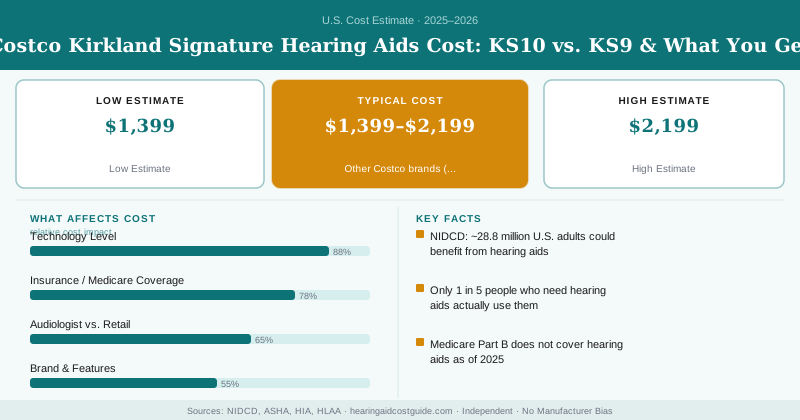
The $1,499 price tag on the Kirkland Signature 10.0 has quietly become one of the most disruptive figures in American hearing care. That’s not a marketing claim — Consumer Reports ranked Costco the highest-rated hearing aid retailer in the U.S. for multiple consecutive years, beating out private audiology practices and every major retail chain on member satisfaction. At Costco, the Kirkland Signature line sits at the center of that value story.
Here’s what the KS10 actually costs, what technology it’s based on, and whether it’s the right fit for your hearing loss.
Kirkland Signature Hearing Aid Prices (2025)
| Model | Price Per Pair | Technology Base | Style |
|---|---|---|---|
| Kirkland Signature 10.0 (KS10) | $1,499 | Phonak Audéo Paradise platform | RIC rechargeable |
| Kirkland Signature 9.0 (KS9) | Discontinued | Phonak Audéo Marvel platform | RIC rechargeable |
| Other Costco brands (Jabra, Philips, Rexton) | $1,399–$2,199 | GN, Demant, Signia | RIC rechargeable |
Costco sells hearing aids only in pairs. If you need one ear fitted, you’ll still pay the pair price — that’s a structural quirk worth knowing upfront.
What Makes Kirkland Different From Generic Store Brands
Kirkland Signature isn’t Costco’s in-house electronics team slapping a label on a budget component. The KS10 is manufactured by Sonova — the same Swiss company that owns Phonak, Unitron, and Hansaton. Multiple independent audiologists have confirmed the KS10 uses the same Sonova Paradise chip platform that powered the Phonak Audéo Paradise, which retailed for $5,000–$6,500 per pair at private clinics.
It’s not identical to the commercial Phonak line — Costco-exclusive SKUs use a slightly modified firmware and feature set — but functional performance for the vast majority of buyers with mild-to-moderate hearing loss is nearly equivalent.
The current Phonak flagship is the Audéo Lumity (2023), which adds improved speech-in-noise algorithms over the Paradise platform. The KS10 uses Paradise-era technology — one generation behind. For most users with mild-to-moderate sensorineural hearing loss, the real-world performance difference is small. For people with severe loss or complex listening environments (restaurants, large groups, noisy workplaces), the Lumity’s updated AutoSense OS may deliver a noticeable edge.
What’s Included in the $1,499 KS10 Price
This is where Costco genuinely stands out from budget hearing aid options. The $1,499 isn’t just for the devices — it includes a bundle of services that add real value over the product’s lifespan:
- Comprehensive hearing evaluation by a licensed hearing instrument specialist (HIS)
- Hearing aid fitting with real-ear measurement at select locations
- Three years of free follow-up appointments for adjustments, programming changes, and cleaning
- Three-year loss and damage coverage (one replacement per aid, per period)
- Rechargeable batteries and charging case included
- Free in-store cleanings at any Costco Hearing Aid Center
At a private audiology practice, professional services over 3 years — fittings, adjustments, cleanings, warranty management — typically add $800–$1,500 on top of the device cost. Costco bundles all of it.
The NIDCD Cost Barrier — and Why Kirkland Matters
According to the National Institute on Deafness and Other Communication Disorders (NIDCD), approximately 28.8 million U.S. adults could benefit from hearing aids, but fewer than 1 in 3 adults over age 70 who need them actually use them. Cost is consistently cited as the primary barrier. The average American waits 7–10 years from first noticing hearing loss to getting fitted.
At $1,499 per pair versus the $5,000–$7,000 industry average, the KS10 directly addresses the cost gap that NIDCD data says is keeping millions of adults from treating their hearing loss. That’s not trivial — untreated hearing loss is associated with accelerated cognitive decline, social isolation, and increased fall risk in older adults.
Who Should Choose the KS10
The Kirkland Signature 10.0 makes the most sense if you:
- Have mild-to-moderate sensorineural hearing loss
- Live within driving distance of a Costco with a Hearing Aid Center (not all 600+ US warehouses have them — check costco.com)
- Are comfortable working with a hearing instrument specialist rather than a doctoral audiologist (AuD)
- Want name-brand technology at a fraction of private clinic pricing
- Plan to stay in the area for follow-up appointments
Costco hearing instrument specialists are licensed professionals but are not doctoral-level audiologists (AuD). For complex situations — including suspected auditory processing disorder, cochlear implant candidacy evaluation, pediatric cases, sudden or asymmetric hearing loss, or balance disorders — you should see a licensed audiologist at a medical center or otolaryngology practice, not a Costco HIS.
Membership Cost: Does It Change the Math?
Yes, you need a Costco membership — $65/year (Gold Star) or $130/year (Executive). Over a 5-year hearing aid lifespan, that’s $325–$650 added to your total cost. The math still works heavily in Costco’s favor. Even with membership fees, you’re typically saving $2,500–$4,500 over private clinic pricing for equivalent technology.
If you’re buying for the first time specifically to get hearing aids, the membership essentially pays for itself within the first few months of savings.
KS10 vs. Costco’s Other Brands
The KS10 isn’t the only good option at Costco. If you want to compare:
- Jabra Enhance Pro 20 ($1,799) — GN ReSound platform, Bluetooth to both iPhone and Android, excellent app
- Philips HearLink 9030 ($2,199) — Demant/Oticon platform, higher tier processing, best for severe loss
- Rexton Reach ($1,799) — Signia platform, rechargeable with portable charging case
The KS10 is the best per-dollar value for most users. The Jabra and Philips lines make sense if your audiologist or HIS recommends a different platform for your specific loss profile.
Bottom Line
The Kirkland Signature 10.0 at $1,499 per pair is the best-value prescription hearing aid available in the United States today. It’s backed by Sonova’s technology, bundled with three years of professional service, and fitted by licensed specialists. If you have a Costco Hearing Aid Center accessible to you and mild-to-moderate hearing loss, it’s hard to justify paying three or four times more for equivalent technology at a private clinic.
Frequently Asked Questions
Costco Kirkland Signature hearing aids cost between $1,399 and $1,799 per pair in 2025, depending on the model and features you choose. The KS10 model is priced at $1,499 per pair, while the KS9 and other models fall within the lower to mid-range of that pricing spectrum. This price typically includes the hearing aids themselves, fitting services, and a trial period.
Medicare does not cover hearing aids, fitting, or related services as of 2025, though some Medicare Advantage plans may offer limited hearing aid benefits. Private insurance rarely covers hearing aids, but you should check your specific plan as a small number of plans offer $500–$2,000 annual benefits. Most Costco hearing aid purchases are out-of-pocket, though Costco members benefit from significantly lower prices compared to private audiology practices.
A typical Costco hearing aid fitting appointment takes 1–2 hours and you can often leave with your devices the same day or within a few days after adjustment. Costco includes a 6-month trial period with your purchase, allowing you to return or exchange the devices if they don't meet your needs. Follow-up adjustments are usually scheduled within the first few weeks to optimize fit and sound quality.