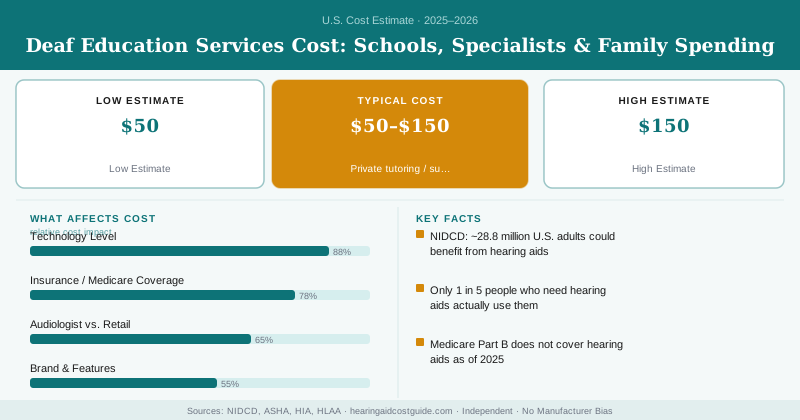
Can a public school really educate a deaf child for free? Yes — federal law guarantees it. So why do some families spend $50,000 a year on private deaf education? The answer is about fit, philosophy, and what each family decides their child needs. Let’s unpack what deaf education actually costs across every option, from the free public route to specialized private schools.
The Range Is Enormous
Deaf education isn’t one product with one price. It’s a spectrum, and where your child lands depends on their hearing, your communication choices, and what’s available near you.
| Setting | Annual Cost to Family |
|---|---|
| Public school with IEP services | $0 |
| State school for the deaf (residential/day) | $0 (state-funded) |
| Itinerant deaf/HoH teacher (public) | $0 |
| Private listening-and-spoken-language school | $20,000–$60,000 |
| Private bilingual (ASL/English) school | $25,000–$80,000 |
| Private tutoring / supplemental services | $50–$150/hr |
The Free Public Foundation
Under IDEA, public schools must provide a free appropriate public education to deaf and hard-of-hearing students, including specialized instruction, deaf-education teachers, interpreters, and assistive technology. The U.S. Department of Education reports that more than 7 million students receive services under IDEA, with deaf and hard-of-hearing students served through individualized programs.
Most states also operate a state school for the deaf — fully funded, often with both day and residential options — for families who want an immersive Deaf-culture environment at no cost.
Public deaf education is genuinely free under IDEA, including specialized teachers, interpreters, and state schools for the deaf. Families pay tuition only when they choose private programs for a specific communication approach the local district can’t provide.
Why Families Pay for Private
So why would anyone pay tens of thousands when free options exist? Usually it comes down to communication philosophy. Some families want intensive listening-and-spoken-language (auditory-oral) instruction; others want a fully bilingual ASL/English environment. If the local district can’t deliver the chosen approach well, families sometimes pay privately — or fight for the district to fund the placement.
The NIDCD notes that early, consistent language access is the strongest predictor of academic success for deaf children, which is why families take the education decision so seriously regardless of the price tag.
Before paying private tuition, request the placement through your IEP team. If the district can’t provide an appropriate program, it may be legally obligated to fund a private one. Many families pay out of pocket for placements the district should have covered.
The Services That Wrap Around School
Deaf education rarely stands alone. It connects to therapy, devices, and family training. If your child uses spoken language, our auditory-verbal therapy cost guide covers that piece. If you’re choosing a signing approach, see our sign language classes cost guide for family training.
Classroom access technology, like the FM system, is the school’s responsibility under IDEA — not a family expense.
How to Get the Most Without Overpaying
- Tour your state school for the deaf before assuming private is the only quality option — many are excellent and free.
- Document your child’s communication needs precisely in the IEP; vague goals lead to weak services.
- If pursuing private placement, get an independent educational evaluation to support the request.
- Connect with your state’s early-intervention and Hands & Voices chapter for free family support.
Your child’s pediatric audiologist and the school’s educational audiologist should both feed into the IEP so services match the actual hearing profile.
Bottom Line
Deaf education costs nothing through the public system — that’s the IDEA guarantee — while private programs run $20,000–$80,000 a year. Explore the free options thoroughly first, and remember that the district may be required to fund a private placement when it can’t meet your child’s needs.
Frequently Asked Questions
Private deaf schools and specialized programs typically cost between $20,000 and $80,000 per year, depending on the school's location, resources, and level of individualized services. Some specialized residential programs can exceed $80,000 annually. In contrast, public school deaf education services are provided at no direct cost to families under federal law (IDEA).
Insurance typically does not cover tuition for private deaf schools, as these are considered educational rather than medical expenses. However, insurance may cover specific services like speech therapy, audiology evaluations, or hearing aids if medically necessary and prescribed by a doctor. Families pursuing private education usually pay out-of-pocket or explore education-specific financing, scholarships, or state vocational rehabilitation programs that may fund services for eligible students.
Public schools must provide free, appropriate deaf education services through an Individualized Education Program (IEP), including sign language instruction, specialized teachers, and interpreters. Families can also explore state schools for the deaf, mainstreaming in public schools with support services, or a combination of public school attendance with supplemental private services like tutoring or speech therapy. The choice depends on your child's communication preference, learning style, and family priorities rather than cost alone.