Here’s the problem nobody tells you about hearing aids: they amplify everything. The server at the restaurant. The couple two tables over. The kitchen noise. The background music. When you’re trying to hear one person across a table in all that chaos, hearing aids alone often don’t cut it.
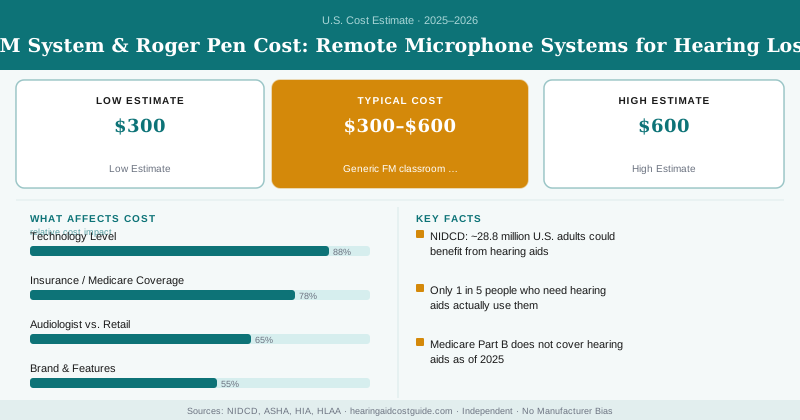
That’s what FM systems — and their modern successor, Roger technology — are designed to fix. Instead of amplifying everything in the room, they clip a microphone to the speaker and stream their voice directly into your hearing aids. Signal-to-noise problem largely solved. The cost ranges from $300 to $1,500 depending on the technology. Here’s what you’re paying for.
FM System and Roger Device Prices
| System | Price Range | Technology | Best For |
|---|---|---|---|
| Phonak Roger Pen iN | $450–$650 | Roger (digital) | Restaurants, one-on-one, meetings |
| Phonak Roger On iN | $700–$1,000 | Roger (digital) | Group settings, 360° pickup |
| Phonak Roger Table Mic II | $800–$1,200 | Roger (digital) | Conference rooms, round tables |
| Phonak Roger Select iN | $900–$1,200 | Roger (digital) | Automatically switches sources |
| Roger EasyPen (budget option) | $300–$450 | Roger (digital) | Entry-level Roger; basic directional |
| Oticon ConnectClip (remote mic mode) | $200–$350 | Bluetooth | Oticon users; mic + streaming |
| ReSound Multi Mic | $200–$350 | Bluetooth | ReSound users; versatile mic |
| Williams Sound PockeTalker Ultra | $130–$180 | Wired analog | No hearing aids needed; plug-in |
| Bellman Audio Mino Classic FM | $180–$280 | FM | Standalone; no aids required |
| Generic FM classroom system | $300–$600 | FM | School use; transmitter + receiver |
FM vs. Roger: What’s the Difference?
Traditional FM systems use radio frequency signals — the same basic technology as a wireless baby monitor or FM radio. They work, but they’re not immune to interference, and they have a fixed transmission range (typically 30–50 feet). Many FM systems were designed for classroom use in the 1980s and ’90s and are still widely deployed in schools.
Roger technology (developed by Phonak, now widely licensed) uses a more sophisticated digital wireless protocol that:
- Automatically adjusts volume based on background noise level
- Has cleaner signal fidelity with less interference
- Supports multi-talker scenarios (table microphones that switch between speakers)
- Integrates with modern hearing aids without an extra neck loop
The catch: Roger devices cost more ($450–$1,200 vs. $130–$600 for FM), and most require either Roger-compatible hearing aids or a separate Roger receiver that attaches to existing aids.
According to NIDCD (National Institute on Deafness and Other Communication Disorders), signal-to-noise ratio is one of the most significant factors affecting speech understanding for people with hearing loss — and remote microphone systems directly address this by essentially eliminating distance as a variable.
Who Uses FM/Roger Systems?
Adults with hearing loss — primarily for restaurants, meetings, religious services, and lectures. The Roger Pen is particularly popular for adults who attend regular meetings or social dinners where following one conversation across a table is the core challenge.
Children and students — FM systems are widely used in K-12 classrooms under IDEA and 504 accommodations. The teacher wears a transmitter; the student receives it through hearing aids. ASHA estimates that FM systems improve speech perception scores in classroom noise by 15–20 percentage points on average compared to hearing aids alone.
Adults 55+ in large spaces — worship services, community center events, and community theater performances are frequently cited by older adults as among the most frustrating listening environments. FM/Roger systems address the distance problem directly.
Roger Pen: Clip to a shirt, pass across a table, or hold like a microphone. Best for one-on-one conversations and small groups. Directional — picks up the person holding or wearing it.
Roger On: Lays flat on a table. Automatically identifies and tracks the loudest voice in a group conversation. 360° pickup. Better for round-table meetings and family dinners. Costs about $250 more.
If you primarily want to hear one person at a time (a partner, a coworker, a server), the Roger Pen is the more cost-effective choice. If you regularly need to follow multi-person conversations, the Roger On is worth the upgrade.
Compatibility Costs: Receivers and Adapters
Here’s the fine print that catches many buyers off guard: most Roger devices don’t stream directly to all hearing aids out of the box. You may need a receiver.
- Roger iN receivers are built into some current Phonak hearing aid models (Lumity, Paradise, Marvel) — no extra hardware needed
- Roger X or Roger MyLink receivers are add-ons for older aids or non-Phonak brands: $200–$400 per receiver
- Roger Neckloop (if your aids have telecoil/t-coil): $150–$250 — a budget option that works through the hearing aid’s loop setting
- Oticon ConnectClip and ReSound Multi Mic use Bluetooth and work directly with their respective brand’s aids without extra receivers
If you have Phonak hearing aids purchased in the last 3 years, check whether they have built-in Roger iN receivers before buying anything. Your audiologist can confirm this in 30 seconds. It could save you $300.
FM Systems Through Schools and Insurance
For children, FM systems are often funded through school systems under IDEA (Individuals with Disabilities Education Act) — the school provides the transmitter; parents typically aren’t expected to pay. If your child’s school hasn’t offered this, speak with the special education coordinator.
For adults, most commercial health insurance plans don’t cover FM/Roger systems. However:
- Vocational Rehabilitation: If hearing loss affects your ability to work, your state VR program may fund FM equipment
- Veterans Affairs: VA audiologists can prescribe Roger systems as assistive technology at no cost to eligible veterans
- Flexible Spending Accounts (FSA) / Health Savings Accounts (HSA): FM and Roger devices are FSA/HSA eligible as hearing assistive devices — a legitimate way to use pre-tax dollars
Before purchasing any Roger or FM system, confirm the compatibility with your specific hearing aid model and purchase date. Some older aids require a separate neck receiver that adds $200–$400 to the total cost. Your audiologist should demo the system with your actual aids before you commit — any reputable clinic will do this.
Real-World Performance Expectations
A remote microphone system doesn’t eliminate hearing loss. It fixes one specific problem: distance and background noise in the environment between the speaker and your ears. In genuinely noisy environments — a crowded restaurant, a cocktail party — users consistently report understanding 50–70% more speech compared to hearing aids alone.
Where FM/Roger systems don’t help: when the problem is your own auditory processing, not the signal-to-noise ratio. If your hearing aids already provide good clarity in quiet but difficulty follows you into quiet settings too, FM systems won’t solve an auditory processing or word recognition issue. That’s a different evaluation.
For most adults 55+ with moderate-to-severe hearing loss who struggle in noisy environments despite good hearing aids, a remote microphone system is among the highest-value investments after the hearing aids themselves.
Frequently Asked Questions
Roger Pen systems typically range from $300 to $1,500, depending on the model and whether you're purchasing the transmitter alone or a complete system with receivers. Basic FM systems start around $300–$500, while advanced Roger devices with wireless streaming capabilities can cost $1,000–$1,500. Many audiologists offer package pricing when bundled with hearing aids.
Most health insurance plans and Medicare do not routinely cover remote microphone systems like Roger Pen or FM devices, though some Medicaid programs may provide partial coverage depending on your state. You can typically expect to pay the full out-of-pocket cost of $300–$1,500, though some audiologists offer payment plans or discounts for patients without coverage. It's worth submitting a claim to your insurance to ask about exceptions for children in school settings or workplace accommodations.
Most fittings take 30–60 minutes at your audiologist's office, where they'll program the device to work with your specific hearing aids and demonstrate how to use the microphone and receiver. You can typically start using the system the same day after your appointment, though it may take a few days to adjust to how the remote microphone changes your hearing experience in different environments. No recovery time is needed—these are external devices that don't require any medical procedure.