In 2010, a basic classroom FM system was a clunky $1,000 box with a clip-on mic. Today’s digital remote-microphone systems are sleek, rechargeable, and stream straight into a child’s hearing aids — and they cost anywhere from $700 to $3,000. The technology got better. The confusion over who pays for it didn’t.
So let’s settle it: here’s what a classroom FM system costs, what drives the price, and when you’ll actually open your wallet.
What an FM System Does
An FM (or DM, digital-modulation) system puts a microphone on the teacher and beams their voice directly to the child’s ears, cutting through classroom noise and distance. For a kid with hearing loss, it’s often the difference between catching every instruction and missing half the lesson.
| Component | Cost |
|---|---|
| Teacher transmitter/microphone | $400–$1,200 |
| Personal receiver (per hearing aid) | $300–$900 each |
| Soundfield speaker setup (whole-room) | $800–$2,000 |
| Full personal FM system (mic + 2 receivers) | $1,000–$3,000 |
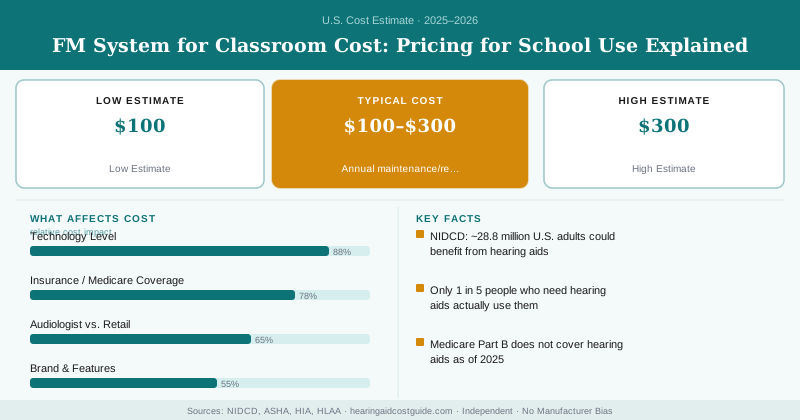
| Annual maintenance/repair budget | $100–$300 |
Personal FM vs. Soundfield — Two Different Bills
There are two flavors. A personal FM system sends sound to one child’s receivers. A soundfield system broadcasts to a classroom speaker so every student benefits. Soundfield gear is often cheaper per room but doesn’t deliver sound as cleanly to a child with significant loss.
The American Speech-Language-Hearing Association (ASHA) recommends remote-microphone technology as a core support for students with hearing loss precisely because classroom signal-to-noise ratios are notoriously poor — background noise routinely drowns out a teacher by the back rows.
A personal FM system retails for $1,000–$3,000, but if it’s needed for classroom access and written into your child’s IEP or 504 plan, the school must provide it at no cost. Families typically pay only when they buy a personal unit for use outside school.
Who Pays — The Part That Trips Everyone Up
Under IDEA, the U.S. Department of Education requires school districts to provide assistive technology needed for a free appropriate public education. An FM system used in the classroom qualifies. So for in-school use, the district buys, maintains, and repairs it.
Where families spend money is on FM systems for life outside the classroom — soccer practice, car rides, religious school — where the school’s obligation ends. Our IEP and 504 hearing accommodations cost guide maps out exactly where that line falls.
Don’t buy a personal FM system before the IEP meeting. If you purchase one yourself and then ask the school to reimburse you, districts often refuse. Request it through the IEP first — let the school’s budget cover the classroom unit.
Compatibility Matters
FM receivers have to match your child’s hearing aids or cochlear implant. Some hearing aids have built-in receivers; others need a separate boot or universal receiver. Check compatibility before anyone orders anything — a mismatched receiver is wasted money.
Our broader FM system cost guide covers the technology across settings, and if your child also wears amplification, the pediatric hearing aid cost guide explains how the two work together.
How to Keep Costs Down
- Get the FM recommendation in writing from your pediatric audiologist and bring it to the IEP.
- Ask the district for a trial period before committing to a specific model.
- For at-home use, ask the manufacturer about bundle pricing with your child’s hearing aids.
- Insist that repair and loaner coverage be written into the plan.
Bottom Line
A classroom FM system costs $700–$3,000 retail, but for school use the price tag is the district’s problem, not yours — provided it’s documented in the IEP. Save your spending for the optional personal unit, and confirm compatibility before you buy anything.
Frequently Asked Questions
A modern digital FM system for classroom use costs between $700 and $3,000, depending on the brand, wireless range, and connectivity features. Basic models start around $700, while advanced systems with streaming capability to hearing aids can reach $3,000 or more.
Most families pay $0 out-of-pocket when an FM system is written into a child's Individualized Education Program (IEP), as schools are required to provide necessary assistive technology under IDEA. If not covered by the school, some health insurance plans may partially cover the cost, but many classify FM systems as educational rather than medical devices, leaving families responsible for the full $700–$3,000 expense.
Request an FM system evaluation and IEP meeting with your school's special education team; bring documentation from your child's audiologist recommending the device for their hearing loss. Once approved and added to the IEP, the school typically orders and sets up the system within 2–4 weeks, with no cost to your family.