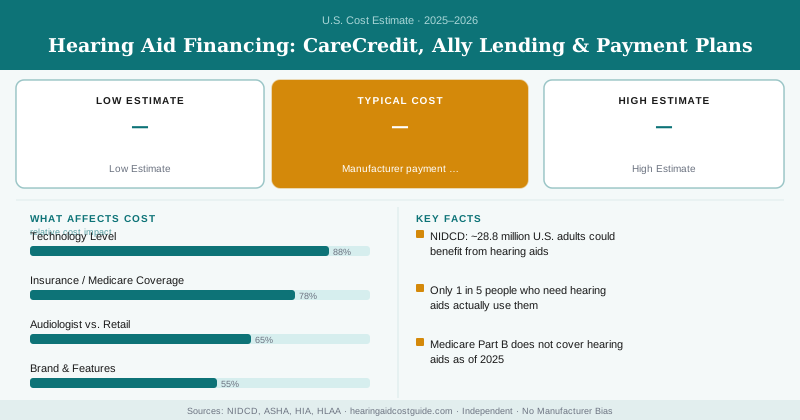
$6,400 for a pair of hearing aids. That’s roughly the average retail price for mid-to-premium prescription aids in 2025 — and most insurance plans cover none of it. If you don’t have that sitting in savings, you have two real options: cheaper aids or financing.
Financing isn’t inherently a bad deal. The right plan costs you nothing extra. The wrong one adds $800–$1,200 in interest to an already expensive purchase. Here’s how to tell the difference.
Financing Options and Typical Terms
| Financing Option | Promo APR | Standard APR | Terms | Credit Needed |
|---|---|---|---|---|
| CareCredit (6-month promo) | 0% | 26.99% | 6 months deferred | Good (660+) |
| CareCredit (12-month promo) | 0% | 26.99% | 12 months deferred | Good (660+) |
| CareCredit (24-month promo) | 0% | 26.99% | 24 months deferred | Very good (700+) |
| Ally Lending (fixed rate) | 3.99%–19.99% | Same (fixed) | 24–84 months | Fair to excellent |
| HearingLife / Connect Hearing in-house | 0%–9.99% | Varies | 12–36 months | Varies |
| Personal loan (bank/credit union) | 7%–18% | Same (fixed) | 24–60 months | Good |
| Manufacturer payment plans | 0%–8% | Same | 12–24 months | Varies |
CareCredit: How It Actually Works
CareCredit is a healthcare-focused credit card accepted at thousands of audiologists, hearing centers, Costco Hearing Centers, and ENT practices. The appeal is the deferred-interest promotional period: pay the full balance within 6, 12, 18, or 24 months and pay zero interest.
The catch is significant: CareCredit uses deferred interest, not true 0% APR. If you pay even $1 short of the full balance at the end of the promo period, retroactive interest on the entire original purchase is charged at 26.99% APR. That’s not an exaggeration — it’s how the product works.
On a $5,000 purchase with a 12-month promo period, failing to clear the balance in time results in roughly $1,000–$1,200 in retroactive interest charges appearing on your next statement.
CareCredit deferred interest is not the same as 0% APR. Divide the total purchase price by the number of promo months and set up automatic monthly payments for that exact amount — don’t make minimum payments and assume you’re covered. One missed or short payment at month 11 triggers the full retroactive interest charge.
When CareCredit makes sense: You’re confident you can clear the balance in the promo period. You want to preserve cash liquidity for other expenses. Your audiologist doesn’t offer in-house plans. The 24-month promo period works for your budget at $200–$300/month on a $5,000 purchase.
Ally Lending: The Alternative for Longer Terms
Ally Lending (formerly known as Ally Health in some regions) offers fixed-rate installment loans for healthcare purchases including hearing aids. Unlike CareCredit, there’s no retroactive interest trap — you pay the quoted rate for the life of the loan, period.
Rates range from 3.99% to 19.99% depending on credit profile, with terms from 24 to 84 months. A $6,000 hearing aid purchase at 9.99% APR over 36 months runs about $194/month — total interest paid: roughly $970. Not free, but predictable.
Ally is accepted at select hearing centers and some Starkey, Phonak, and Oticon dealer networks. Not all audiologists offer it; ask during the consultation.
In-House Financing at Major Chains
HearingLife (formerly Audibel): Offers promotional financing through a partner lender. Terms vary by location and credit profile. Some patients report 0% financing for 12–18 months on qualifying purchases.
Connect Hearing / Phonak Network: Partner financing programs with periodic 0% promotions, particularly during seasonal sales events.
Miracle-Ear: Has offered in-house financing plans, though terms and availability vary by franchise location.
These programs are worth asking about, especially during promotional periods when chains run “0% for 18 months” offers that align with manufacturer incentives.
Personal Loans vs. Healthcare Credit
A personal loan from your bank or credit union is often the safest financing option for hearing aids, especially if you have good credit and need more than 24 months:
- No retroactive interest trap — fixed rate from day one
- Predictable monthly payments — same amount every month
- Can shop for the best rate — credit unions often beat banks by 2–4 percentage points
- Not tied to a specific provider — use the loan at any audiologist, including Costco
Many credit unions offer personal loans at 7%–10% for members with good credit. A $5,000 loan at 8% over 36 months costs about $157/month with total interest of roughly $650. That’s less than half what retroactive CareCredit interest would cost on the same purchase.
Using HSA/FSA Alongside Financing
Hearing aids are an eligible expense under both Health Savings Accounts (HSA) and Flexible Spending Accounts (FSA). If you have either, use that money first before financing. The tax savings (24–32% for most middle-income earners) reduce the effective cost before interest is even a factor.
Strategy: pay a portion with HSA/FSA funds, finance the remainder with CareCredit or Ally. A $6,000 purchase with $2,000 in HSA funds means you’re only financing $4,000 — more manageable on any plan.
Approval Odds by Credit Profile
- 700+ credit score: Likely approved for CareCredit 24-month promo and Ally’s best rates
- 660–699: Likely approved for CareCredit 6–12 month promo; Ally available at higher rates
- 620–659: CareCredit likely declined or approved with no promo; Ally rates 15%+
- Below 620: In-house installment plans from larger chains may be the best option; expect weekly or bi-weekly payment structures
Some audiologists offer internal payment plans (no lender, just a contract with the practice) that bypass credit requirements. These are most common at independent practices with long-term patient relationships.
The Bottom Line
CareCredit is genuinely useful if you’ll pay it off in the promo period — and genuinely expensive if you won’t. Ally Lending is more honest for longer-term needs. A personal loan from your credit union beats both on total cost if you have decent credit. Whatever option you choose, run the math on total repayment — not just the monthly payment — before signing.
Frequently Asked Questions
A pair of mid-to-premium prescription hearing aids costs approximately $6,400 at retail prices in 2025. Budget hearing aids may cost $1,000–$3,000 per pair, while high-end models can exceed $8,000, depending on features and technology level.
Most standard health insurance plans, including Medicare, do not cover hearing aids or their fitting costs. Some supplemental plans and Medicaid programs in certain states offer limited coverage, but out-of-pocket costs typically remain $3,000–$6,400+ for a pair of prescription aids.
Financing makes sense only if you use a 0% interest plan like CareCredit (available for 6–24 months with no added cost) and can pay off the balance before interest kicks in. Paying cash is better if you have savings available, since wrong financing plans can add $800–$1,200 in interest to your purchase.