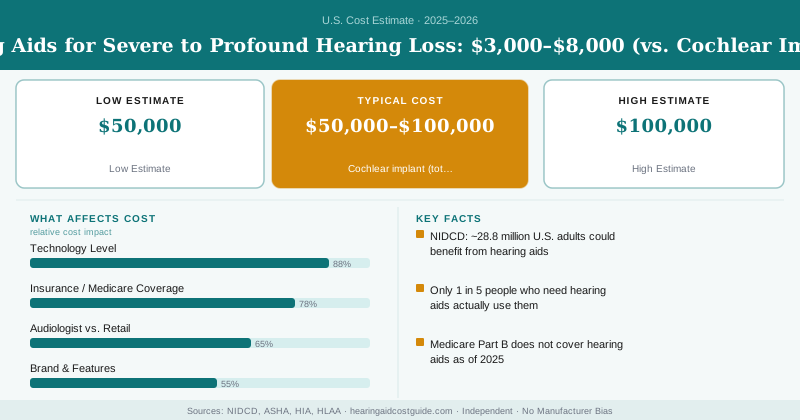
There’s a fundamental ceiling on what hearing aids can do. Most people don’t know where that ceiling sits — or that crossing it means a completely different device category becomes the better solution. If you or someone you care for has severe or profound hearing loss, that ceiling matters more than it does for anyone else.
Let’s walk through what’s available, what it costs, and how to know when you’ve reached the point where hearing aids stop being the right answer.
Defining Severe vs. Profound Hearing Loss
These two categories get grouped together but they’re meaningfully different on an audiogram:
- Severe hearing loss: 71–90 dB HL. At this level, loud speech at close range is difficult to understand without amplification. Normal conversational speech is inaudible.
- Profound hearing loss: 91+ dB HL. At this level, even amplified speech may be insufficient for reliable comprehension. Environmental sounds — traffic, alarms, shouted voices — may be partially perceptible but speech understanding is severely compromised.
The NIDCD estimates that approximately 15% of American adults (37.5 million people) report some degree of hearing trouble, but severe and profound loss affects a much smaller subset — roughly 1.5 million Americans have hearing loss severe enough to qualify for cochlear implant consideration.
Hearing Aid Cost for Severe to Profound Loss
| Device Type | Degree | Cost per Pair |
|---|---|---|
| Standard BTE (entry-level) | Severe | $2,000–$3,500 |
| High-power BTE (mid-range) | Severe | $3,500–$5,500 |
| High-power BTE (premium) | Severe | $5,500–$8,000 |
| Super-power / ultra-power BTE | Profound | $4,000–$8,500 |
| CROS / BiCROS system | Single-sided severe | $2,500–$5,000 |
| Cochlear implant (total cost) | Profound (when aid fails) | $50,000–$100,000 |
Why Severe/Profound Loss Demands Specific Hearing Aids
Not every hearing aid works at severe and profound levels. The compact in-the-canal (IIC) and even receiver-in-canal (RIC) designs that work beautifully for mild-to-moderate loss often can’t deliver the output power needed for severe loss without problems.
High-power severe loss typically requires a behind-the-ear (BTE) form factor with an earmold — a custom-made piece that fills the ear canal and couples the hearing aid’s amplified output directly into the ear. The earmold also prevents acoustic feedback (whistling), which is a serious problem when you’re pushing high amplification levels in a small enclosed space.
For profound loss, super-power or ultra-power BTEs push sound pressure levels that would be dangerous for normal-hearing ears. These are specialized instruments from manufacturers like Phonak (Naída series), Oticon (Xceed series), and Widex (Moment). They’re not cosmetically subtle, but they’re engineered to deliver output that lighter devices simply can’t provide.
Compact, discreet hearing aids have smaller speakers (receivers) and less physical space for amplification circuitry. Even when set to maximum output, most RIC and IIC aids physically cannot produce the 130–140 dB SPL output needed for severe-to-profound loss. Trying to force them to that level causes feedback and distortion. If an audiologist recommends a full-shell BTE with earmold for severe loss, that’s not a cosmetic recommendation — it’s a clinical requirement.
Hearing Aid Brands Specializing in High-Power Devices
Several manufacturers have invested heavily in the severe/profound segment:
Phonak Naída Lumity (Ultra Power) The Naída series is the industry reference point for ultra-high-power hearing aids. The Naída Lumity UP handles profound loss up to 120+ dB HL, includes Roger compatibility (critical for classroom and meeting environments), and pairs with Phonak’s AutoSense OS. Cost: $5,500–$8,000 per pair.
Oticon Xceed Marketed specifically for severe-to-profound loss, the Xceed uses Oticon’s OpenSound Navigator to process the entire soundscape rather than focusing a directional beam. This open-processing approach aims to reduce listening fatigue. Cost: $5,000–$7,500 per pair.
Widex Moment Super/Power Widex’s ultra-low processing delay (0.5ms in Pure Sound mode) is designed to prevent the “hollow” effect that some high-power users experience. Not the highest-output option but among the best-sounding for severe (not profound) loss. Cost: $4,500–$7,000 per pair.
Starkey Edge AI Power Starkey’s high-power option includes the Edge AI health sensor platform, though the primary benefit is processing power. Fall detection and activity tracking remain available at severe-loss output levels. Cost: $5,000–$7,500 per pair.
When Hearing Aids Stop Working: Cochlear Implant Candidacy
This is the conversation audiologists sometimes delay having — but it’s the most important cost consideration for profound loss.
A cochlear implant (CI) bypasses the damaged hair cells in the cochlea entirely. A surgically implanted electrode array stimulates the auditory nerve directly, and an external sound processor converts speech and environmental sound into electrical signals. It’s not “better hearing” in the audiogram sense — it’s a completely different hearing experience, processed through the brain differently than natural hearing.
FDA candidacy criteria for adults include:
- Bilateral severe-to-profound sensorineural hearing loss
- Limited benefit from appropriately fit hearing aids (typically defined as sentence recognition scores below 50–60% in the best-aided condition)
- No medical contraindications
The clinical turning point is that sentence recognition score. If you’re wearing the best available high-power hearing aids and still only understanding 30–40% of sentences in quiet conditions, hearing aids are not solving your problem — they’re managing it poorly. An implant evaluation is warranted.
Cochlear Implant vs. High-Power Hearing Aid: Cost Reality
| Option | Total Cost | Insurance Coverage |
|---|---|---|
| High-power hearing aids (bilateral) | $5,000–$8,500 | Rarely covered |
| Cochlear implant (one ear) surgery + device | $50,000–$70,000 | Medicare/most private ins. (with criteria) |
| Cochlear implant (bilateral) | $80,000–$130,000 | Some plans cover bilateral |
| CI aural rehabilitation (auditory therapy) | $1,000–$5,000 | Partially covered |
| Annual CI external processor maintenance | $500–$2,000/year | Partially covered |
The cost inversion is stark: hearing aids cost far less upfront, but insurance rarely covers them. Cochlear implants cost 10–15x more upfront, but Medicare and most commercial insurance plans cover them as a medical necessity when you meet the criteria. Many CI recipients pay $0–$5,000 out-of-pocket for a procedure that costs $70,000+.
Cochlear implants are classified as prosthetic devices, not hearing aids, under insurance law. That distinction is why Medicare covers CIs (as durable medical equipment/surgical procedure) but won’t pay a dollar toward hearing aids. If you’re profound-loss and uninsured or under-insured, this asymmetry is a real factor in the calculus — getting insurance coverage before pursuing a CI is worth significant effort.
Bone-Anchored Hearing Aids: A Third Option
For specific types of severe hearing loss — particularly single-sided deafness or conductive hearing loss — bone-anchored hearing aids (BAHA) offer another pathway. BAHA devices transmit sound through the skull bone to the cochlea, bypassing the outer and middle ear entirely. Brands include Cochlear (Osia, Baha), Oticon Medical, and Medel.
BAHA systems cost $5,000–$12,000 and involve either a surgically implanted abutment or a non-surgical softband/magnetic attachment. Like CIs, they’re covered by Medicare and commercial insurance when candidacy criteria are met.
If you have severe or profound hearing loss and haven’t had a comprehensive audiological evaluation in the past 2 years, get one before purchasing new hearing aids. Loss can progress significantly, and what was appropriate amplification two years ago may now be under-powering your hearing significantly — or you may have crossed the threshold where a cochlear implant evaluation is medically indicated. A proper evaluation costs $200–$400 and can save you from spending $6,000+ on devices that won’t deliver adequate benefit.
The Bottom Line
Severe and profound hearing loss is expensive to address. High-power hearing aids run $3,000–$8,500 per pair and are rarely covered by insurance. But profound loss that doesn’t respond to aids has a genuinely covered option in cochlear implants — the challenge is knowing when you’ve crossed that line and pursuing the evaluation aggressively. If you’re at 80+ dB with declining speech scores, don’t let the $70,000 sticker price of a CI stop you from asking the question. Your insurance company may pay for most of it.
Frequently Asked Questions
High-power hearing aids for severe loss (71–90 dB) typically cost $2,500–$5,500 per pair for mid-range models and $5,000–$8,000 per pair for premium devices. Ultra-power BTEs for profound loss (91+ dB) run $4,000–$8,500 per pair. These prices usually include professional fitting and follow-up care in bundled pricing. Cochlear implant surgery, by comparison, costs $50,000–$100,000 total but is covered by Medicare and most private insurance when candidacy criteria are met.
Cochlear implant candidacy is typically indicated when hearing aids no longer provide adequate speech understanding — specifically, when sentence recognition in quiet falls below 50–60% with optimally fit hearing aids. FDA criteria also include bilateral severe-to-profound sensorineural hearing loss. An audiologist-led implant evaluation includes speech perception testing while wearing best-fit hearing aids; if you score below threshold, your team will discuss CI candidacy. Most adults wait too long to pursue this evaluation.
Insurance coverage doesn't change based on degree of hearing loss — it depends on whether your specific plan includes a hearing aid benefit. Original Medicare covers diagnostic testing but not hearing aids regardless of severity. Medicare Advantage plans vary; those with hearing benefits typically offer $500–$3,000 per ear per benefit period. Cochlear implants are different: they are covered by Medicare and most private insurance as a medical device when candidacy criteria are met, with patient out-of-pocket costs typically $1,000–$5,000 depending on deductible and plan.