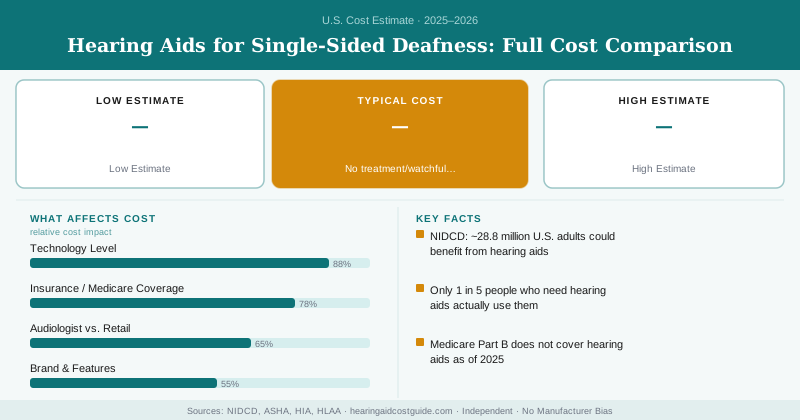
In 2018, treatment for single-sided deafness essentially meant one option: a CROS hearing system routing sound from the deaf ear to the hearing ear. Today, patients diagnosed with single-sided deafness have three genuinely different treatment paths available, each with dramatically different costs, and choosing between them means understanding what each one actually does — because none of them restore normal hearing to the affected ear.
Single-Sided Deafness Treatment Cost Comparison
| Treatment | Total Cost | How It Works |
|---|---|---|
| CROS hearing system | $2,000–$5,500 | Routes sound wirelessly from deaf ear to hearing ear |
| Bone-anchored hearing system (surgical) | $8,000–$15,000 | Routes sound via bone conduction to the functioning inner ear |
| Cochlear implant (FDA-approved for SSD) | $30,000–$50,000 | Restores sound awareness directly in the deaf ear |
| No treatment/watchful monitoring | $0 | Relies on the hearing ear alone |
The Three Approaches, Compared
CROS systems are non-surgical, lowest-cost, and reversible — if you don’t like it, you simply stop wearing it, no permanent change made. They work by picking up sound on the deaf side and wirelessly transmitting it to a receiver worn on the functioning ear. The limitation: your deaf ear still can’t perceive sound directly, and some adjustment period is needed to interpret sound arriving effectively “from the wrong side.”
Bone-anchored hearing systems require a minor surgical procedure to place a small titanium implant, then attach an external sound processor that transmits vibrations through the skull bone to the functioning inner ear. This is a middle-cost, moderately invasive option that avoids the wireless transmission CROS systems rely on, instead using bone conduction directly.
Cochlear implants for single-sided deafness are a more recent FDA-approved application of existing cochlear implant technology, specifically for cases where the deaf ear still has an intact auditory nerve capable of receiving electrical stimulation. Unlike the other two options, this approach directly stimulates the deaf ear itself rather than routing sound to the functioning ear — but it comes with the significant cost and surgical considerations of full cochlear implantation.
Most audiologists and ENT surgeons recommend trialing a CROS system first, even for patients who may ultimately be candidates for a surgical option. It’s reversible, far less expensive, and gives you real-world experience with rerouted sound before committing to an $8,000–$50,000 surgical procedure. If CROS technology genuinely doesn’t work for your lifestyle or specific hearing needs, that experience also helps clarify whether a surgical option is worth pursuing.
Why Insurance Coverage Differs So Much Between Options
Because these three treatments are classified differently for billing purposes — a wearable consumer device (CROS) versus surgical prosthetics (BAHA) versus a major implanted medical device (cochlear implant) — insurance coverage varies significantly between them, sometimes counterintuitively. Surgical options are often covered better than the cheaper non-surgical CROS system, since insurers classify surgical single-sided deafness treatments as clearly medically necessary procedures, while CROS systems sometimes fall under the same limited hearing aid benefit exclusions that apply to routine hearing aids.
What Causes Single-Sided Deafness
Common causes include sudden sensorineural hearing loss (sometimes with no identifiable cause), acoustic neuroma or its surgical removal, Meniere’s disease, congenital causes, and head trauma. The underlying cause matters for both treatment candidacy and insurance coverage — a clearly documented medical cause, like post-surgical hearing loss from acoustic neuroma removal, often supports a stronger insurance case than idiopathic (unexplained) sudden hearing loss.
Don’t assume the most expensive option is automatically the best choice for your specific situation. Cochlear implants for single-sided deafness require an intact auditory nerve and aren’t appropriate for every cause of deafness, while some patients find CROS systems, despite their lower cost, provide entirely adequate real-world benefit. Get a clear explanation from your ENT or audiologist about which options you’re actually a candidate for before assuming higher cost means better outcome for your case.
Making the Decision
Start with a genuine trial of the least invasive, lowest-cost option — typically a CROS system — and give it real-world time in your actual daily environments before deciding whether to pursue a more expensive surgical alternative. This sequence protects you from an expensive, difficult-to-reverse surgical decision before you’ve confirmed less invasive options aren’t sufficient for your needs.
Frequently Asked Questions
A CROS hearing system is typically the least expensive option for single-sided deafness, costing $2,000 to $5,500 for the pair, compared to $8,000–$15,000 for a bone-anchored system or $30,000–$50,000 for a cochlear implant.
Coverage varies by treatment type and cause. Bone-anchored systems and cochlear implants for single-sided deafness are often covered as medical devices when medical necessity is documented, while CROS hearing systems are sometimes classified under standard hearing aid exclusions with more limited coverage.
A cochlear implant for single-sided deafness doesn't restore hearing to normal levels, but it can provide meaningful sound awareness and improved spatial hearing in the deaf ear for appropriately selected candidates, and is FDA-approved for this specific use in the U.S.