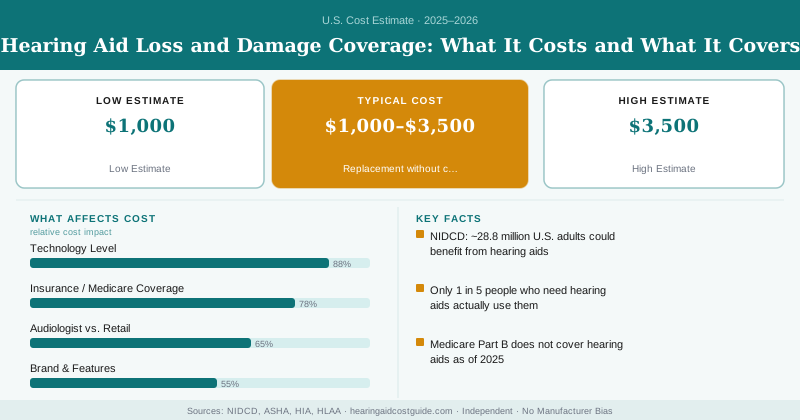
What happens when your dog eats your $3,000 hearing aid? It happens more often than you’d think — and the answer depends entirely on one line item most people skip reading: loss and damage coverage.
Hearing aids aren’t like eyeglasses you can replace for $150. A single premium device runs $1,500–$3,500, and standard manufacturer warranties only cover manufacturing defects — not the moment it slips off a boat dock, gets run over by a car, or ends up in the washing machine. That’s where loss and damage (L&D) coverage comes in, and understanding what you’re actually buying can save you thousands.
What Loss and Damage Coverage Costs
| Coverage Type | Typical Cost | What’s Included |
|---|---|---|
| Included with new purchase (Year 1–3) | Bundled into device price | Usually 1–2 replacement claims total |
| Standalone L&D policy (per year) | $100–$250/pair | 1 replacement claim per year, $50–$150 deductible |
| Extended manufacturer warranty w/ L&D | $200–$400/pair/year | Full L&D + repairs, higher claim limits |
| Third-party electronics insurance (Asurion-style) | $8–$15/month | Loss, theft, damage; lower claim caps |
| Replacement without coverage (out-of-pocket) | $1,000–$3,500/device | No deductible — full retail replacement cost |
Why This Isn’t Optional the Way It Feels
Here’s a number that should change how you think about this: hearing aids are worn, on average, 10–14 hours a day. That’s more daily physical contact than almost any other piece of technology people own. They get sweated on during workouts, dropped while showering, knocked off during sports, and — frequently — become a favorite chew toy the moment they land on the floor. The Hearing Loss Association of America (HLAA) has noted that device loss and accidental damage are among the top reasons patients delay replacement, simply because the sticker shock of a full-price device stops them cold.
What’s Actually Covered vs. What Isn’t
Loss and damage coverage is not the same as your manufacturer’s standard warranty, and mixing the two up leads to unpleasant surprises at claim time.
Typically covered under L&D:
- Complete loss (left it at a restaurant, lost at the beach, fell out during a run)
- Accidental physical damage (dropped, stepped on, run over)
- Water damage beyond the device’s rated IP resistance
- Pet damage
Typically NOT covered — falls under standard warranty or repair instead:
- Normal wear and tear (worn tubing, faded casing)
- Manufacturing defects
- Battery failure
- Software/programming issues
- Cerumen (earwax) blockage damage from lack of cleaning
Most L&D policies cap you at 1–2 replacement claims per device, per year (or sometimes per policy period, which could be 2–3 years). If you lose one aid in March and damage the other in April, check your policy — you may already be at your limit for the year, and the second incident comes entirely out-of-pocket. Read the claim cap before you buy, not after you need it.
Is It Worth Buying Separately After Year One?
Most hearing aid purchases bundle 1–3 years of L&D coverage into the upfront price. When that runs out, you get a renewal offer — often $150–$300/year per pair. Whether it’s worth it comes down to a simple comparison:
- Cost of the device itself. Premium aids ($2,500–$3,500/ear) justify continued coverage almost every time. Basic OTC devices under $1,000 often don’t — the math tips toward self-insuring.
- Your household risk factors. Young kids, dogs, an active outdoor lifestyle, or a physically demanding job all raise your real loss/damage probability well above average.
- How many years you plan to keep the device. Most hearing aids last 5–7 years. If you’re two years in with five to go, the coverage math usually favors renewing.
Filing a Claim: What to Expect
Most manufacturers and third-party insurers require documentation — sometimes a police report for theft, sometimes just a signed loss affidavit. Processing typically takes 5–10 business days, and you’ll pay the deductible upfront before the replacement ships. Keep your original purchase receipt and serial numbers in a dedicated folder; claims move faster with documentation ready.
Do not let your loss and damage coverage lapse without a replacement plan in place. A gap of even a few weeks between your bundled coverage ending and a new policy starting means any incident during that window is 100% your cost — and replacement hearing aids don’t come with a payment plan built in unless you arrange one in advance.
If you’re shopping for new hearing aids, ask specifically what loss and damage terms are bundled in before you compare prices between providers — a $2,800 device with 3 years of L&D coverage may be a better deal than a $2,400 device with none.
Frequently Asked Questions
Loss and damage coverage typically costs $100–$400 per year per pair, either bundled into the purchase price for the first 1–3 years or purchased separately as an extended warranty afterward, with deductibles of $50–$300 per replacement claim.
Most policies cover accidental damage (dropped devices, water exposure not covered by IP rating, pet damage) and complete loss, typically limited to one or two replacement claims per year, per device. Cosmetic wear and routine repairs are usually excluded and handled under the standard manufacturer warranty instead.
It depends on your device cost and lifestyle. If you have an active lifestyle, young kids or pets at home, or devices costing over $2,000 per ear, continued coverage at $150–$300/year is usually cheaper than a single out-of-pocket replacement, which can run $1,000–$3,500 per device.