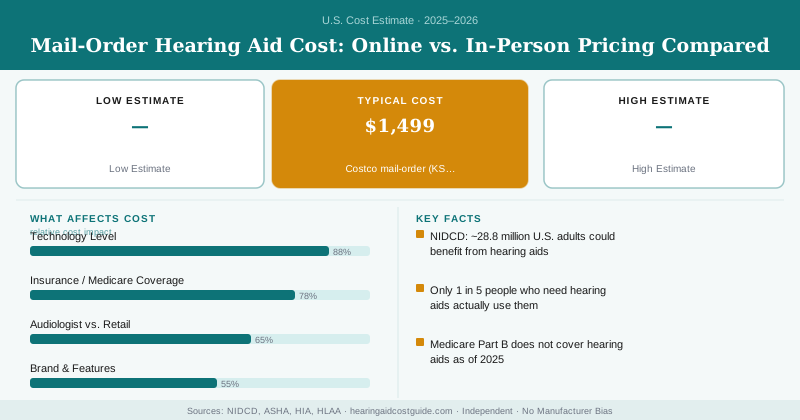
28.8 million U.S. adults could benefit from hearing aids, according to the National Institute on Deafness and Other Communication Disorders (NIDCD) — and the vast majority of them aren’t wearing any. For many, the price of traditional prescription hearing aids ($4,000–$7,000 per pair) is simply out of reach. Mail-order and direct-to-consumer hearing aids have emerged as a lower-cost alternative, but understanding exactly what you’re trading away matters before you order.
Mail-Order Hearing Aid Price Ranges (2025)
| Category | Price Per Pair | Examples | Fitting Method |
|---|---|---|---|
| Basic amplifiers (PSAPs) | $20–$200 | Various Amazon brands | None — plug in and go |
| OTC self-fit (mail order) | $200–$1,000 | Sony CRE, Jabra Enhance Select | App-based self-fitting |
| Online prescription hybrid | $1,500–$3,000 | Lively, Audicus, MDHearing | Remote audiologist programming |
| Costco mail-order (KS10 local pickup) | $1,499 | Kirkland Signature 10.0 | In-store fitting required |
The most important distinction: “mail-order hearing aids” covers a wide spectrum, from $30 amplifiers with no fitting whatsoever to legitimate prescription-class devices with remote audiologist programming. What you pay reflects where on that spectrum you’re buying.
The Three Main Categories
1. Basic Amplifiers (PSAPs) — $20–$200
Personal Sound Amplification Products (PSAPs) aren’t technically hearing aids — the FDA specifically distinguishes between PSAPs (wellness devices) and hearing aids (medical devices). PSAPs amplify all sounds indiscriminately. They don’t have frequency-specific programming, noise reduction algorithms, or directional microphones.
For very mild hearing loss in quiet environments — TV watching, one-on-one conversation — some users find them adequate. For anyone with moderate-to-severe hearing loss, or anyone who needs to function in noise, PSAPs are typically frustrating and potentially counterproductive (over-amplifying loud sounds can cause discomfort and may not improve speech understanding).
2. OTC Self-Fit Hearing Aids — $200–$1,000
The FDA’s 2022 OTC hearing aid rule created a new category of legitimate hearing aids that can be sold without a prescription and without professional fitting for adults with mild-to-moderate hearing loss. Sony CRE-10/CRE-20, Jabra Enhance Select, and similar products fall here.
These are real hearing aids with real digital signal processing. They’re self-fitted using a smartphone app — you take a brief in-app hearing test, and the app sets initial settings. You then adjust settings based on your own listening experience.
What you get: FDA-registered hearing aids with noise reduction and Bluetooth, at a fraction of prescription prices.
What you don’t get: professional audiometric testing, real-ear measurement to verify fit accuracy, or customized programming for your specific hearing loss configuration.
3. Online Prescription Hybrids — $1,500–$3,000
Companies like Lively and Audicus occupy the middle ground. You order devices online, complete an online or at-home hearing test, and work with a remote audiologist who programs your devices via telehealth. This model delivers prescription-class hearing aids with professional programming — but without in-person fitting.
Real-ear measurement (REM) is the gold standard for verifying that a hearing aid is accurately amplifying the frequencies you need it to amplify — at the right levels for your specific ear canal size. Without REM, even correctly programmed aids may under-amplify or over-amplify in ways that matter. The American Academy of Audiology (AAA) recommends REM for all new hearing aid fittings. Mail-order and OTC aids cannot provide this. Studies have found that aids fitted without REM are often significantly miscalibrated compared to prescriptive targets.
Who Mail-Order Hearing Aids Work Best For
Mail-order and OTC hearing aids make the most sense for:
- Adults with confirmed mild-to-moderate hearing loss who’ve had a recent audiogram (within the last 1–2 years) and simply want a lower-cost treatment option
- First-time buyers who want to experience hearing aid amplification before committing thousands of dollars
- Buyers in rural or underserved areas where traveling to an audiology practice is difficult
- Budget-constrained buyers for whom prescription pricing is genuinely prohibitive
They’re not the right fit for:
- Adults with moderate-to-severe or severe hearing loss (who need prescription-grade devices and professional fitting)
- Anyone who hasn’t had a proper audiogram recently — hearing loss can have medical causes (ear infections, acoustic neuroma, sudden hearing loss) that need evaluation before self-treating
- People with complex loss profiles (asymmetric hearing loss, poor word recognition, single-sided deafness)
The FDA requires that OTC hearing aid packaging include a recommendation for adults to consult a physician if they notice asymmetric hearing loss, sudden hearing loss, pain or drainage from the ear, or dizziness. These symptoms can indicate conditions requiring medical treatment, not just amplification. Don’t use any hearing aid — mail-order or otherwise — to self-treat symptoms that warrant a physician visit.
Return Policies: Your Most Important Protection
Mail-order buying means you can’t trial the devices in your daily environments before purchasing. Return policies become critical. Before ordering any mail-order or OTC hearing aids:
- Verify the return window (30–75 days is standard for reputable brands)
- Confirm what “return” means — full refund, store credit, or restocking fee
- Check whether return shipping is free
- Understand what voids the return (damage, lost parts, opened packages)
Sony, Jabra, and most reputable OTC brands offer 30–45 day trials with full refunds. Lively and Audicus typically offer 100-day trials. Avoid any company that won’t clearly disclose their return policy before purchase.
Total Cost Comparison Over 5 Years
When evaluating mail-order vs. in-person hearing aids, factor in the full cost over the device lifespan:
| Option | Upfront Cost | Year 1–3 Follow-up | Year 4–5 | 5-Year Total |
|---|---|---|---|---|
| OTC self-fit (e.g., Sony CRE) | $400–$1,000 | $0 (self-managed) | Potential replacement $400–$1,000 | $800–$2,000 |
| Online prescription hybrid (Lively) | $1,500–$2,500 | Remote support included | Possible upgrade | $1,500–$3,500 |
| Costco Kirkland (in-person) | $1,499 | $0 (included) | $0 | $1,499 + membership |
| Private audiology (prescription) | $4,000–$7,000 | Adjustment fees $500–$1,500 | Partial coverage | $4,500–$8,500 |
Bottom Line
Mail-order hearing aids aren’t a scam — but they’re not a complete substitute for professional care either. For adults with confirmed mild-to-moderate hearing loss who understand what they’re getting and what they’re giving up, OTC and online options at $400–$2,500 can deliver meaningful improvement in hearing. For everyone else, the professional fitting, diagnostic evaluation, and follow-up included in prescription pricing carries its own value. The NIDCD’s data makes clear that cost is keeping millions from treating hearing loss — and for that population, a well-chosen mail-order option is far better than nothing.
Frequently Asked Questions
Mail-order hearing aids typically cost $200–$3,000 per pair in 2025, while traditional prescription hearing aids from audiologists range from $4,000–$7,000 per pair. The savings with mail-order options can reach $4,000 or more per pair, making them accessible to the millions of Americans who cannot afford in-person fitting and dispensing.
Most traditional health insurance plans, including Medicare, do not cover hearing aids regardless of where you purchase them, leaving patients responsible for the full out-of-pocket cost. However, some employer-sponsored plans and specific supplemental insurance policies may offer partial reimbursement of $500–$2,000 per pair, so you should contact your insurer directly to confirm your coverage before purchasing.
Mail-order hearing aids eliminate the cost of professional fitting, programming, and follow-up appointments, but you lose personalized audiological testing, custom device adjustments, and ongoing clinical support that in-person providers offer. Most mail-order buyers are responsible for self-fitting using online tools or phone guidance, which works well for mild-to-moderate hearing loss but may not suit those needing complex tuning or frequent adjustments.