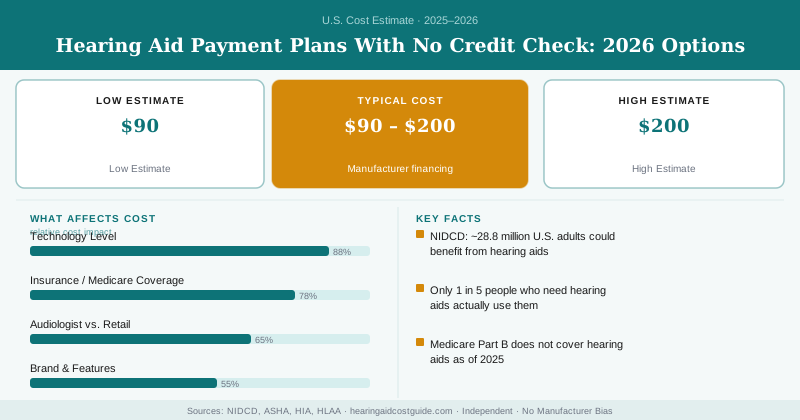
“Will this run my credit?” If you’ve been quoted $4,000 for a pair of hearing aids and your credit isn’t great, that’s probably the first thing on your mind. Here’s the reassuring part: you don’t always need a strong credit score to spread out the cost. Several no-credit-check and soft-pull options exist specifically for medical purchases like this.
Let’s walk through what’s actually out there.
What “no credit check” really means
Be precise here, because the term gets used loosely. There are two different things:
- No credit check at all — the provider doesn’t look at your credit. Usually in-house clinic plans or layaway.
- Soft credit check — the provider peeks at your credit but it doesn’t ding your score, and approval bars are lower.
Both can get you into hearing aids without the hard inquiry that a traditional loan triggers. Here’s how the common options stack up.
| Option | Credit Check | Typical Monthly |
|---|---|---|
| Clinic in-house payment plan | Often none | $100 – $250 |
| Layaway (pay before pickup) | None | Varies |
| Buy-now-pay-later (e.g., 4 payments) | Soft pull | 25% per installment |
| Medical credit lines | Soft or hard pull | $80 – $200 |
| Manufacturer financing | Varies | $90 – $200 |
So a $4,000 pair on a 24-month clinic plan lands around $165/month before any interest the clinic adds.
In-house clinic plans: the most overlooked route
The simplest no-credit-check option is often sitting right in front of you — the clinic itself. Many independent audiology offices offer their own payment plans because they’d rather make the sale than lose it over financing. These frequently skip credit checks entirely because the clinic holds the risk.
Just ask directly: “Do you offer an in-house payment plan, and does it require a credit check?” The worst they can say is no.
Buy-now-pay-later for OTC and lower-cost devices
For OTC hearing aids and lower-priced devices sold online, buy-now-pay-later services split the cost into a handful of payments. These run a soft credit check at most and approve a lot of people who’d be turned down for a traditional loan. They work best on smaller purchases — a few hundred to about a thousand dollars.
You don’t need great credit to finance hearing aids. In-house clinic plans and layaway often skip credit checks entirely, while buy-now-pay-later uses only a soft pull. A $4,000 pair can become roughly $100 to $200 a month — just ask the clinic before assuming you can’t qualify.
Watch the fine print
No-credit-check doesn’t mean no-cost. Some plans bake in high interest or fees to offset the risk of skipping the credit check.
Always ask for the total amount you’ll pay over the full plan, not just the monthly figure. A “no credit check” plan with a steep interest rate can cost hundreds more than the sticker price. Get the all-in number in writing before you sign.
Compare against standard financing first
Before defaulting to a no-credit-check plan, it’s worth seeing whether you qualify for a standard one — they often carry lower or zero interest promotions. Our hearing aid financing guide covers the mainstream options and 0% promo periods that can beat a high-rate no-check plan.
Cheaper paths that skip financing entirely
Sometimes the best move is to lower the price instead of financing it. A few options:
- OTC devices for mild-to-moderate loss cost a few hundred dollars outright.
- Grants and charities can cover devices at no cost — see free hearing aids programs and hearing-loss financial assistance.
- Insurance you forgot about — check does insurance cover hearing aids before financing the full retail price.
The bottom line
Shaky credit isn’t a wall. In-house clinic plans and layaway often skip the credit check completely, and buy-now-pay-later only does a soft pull. Just confirm the total cost over the life of the plan so a low monthly payment doesn’t hide a high price. Ask the clinic first — they want the sale as much as you want to hear.
Frequently Asked Questions
A pair of hearing aids typically ranges from $2,000 to $6,000, with most quality devices falling between $3,000 and $4,000. Premium models with advanced features can exceed $6,000 per pair, while basic models may start around $1,500, but the average out-of-pocket cost for a mid-range pair is approximately $4,000.
Original Medicare does not cover hearing aids or fitting services, though some Medicare Advantage plans offer limited hearing aid benefits of $0–$2,000 per year. Private health insurance typically does not cover hearing aids either, leaving most Americans to pay out-of-pocket, though some employer plans and state Medicaid programs in a few states provide partial coverage.
No-credit-check plans allow you to spread the cost over 12–36 months with monthly payments of $100–$250, depending on the total device cost and plan length, without a hard inquiry that would impact your credit score. These plans are offered directly by hearing aid retailers and third-party medical financing companies and typically require only income verification or a soft credit pull rather than a traditional credit application.