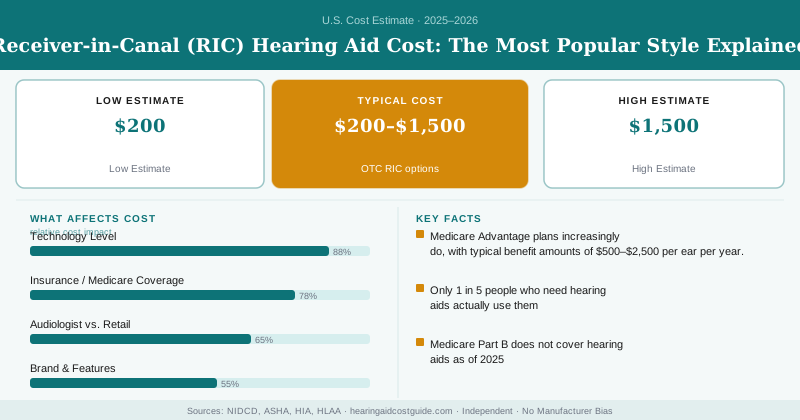
More hearing aids sold in the United States are receiver-in-canal style than any other type — about 65% of all prescription fittings according to the Hearing Industries Association’s 2023 market data. If you’ve seen someone wearing a hearing aid recently, it was probably an RIC. And there’s a reason they’re so dominant: they balance performance, cosmetics, and repairability better than most alternatives.
Here’s what an RIC hearing aid actually costs, and what’s driving that number.
RIC vs. BTE: What’s the Difference?
Both receiver-in-canal (RIC) and behind-the-ear (BTE) models sit with a housing behind the ear. The difference is where the speaker — called the receiver — lives. In a traditional BTE, the speaker is inside the housing behind the ear, and sound travels through a tube to an earmold. In an RIC, the speaker is at the end of a thin wire that sits in the ear canal itself.
That seemingly small change has real consequences:
- Thinner, less visible wire instead of a bulky tube
- More natural sound (the speaker is closer to the eardrum)
- The receiver can be replaced at the audiologist’s office if it fails — often without sending the device out for repair
- Prone to moisture damage if the receiver isn’t properly maintained
RIC Hearing Aid Costs
| Tier | Price Per Pair | Technology Level |
|---|---|---|
| Basic / entry-level RIC | $1,200–$2,400 | 2–4 program channels, limited noise management |
| Mid-tier RIC | $2,400–$4,500 | 8–16 channels, directional microphones, Bluetooth |
| Premium RIC | $4,500–$7,000+ | 20–64 channels, AI processing, rechargeability, full app control |
| OTC RIC options | $200–$1,500 | Limited customization, self-fitting |
These prices typically include the initial fitting, a follow-up adjustment session, a 30–60 day trial period, and a 2–3 year warranty. When comparison-shopping, always ask what’s included in the quoted price — some providers charge separately for fittings, follow-ups, and accessories.
What “Technology Level” Actually Means
The biggest driver of RIC cost isn’t the physical hardware — it’s the signal processing software. Premium hearing aids process sound differently in dozens of acoustic environments simultaneously. They distinguish speech from noise more effectively, adapt faster to changing environments, and connect seamlessly to smartphones via Bluetooth.
For most adults with mild-to-moderate hearing loss in quiet environments, a mid-tier RIC performs nearly as well as a premium one in daily life. The premium matters most if you’re regularly in loud restaurants, large meetings, or outdoors in wind — scenarios that stress the noise management system.
Most premium and mid-tier RICs now offer rechargeable options. You place the devices in a charging case overnight. Rechargeable models typically cost $200–$400 more than battery-powered equivalents in the same line.
The practical tradeoff: no more buying and swapping size 312 batteries every 5–7 days, but if the rechargeable battery degrades after 3–5 years, replacement adds $150–$400 per device.
For adults who find small battery handling difficult (arthritis, vision issues), rechargeable is worth the premium.
Receiver Replacement: The Hidden Advantage
One thing most buyers don’t appreciate until it matters: if your RIC receiver (the piece in your ear canal) fails due to moisture or wax damage, your audiologist can often replace just the receiver — typically $50–$150 — rather than sending the entire device in for repair at $200–$400. This serviceability advantage makes RICs genuinely less expensive to maintain over a 4–6 year ownership period.
BTE hearing aids with tube-and-earmold setups can’t offer this. The speaker is sealed inside the housing.
OTC RIC Options
The FDA’s 2022 over-the-counter hearing aid ruling opened the door for RIC-style devices sold without a prescription. Brands like Jabra Enhance, Lexie, Sony CRE-E10, and others now offer self-fitting RIC devices at $200–$1,500 per pair.
OTC RICs are appropriate for adults with mild-to-moderate hearing loss who are comfortable with app-based fitting. They’re not suitable for severe or profound loss, children, or adults who want ongoing audiological support built into the price.
NIDCD data from 2024 shows that hearing aid adoption rates remain low — only about 1 in 5 adults who need aids actually wear them, with cost cited as the primary barrier. OTC options at lower price points are beginning to close that gap.
Don’t skip the audiological evaluation to save money on a prescription RIC fitting. The evaluation determines not just your hearing thresholds but your word recognition scores and uncomfortable loudness levels — data that directly affects how the RIC is programmed. An improperly programmed hearing aid (too loud in certain frequencies, not tuned for your specific loss pattern) will be uncomfortable and may get abandoned in a drawer. The evaluation is not optional.
What a Complete RIC Purchase Includes
When you buy prescription RIC hearing aids from an audiologist, here’s what a complete bundled price should cover:
- The physical devices (pair)
- Initial audiological fitting using real-ear measurement or similar verification
- 30–60 day trial period with right of return
- 1–3 follow-up programming adjustments in the first year
- Manufacturer warranty (2–3 years standard; extended warranty available at extra cost)
- Cleaning supplies and wax guards for the first year
Unbundled pricing — where devices and services are priced separately — is becoming more common. It can save money if you’re confident you won’t need many follow-up visits, but adds cost if you do.
Insurance and RIC Hearing Aids
Traditional Medicare doesn’t cover hearing aids. Medicare Advantage plans increasingly do, with typical benefit amounts of $500–$2,500 per ear per year. RIC aids are covered under standard hearing aid benefits — there’s no reason your plan would cover BTE but not RIC.
Check your plan’s benefit, then ask your audiologist to work within that budget. A mid-tier RIC at $2,000–$2,500 per pair often hits the sweet spot where the hearing benefit is substantial and the out-of-pocket cost is manageable.
Frequently Asked Questions
RIC hearing aids typically cost between $1,200 and $7,000 per pair, depending on the brand, technology level, and features included. The price variation reflects differences in wireless connectivity, battery life, noise reduction capabilities, and manufacturer reputation. Most patients pay somewhere in the $2,000 to $5,000 range for mid-to-premium models.
Medicare does not cover hearing aids, leaving most seniors with 100% out-of-pocket costs, though some Medicare Advantage plans offer limited coverage up to $500 per ear. Private insurance rarely covers hearing aids, though a small number of plans provide partial reimbursement of $500 to $2,000 per pair. State Medicaid programs vary widely; some cover hearing aids for children or adults with severe hearing loss, while others offer no coverage at all.
The entire fitting process typically takes 2 to 4 weeks from initial consultation to receiving your devices, including a hearing test, device selection, programming, and follow-up adjustments. Most patients have their first appointment within 1 to 2 weeks and receive their hearing aids 1 to 2 weeks later after programming and customization. You'll usually return for at least one adjustment appointment within the first month to optimize fit and settings.