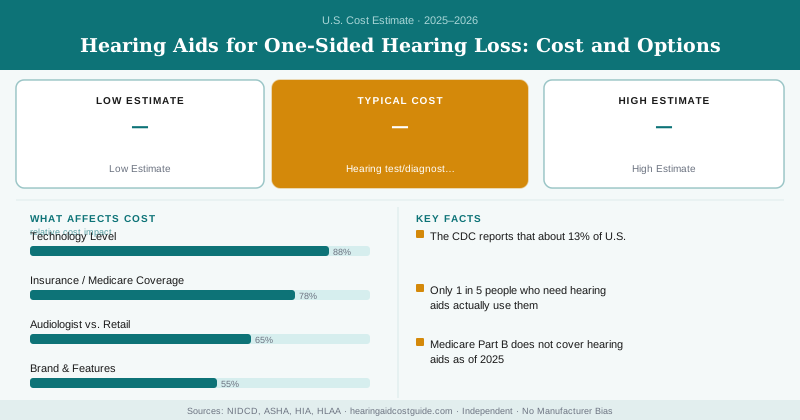
Why does a $4,000 hearing aid sometimes not help one-sided loss at all? Because if the bad ear is too far gone, amplifying it does nothing — and the real solution routes sound to your good ear instead. One-sided hearing loss is its own puzzle, and the right answer depends entirely on how much hearing remains in the affected ear. Costs range from $1,500 to $6,000.
Get this wrong and you waste money on a device that can’t deliver. Get it right and you regain something one-eared listening can’t: the ability to hear from both sides.
What One-Sided Solutions Cost
| Option | Cost | Best When |
|---|---|---|
| Single standard hearing aid | $1,000–$3,000 | Bad ear has usable hearing |
| CROS system | $2,500–$5,000 | Bad ear has no usable hearing |
| BiCROS system | $3,000–$6,000 | Bad ear dead + good ear also impaired |
| Bone-anchored (surgical) | $8,000–$12,000+ | Specific medical cases |
| Hearing test/diagnostic | $0–$250 | Required to determine path |
First Question: How Much Hearing Is Left?
This determines everything. If your weaker ear still has usable hearing, a single standard hearing aid in that ear may restore balanced listening for $1,000–$3,000. Straightforward.
But if the ear has little or no usable hearing — what audiologists call single-sided deafness — amplifying it is pointless. The nerve or cochlea can’t make use of the sound. That’s when you need a CROS system, which works completely differently.
The right device for one-sided loss depends on whether your weak ear still hears. Usable hearing remaining? A single standard aid ($1,000–$3,000) may work. No usable hearing? You need a CROS system ($2,500–$5,000) that routes sound to your good ear. Don’t pay for amplifying an ear that can’t process sound.
How CROS and BiCROS Work
CROS stands for Contralateral Routing of Signal. Here’s the clever part: a microphone sits on your deaf ear and wirelessly sends sound across to a receiver in your good ear. You can’t truly hear “from” the dead side, but your good ear now picks up voices and sounds coming from that side instead of missing them entirely. No more turning your head to catch someone on your bad side.
BiCROS is the same idea with a twist: it’s for people whose dead ear is silent AND whose good ear also has some hearing loss. The good-ear device amplifies normally while also receiving the cross-routed signal. It does double duty.
The Quiet Cost of Ignoring It
People with one-sided loss often “manage” by always positioning the good ear toward the speaker. It works until it doesn’t — restaurants, cars, meetings, crowds. The CDC reports that about 13% of U.S. adults have measurable hearing loss, and a meaningful slice of those have asymmetric or one-sided patterns. Localizing where sound comes from is also harder with one good ear, which has real safety implications near traffic.
The NIDCD notes that sudden one-sided hearing loss can be a medical emergency. If you lose hearing in one ear quickly, see a doctor right away — prompt steroid treatment can sometimes restore it. Don’t wait to “see if it comes back.”
Why You Can’t Self-Diagnose This
You truly need a professional audiogram here, because the device choice hinges on numbers you can’t feel. Our hearing test cost guide explains the testing, and an audiologist visit is where word-recognition scores in the bad ear get measured — the figure that decides between a standard aid and CROS. This is one area where OTC hearing aids generally don’t fit the need, since CROS systems require professional fitting.
Sudden hearing loss in one ear is an emergency, not a “wait and see.” If you lose hearing rapidly in a single ear, see an ENT or audiologist within days — ideally 24–72 hours. Sudden sensorineural hearing loss can sometimes be reversed with prompt steroid treatment, but the window is short. Don’t assume it’s earwax or a cold and let weeks pass.
Choosing and Budgeting
If your weak ear retains usable hearing, you’re in standard-aid territory — review styles in our hearing aid styles explained guide and consider a rechargeable hearing aid for daily ease. If your ear is non-functional, plan for a CROS or BiCROS system and the higher price that comes with the paired hardware.
Either way, the audiogram comes first. Compare the full cost picture in our hearing aid cost overview once you know which path your ears point you toward.
Frequently Asked Questions
Costs range from $1,500 to $6,000 depending on the device type. A standard hearing aid for your better ear runs $1,500–$3,000, while CROS (Contralateral Routing of Signals) and BiCROS systems that route sound from your deaf ear to your good ear typically cost $3,500–$6,000 per pair.
Most traditional health insurance plans do not cover hearing aids, though some Medicare Advantage plans now offer limited coverage of $0–$3,000 per year. Your out-of-pocket cost is typically the full price unless you have a specialized hearing benefit plan or work for an employer offering hearing aid coverage.
If your affected ear has minimal or no usable hearing, a CROS system is necessary—it wirelessly transmits sound from your bad ear to a hearing aid in your good ear, costing $3,500–$6,000. If your affected ear still has some hearing remaining, an audiologist may recommend a standard hearing aid for that ear alone at $1,500–$3,000, or a BiCROS system that amplifies both ears.