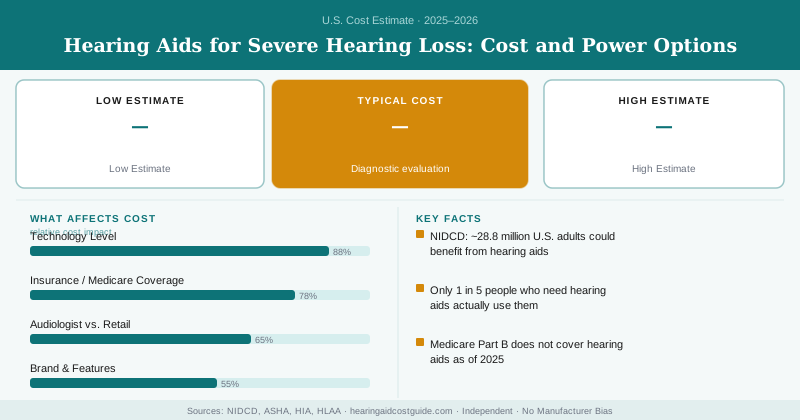
Severe hearing loss starts at 70 decibels — meaning normal conversation, around 60 dB, is below what you can hear unaided. At that level, the slim, trendy devices in glossy ads won’t cut it. You need power, and power hearing aids cost $2,500–$7,000 per pair. Push into profound loss above 90 dB and the conversation may shift to cochlear implants entirely.
This is the tier where the right hardware genuinely changes lives — and where buying the wrong device wastes thousands. Here’s the real breakdown.
Severe-Loss Hearing Aid Costs
| Option | Cost | Notes |
|---|---|---|
| Power BTE (mid-tier) | $2,500–$4,000/pair | Larger receiver, more output |
| Super-power BTE (premium) | $4,500–$7,000/pair | Highest gain, profound loss |
| Custom earmolds | $100–$300/pair | Required to prevent feedback |
| Cochlear implant (per ear) | $30,000–$50,000 | Often insurance/Medicare covered |
| Diagnostic evaluation | $0–$250 | Determines candidacy |
Why Power BTE Wins for Severe Loss
The behind-the-ear power style isn’t fashion — it’s physics. A larger device houses a bigger receiver and battery, delivering the high amplification severe loss demands. Tiny in-canal aids simply can’t push enough volume without distorting or whistling. For severe loss, the bigger BTE is the right tool, and a custom-molded earpiece is essential to seal the ear and prevent feedback.
The NIDCD reports that about 28.8 million U.S. adults could benefit from hearing aids, and while most have milder loss, those at the severe-to-profound end have the most to gain — and the fewest workable shortcuts. This is not the place for bargain-bin devices.
Severe loss (70+ dB) needs power behind-the-ear aids with custom earmolds, costing $2,500–$7,000 per pair. Don’t waste money on tiny in-canal devices — they can’t deliver enough gain without feedback. If loss reaches profound levels, ask about cochlear implants, which insurance often covers far better than hearing aids.
When to Consider a Cochlear Implant
There’s a threshold where even the strongest hearing aid can’t help enough. If you have profound loss and poor word recognition even with power aids, a cochlear implant may restore far more understanding. It’s surgical and costs $30,000–$50,000 per ear — but here’s the encouraging part: cochlear implants are frequently covered by private insurance, Medicare, and Medicaid because they’re classified as a medical procedure, unlike hearing aids. Many recipients pay a fraction of the sticker price.
An audiologist and ENT determine candidacy through specialized testing. Don’t self-rule-out — people are often surprised to learn they qualify.
Insurance and Funding for Severe Loss
Because severe loss is medically significant, you have more funding avenues than people with mild loss:
- Vocational rehabilitation programs may fund aids if hearing loss affects your job.
- VA benefits provide free hearing aids — including power models — to eligible veterans.
- Cochlear implant coverage is broad across major insurers and Medicare.
- Charitable programs like the Starkey Foundation and Lions Club help low-income applicants.
A 2021 Hearing Industries Association report found that satisfaction rises with appropriate technology matching — meaning a correctly fitted power device for severe loss yields strong results, while an underpowered one disappoints. Matching tech to loss is everything here.
The Fitting Is Not Optional
This is firmly professional territory. You need precise programming, real-ear measurement, and custom molds. Our hearing test cost guide explains the diagnostic audiogram that confirms severe loss, and an audiologist visit is where the power device gets dialed in and verified. Over-the-counter OTC hearing aids are explicitly designed for mild-to-moderate loss only — they are not appropriate for severe loss, so skip them for this need.
Don’t try to treat severe or profound loss with OTC devices or personal sound amplifiers — they’re capped at mild-to-moderate amplification by design and law. Using them for severe loss leaves you under-amplified and frustrated, and cranking the volume invites painful feedback. Severe loss requires a professionally fitted power aid with custom earmolds, or an evaluation for a cochlear implant.
Choosing Your Path
Start with a full diagnostic evaluation to confirm exactly how severe your loss is and whether a power aid or implant fits best. If a power BTE is the answer, review the form factors in our hearing aid styles explained guide and consider a rechargeable hearing aid model — many power BTEs now offer all-day rechargeable batteries.
Compare the full range and funding options in our hearing aid cost overview, and don’t let the higher price scare you off: for severe loss, insurance, the VA, and cochlear implant coverage open doors that milder cases don’t have.
Frequently Asked Questions
Power hearing aids designed for severe to profound hearing loss typically cost $2,500–$7,000 per pair, depending on the brand, technology level, and features like wireless connectivity or rechargeable batteries. Behind-the-ear (BTE) models are the most common option at this level because they can deliver the amplification needed for 70+ decibel hearing loss.
Original Medicare does not cover hearing aids, though some Medicare Advantage plans offer limited coverage (typically $0–$2,000 per year). Private insurance rarely covers hearing aids, making out-of-pocket costs the norm for most US patients; however, some states mandate coverage and the VA covers eligible veterans at no cost.
Cochlear implants are typically considered when hearing loss exceeds 90 decibels (profound loss) and power hearing aids provide insufficient benefit after a 30-day trial period. The implant surgery takes 1–2 hours with 2–4 weeks of recovery, followed by 4–6 weeks of activation and mapping appointments before full use.