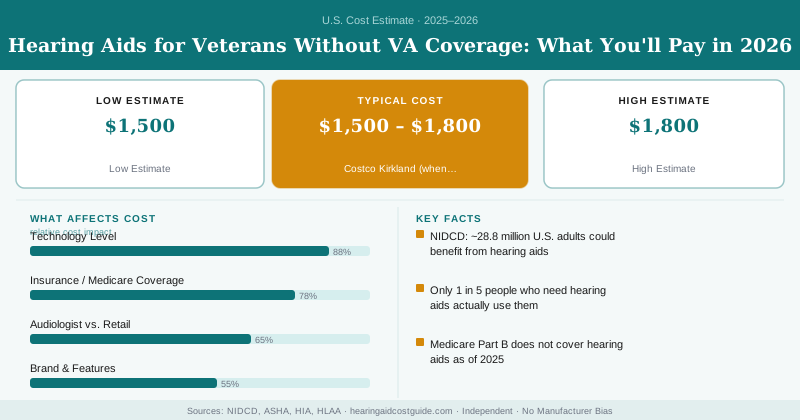
You served, you’ve got hearing loss, and someone told you the VA hands out hearing aids for free. So why did the clerk just tell you that you don’t qualify? It happens more than you’d think. The VA covers hearing aids only when your hearing loss is service-connected or you meet specific eligibility tiers — and plenty of veterans fall outside those lines.
If that’s you, the good news is your costs aren’t a dead end. They’re just different.
Why some veterans don’t get free VA hearing aids
The VA provides hearing aids at no cost when your hearing loss is rated service-connected, or when you fall into certain priority groups. But veterans who enrolled later, have higher incomes, or whose hearing loss isn’t tied to service often get denied audiology benefits. The Department of Veterans Affairs treated roughly 1.3 million veterans for tinnitus and hearing loss claims in recent years, yet not everyone with hearing trouble clears the eligibility bar.
If your claim came back denied, your first move is to confirm whether VA hearing aid benefits might still apply through an appeal or a service-connection request. Many veterans give up too early on that.
What hearing aids cost when you pay yourself
Once you’re buying on the open market, you’re looking at standard retail pricing. Here’s the typical range for a pair in 2026.
| Option | Typical Cost (Pair) |
|---|---|
| OTC hearing aids | $200 – $1,000 |
| Entry-level prescription | $1,400 – $2,500 |
| Mid-range prescription | $2,500 – $4,500 |
| Premium prescription | $4,500 – $6,500 |
| Costco Kirkland (when stocked) | $1,500 – $1,800 |
That’s a wide spread, and it lines up with the broader market — most prescription pairs land between $2,000 and $6,000. If you want the full breakdown of where that money goes, our guide on the average hearing aid cost lays it out, and why hearing aids are so expensive explains the markup.
Lower-cost paths for non-qualifying veterans
You’ve got more options than the VA-or-bust choice suggests.
OTC devices. Since the FDA’s 2022 rule let over-the-counter hearing aids hit shelves, prices for mild-to-moderate loss have dropped hard. A solid OTC pair runs a few hundred dollars. See our OTC hearing aid cost breakdown to compare.
Veteran-focused nonprofits. Some charities prioritize veterans for refurbished or discounted devices. We cover the broader landscape in free hearing aids programs.
State vocational rehab. If hearing loss affects your ability to work, your state’s vocational rehabilitation office may cover devices regardless of VA status.
A VA denial doesn’t mean you’re stuck paying full freight. Most non-qualifying veterans pay $2,000 to $6,000 for a prescription pair — but OTC devices, veteran nonprofits, and an appeal of your VA decision can each knock that down sharply.
Don’t skip the appeal
Here’s the part veterans regret missing. A denial isn’t always final. If your hearing loss could plausibly trace back to service — artillery, aircraft, machinery, range time — you can file for service connection. Tinnitus and hearing loss are among the most common service-connected disabilities the VA recognizes.
Before you spend thousands out of pocket, request your military audiogram records and talk to a Veterans Service Officer (VSO). VSO help is free, and a successful service-connection claim flips you from paying full price to $0 — plus future battery and repair coverage.
Stretching the dollars you do spend
If you’re paying out of pocket, treat it like any major purchase. Use an FSA or HSA if you have one — hearing aids are a qualified medical expense. Ask about payment plans. And don’t assume the priciest pair is the right one; for many veterans with noise-induced loss, a mid-range device handles the job fine.
You can also check whether any private insurance you carry offers help — our overview of whether insurance covers hearing aids and hearing-loss financial assistance both apply here.
The bottom line
Falling outside VA coverage stings, but it’s not the wall it feels like. Appeal first — it’s free and could zero out your cost entirely. If the appeal fails, OTC devices and veteran charities can get you hearing again for a fraction of retail. And if you do buy prescription, walk in knowing the $2,000-to-$6,000 range so no clinic talks you into more than you need.
Frequently Asked Questions
Out-of-pocket costs for a pair of hearing aids typically range from $2,000 to $6,000 for veterans who don't qualify for VA benefits, depending on the style, features, and brand. Premium models with advanced noise cancellation or Bluetooth connectivity can exceed $6,000 per pair, while basic analog hearing aids may cost less. Most audiologists offer payment plans to spread costs over 12 to 36 months.
Original Medicare does not cover hearing aids, though some Medicare Advantage plans offer limited coverage of $500 to $2,000 per year. Private insurance rarely covers hearing aids unless they're bundled as part of a supplemental plan, and most plans cap coverage at $1,000 to $3,000 per ear. Veterans should check their specific plan details, as coverage varies significantly by insurer and policy type.
The typical timeline is 2 to 4 weeks from initial hearing test to receiving fitted hearing aids, though some audiologists can expedite this to 1 to 2 weeks for urgent cases. After receiving your devices, expect 2 to 4 follow-up appointments over several months for adjustments and fine-tuning as you adapt. Most audiologists offer a trial period of 30 to 45 days, allowing you to return devices for a full or partial refund if they don't meet your needs.