In 2010, you might have shrugged off a $1,500 hearing aid bill. On a fixed Social Security income today, a $4,000 quote for a pair can feel impossible. And it’s a cruel catch — hearing loss is most common exactly when budgets are tightest. The NIDCD reports that roughly half of adults over 75 have disabling hearing loss, many of them retirees living on a set monthly check.
The good news: a fixed income changes your strategy, but it doesn’t mean going without.
Start with the programs built for low income
When money is fixed, the smartest first move isn’t shopping — it’s checking which programs will pay for you. Several are aimed squarely at people in your situation.
| Resource | What You Might Pay |
|---|---|
| Medicaid (if eligible) | $0 in covered states |
| Grants & charities | $0 to a few hundred |
| Lions Club / service clubs | $0 (refurbished) |
| OTC hearing aids | $200 – $1,000 |
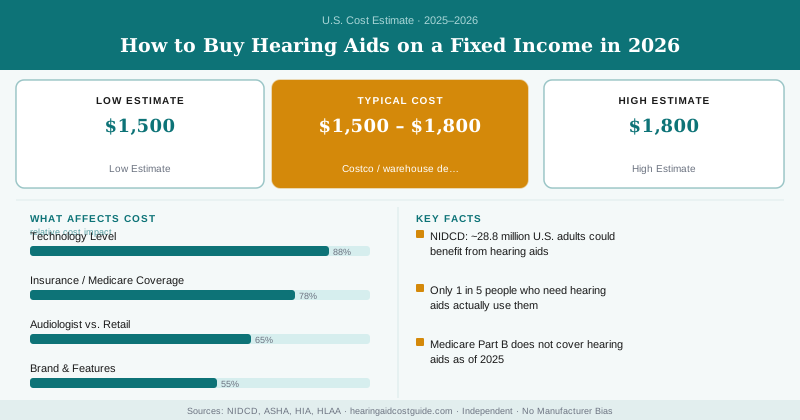
| Costco / warehouse devices | $1,500 – $1,800 (pair) |
If you qualify for Medicaid hearing aid coverage, that’s the single biggest lever — in covered states it can mean $0. Even if your income feels too high, check, because Medicaid limits are higher than many retirees assume.
Medicare won’t help, so plan around it
Here’s a hard truth for retirees: Original Medicare does not cover hearing aids. Many people assume Part B handles it and get a nasty surprise. Our does Medicare cover hearing aids guide explains the gap — the only Medicare route is a Medicare Advantage plan with a hearing benefit, and those vary by county. If you’re choosing a plan during open enrollment, a hearing benefit can be worth real money on a fixed income.
OTC devices changed the math
The biggest break for budget-conscious buyers came in 2022, when the FDA allowed over-the-counter hearing aids. For mild-to-moderate loss — the most common kind — a solid OTC pair costs a few hundred dollars, no prescription or fitting fee required. That’s a fraction of traditional pricing. See OTC hearing aid cost to compare models and prices.
On a fixed income, work top-down: check Medicaid first (potentially $0), then grants and service clubs, then OTC devices at $200 to $1,000. Original Medicare won’t help, so don’t count on it. Most retirees can get hearing again for far less than the $4,000+ retail quote suggests.
Charities and grants for retirees
Several foundations and the Lions Club prioritize older adults and low-income applicants for donated or refurbished devices. The application usually needs a recent hearing test and proof of income. Our free hearing aids programs and hearing-loss financial assistance guides list these routes in detail.
Never pay an upfront “processing fee” for a charity hearing aid or government program. Legitimate assistance never charges to apply. Scammers target seniors on fixed incomes specifically — if someone asks for payment or your bank login to “release” a benefit, hang up.
If you do pay, stretch every dollar
When you have to buy, keep it lean:
- Skip premium features you won’t use. A mid-range device handles most everyday hearing fine; you’re often paying extra for connectivity bells and whistles.
- Ask clinics for an in-house payment plan to spread the cost — many offer them, sometimes with no credit check.
- Compare warehouse-club pricing. Costco and similar retailers undercut traditional clinics significantly on a pair.
Our hearing aid cost breakdown shows where you can safely trim.
The bottom line
A fixed income reshuffles the order of operations, not the outcome. Check Medicaid first, then grants and service clubs, then lean on OTC devices that now cost a few hundred dollars. Don’t expect Medicare to step in, and never pay a fee just to apply for help. With the right sequence, hearing again is far more affordable than that first scary quote.
Frequently Asked Questions
A pair of hearing aids typically costs $4,000–$6,000 at private audiology clinics, but seniors on fixed incomes can access devices for $0–$500 through VA benefits (if eligible), state programs, non-profits like the Miracle-Ear Foundation, or refurbished/basic models from Costco ($800–$1,500 per pair). Many retirees also qualify for payment plans that spread costs over 12–24 months at $50–$200 monthly.
Traditional Medicare does not cover hearing aids or exams for hearing loss, though some Medicare Advantage plans (Part C) offer limited coverage of $0–$1,500 per year depending on the plan. Veterans and low-income seniors should check their state Medicaid program, as coverage varies: some states cover basic hearing aids while others cover none.
Budget-friendly options can take 2–8 weeks: VA processing typically takes 4–8 weeks, non-profit programs take 2–6 weeks, and direct-to-consumer or Costco models are usually fitted within 1–2 weeks. Private audiologists usually fit devices within 1 week, but cost $4,000+, while over-the-counter amplifiers can be purchased immediately online for $200–$800.